Information Technology
DIDLOO Business Messaging API: From Approved Templates to Reliable Customer Communication
A business messaging API connects an event in business software with a message on a particular communication network. That connection can be useful, but the API itself does not decide whether the customer wants the message, whether the underlying order is correct or whether a staff member is ready to help. A reliable integration has to answer those questions before it starts sending. DIDLOO's Business Messaging API is an independent service for reaching DIDLOO users through authorised business identities and approved message workflows.
This guide explains the product boundaries and develops a practical integration plan around them. It draws a careful line between publicly described capabilities, current account-specific availability and general engineering recommendations. It is not a credential-bearing setup guide or a promise that every feature in a documentation catalogue is operational for every account. Consult the current Business portal and authenticated reference before implementing a request, especially where approval, content types, scheduling or credits are involved.
1. Understand the channel before choosing the API
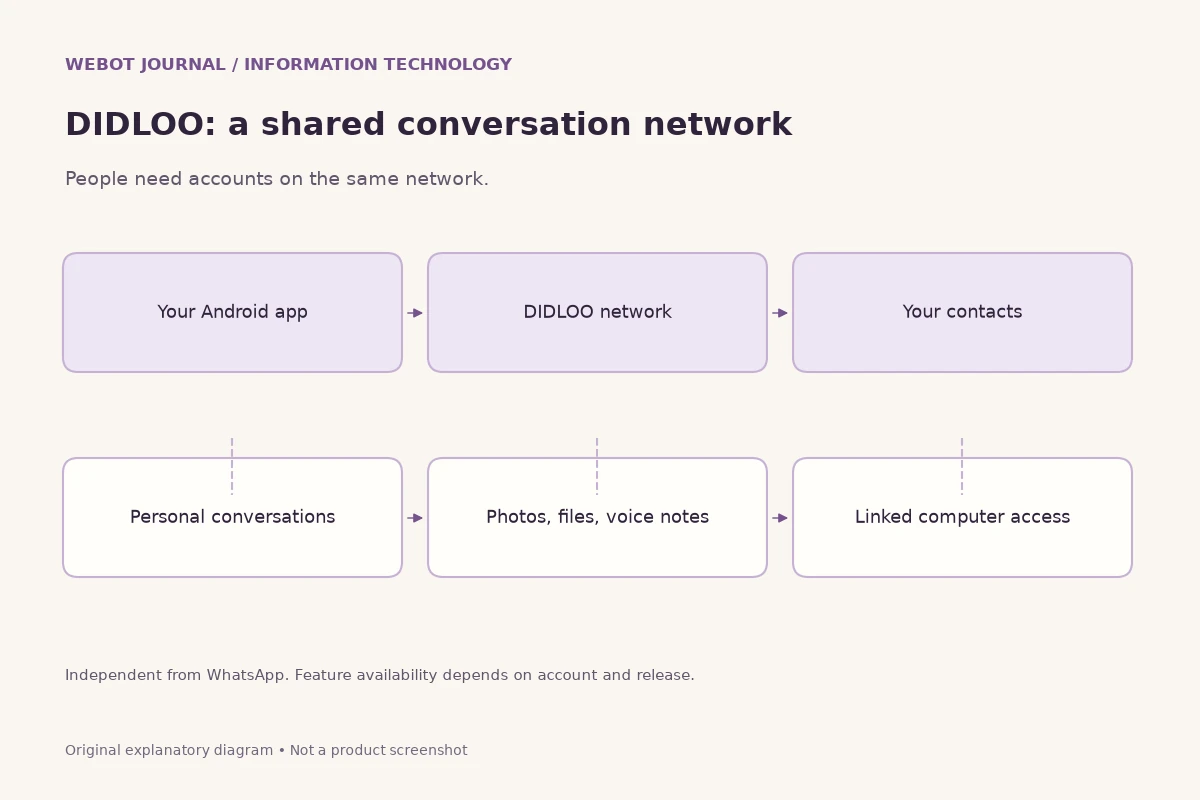
DIDLOO messaging reaches the DIDLOO network. It is not a gateway into WhatsApp, ordinary SMS or every application attached to the same phone number. A business should therefore begin by establishing where its customers actually receive messages. If a customer has never used DIDLOO, knowing their telephone number alone does not make this channel a suitable replacement for an existing contact method. Document the intended audience before investing in automation.
Consider a workshop sending attendance information to people who have chosen DIDLOO for updates. Its integration has a clear purpose, a known recipient group and an opportunity to explain support options. Compare that with uploading an unrelated contact list and assuming every entry is reachable. The second approach confuses data possession with network participation and permission. The first gives the team a concrete way to test usefulness, clarify expectations and avoid treating message volume as the main measure of success.
2. Separate Business API sending from Business Web replies
The public product explanation distinguishes approved API-initiated template messages from customer-service replies in Business Web. The API is intended for authorised OTP, transactional and promotional workflows. Business Web handles service conversations within the configured customer-initiated reply window. Opening the dashboard or signing in again does not by itself create a new permission to send a service reply outside that window.
Map these as separate operations in your process diagram. An order-confirmation event may select an approved transactional template. A customer asking a question may create work for the service team. The organisation needs both a message-generation rule and a reply-handling rule; one does not substitute for the other. Do not copy another provider's service-window duration into DIDLOO instructions. Read the current DIDLOO policy applicable to the account and design around the actual configured boundary rather than a familiar number from a different platform.
3. Set up identities with a responsible owner
Business identities should represent the organisation customers expect to hear from. Establish who owns the account, who may administer it and which business phone identity will be used. The public setup guidance describes business registration, phone verification, approvals and API-key management. Completion of one step should not be mistaken for approval of every sending category or every content format. Confirm each required gate in the current dashboard.
Avoid building an integration around an employee's personal account simply because it is available quickly. Staff turnover, shared passwords and unclear ownership become operational problems later. DIDLOO's public information also warns that changing between app-number and business-number use requires deliberate account steps and does not merge histories. Plan that choice before taking account actions. A pilot should use an appropriately owned identity and a documented approval path, rather than deleting or converting a production identity while developers are still exploring.
4. Treat the current authenticated contract as authoritative
API documentation describes field names, permitted values and response shapes, but those details can evolve. DIDLOO's detailed endpoint references are accessed through its Business portal. Public descriptions provide an overview, not unrestricted permission to execute every operation. Before implementation, read the current contract for the intended endpoint and reconcile it with the permissions and enabled features of the owned business account.
A useful development note records the documentation version, operation name, required identity, expected request fields and allowed content type. Keep that note separate from secrets. Do not infer a working endpoint from a route name or assume that a catalogue entry proves full execution support. Where documentation and observed behaviour disagree, stop the affected rollout and seek clarification through the authorised support process. A successful HTTP connection is not enough to establish that the business operation was accepted, approved or delivered.
5. Keep credentials on the server
The integration credential belongs in a protected server-side configuration or secrets system. It should not be embedded in browser JavaScript, mobile application source, public repositories, screenshots or article examples. A customer viewing a web page must not be able to extract a business sending key from that page. Treat development, testing and production access as distinct responsibilities even where the platform's exact key-management options differ.
Limit access to the people and systems that genuinely need it. Record who is responsible for rotation and how the application will be updated if a key is replaced. Logs should capture enough information to investigate an error without storing an authorisation header. If a credential is accidentally exposed, removing it from the latest file is only part of the response; the responsible owner should follow the platform's current revocation and replacement process. Never test a suspected leaked key against accounts or data you do not own.
6. Design consent around an understandable purpose
A useful message has an expected sender, a clear purpose and an appropriate audience. Tell customers which channel will be used and what kind of information they should expect. An order update and a promotional offer are different purposes, even when both come from the same business. Keep an internal record of the customer's choice and a practical way to stop unwanted communication. This is responsible workflow design, not a claim that a particular legal requirement is satisfied automatically.
Do not use imported contacts or a previous purchase as unquestioned permission for unrelated campaigns. A team should be able to explain why an individual recipient is included in a send. For regulated activities or sensitive personal information, obtain advice appropriate to the actual jurisdiction and data involved. The engineering goal remains straightforward: permission should be checked before dispatch, and staff should not have to reconstruct the reason for a message after a customer complains.
7. Create templates that remain useful after approval
An approved template is a controlled message structure, not an invitation to replace its meaning with arbitrary promotional text. Write a template for one recognisable purpose. Explain the sender, the event and the next action in ordinary language. Use variables for information that legitimately changes, such as an order reference or appointment time, rather than turning every sentence into an unrestricted substitution slot.
Review examples with the person responsible for customer communication. Could a recipient understand the message without reading the internal system that triggered it? Does a link lead to an owned, relevant destination? Are amounts, dates and identifiers clearly distinguished? Submit the appropriate category and wait for the required approval before using the template. For an initial integration, approved text templates provide a concrete boundary to validate. Confirm any richer content support separately; authoring controls or a field in a schema do not prove that an account may send every media format.
8. Handle OTP workflows as an authentication component
An OTP message can support an authentication journey, but receiving a code is not the same as completing secure authentication. Your application must still generate, validate and expire the code correctly and bind it to the intended user action. Limit attempts and avoid exposing the code in ordinary application logs. A messaging template transports information; it should not become the only security decision in the application.
For example, a login flow should distinguish a request to send a code from a successful verification of that code. If the customer requests another code, the application needs a clear rule about which code remains valid. Avoid revealing whether an unrelated person's account exists through careless error messages. These are general design recommendations, not claims about hidden DIDLOO authentication implementation. Integrate only the parts you own, and follow the current API's permitted OTP template and recipient rules when submitting the actual message.
9. Build transactional updates from authoritative events
A transactional message should reflect a business event that has actually occurred. An order acknowledgement should come from a committed order record, while a shipping update should come from verified fulfilment evidence. Avoid sending a success message because a browser displayed a confirmation animation or because an internal worker started processing. If the underlying event later fails, the message may mislead the customer and create additional support work.
Store an application-side record connecting the business event to the intended notification. That record can include the event type, customer reference, selected template and dispatch outcome, with access limited appropriately. Consider what happens if the event is delivered to your worker twice. Preventing duplicate messages begins in your own workflow; do not assume that a provider supports a particular idempotency header unless the current contract documents it. An internal deduplication rule is useful, but it is not proof that a timed-out external request was never accepted.
10. Make promotional messages a separate decision
Promotional messaging deserves its own audience selection, content review and frequency decisions. A customer may welcome a requested service update while finding repeated offers intrusive. Keep the reason for inclusion explicit and honour stop requests in the workflow that selects recipients. An approved promotional template should not be used as a convenient way around a different category's requirements or the account's current permissions.
Evaluate campaigns using customer experience as well as business response. A smaller relevant audience can be more valuable than a large list that does not recognise the sender. Establish who may author a campaign, who approves it and how the team can halt future dispatch safely. Never interpret API access as permission to send unsolicited bulk messages. Product approval and the organisation's responsibility for appropriate communication are separate layers, and neither should disappear behind an automated send button.
11. Model submission, delivery and reading separately
A messaging system can expose several different facts: a request was accepted, a message was sent, delivery was recorded or a read event became available. Those states should not be collapsed into a single green success label. DIDLOO's documented delivery-report concept distinguishes message tracking from conversation-history retrieval. Preserve the identifiers returned for the owned operation and consult the current report contract when asking what evidence exists.
Explain status in the language your staff need. Accepted can mean that processing has begun; it does not establish that a human saw the message. A missing read time is not proof that someone ignored the business. Connectivity, settings and product behaviour can affect available evidence. Keep unknown states visible, and make customer-service decisions from verified records rather than optimistic assumptions. Where a response is ambiguous, investigate before submitting a replacement message that may become a duplicate.
12. Treat scheduling as a separately verified capability
The public business overview mentions scheduling, and the documentation catalogue includes scheduled-message operations. Operational scheduling also depends on the relevant server scheduler and current account support. Before promising an appointment reminder at a particular time, verify that the feature is enabled and functioning in the actual environment. A saved schedule record is not the same as a completed send, and a successful authoring screen is not evidence that a background worker will run.
If scheduling is available, define the intended time zone and the behaviour when an appointment changes. Establish how edits, pauses and cancellations interact with an already-started dispatch. Test with owned recipients and nonurgent examples first. If operational readiness has not been verified, keep the feature described as something to confirm rather than advertising it as a dependable service. The business should never rely on a reminder for an essential obligation until it has a tested process and an appropriate fallback.
13. Use retry logic that respects uncertainty
Network failures create an important distinction between a rejected request and an unknown outcome. If validation explicitly rejects a request before acceptance, correcting the invalid data may be appropriate. If the connection times out after submission, the server may already have accepted the message. Blindly sending again can create duplicates. Persist the request context and use the documented evidence available to determine the state before deciding what to do next.
Create a retry policy for each class of failure rather than one loop for everything. Invalid credentials need an access review, unavailable permissions need an approval review and malformed fields need a contract correction. Temporary network problems deserve bounded backoff and investigation. Do not rotate identities or alter payloads merely to evade a restriction. A reliable system preserves uncertainty honestly and gives the responsible operator enough information to resolve it without exposing keys or unnecessary customer content.
14. Reconcile credits with real records
DIDLOO's business sending is subject to current credit rates and account checks. Read the actual dashboard and current contract instead of copying a fixed price into an integration plan. Estimate the intended workload with clearly stated assumptions, including category and any content-specific factors that the current platform supports. Keep commercial approval separate from the technical fact that an API call can be constructed.
For operations staff, preserve the receipts and records returned by the owned sending workflow. A schedule being saved, a request being accepted and a verified financial debit are different events. Do not manufacture a refund rule or infer a zero charge from a missing delivery record. If financial evidence does not reconcile, make that discrepancy visible and follow the authorised resolution process. This article does not set product rates, change settlement behaviour or promise an amount of free messaging; those decisions belong to current platform policy and actual account evidence.
15. Protect customer data throughout the workflow
An integration often creates more copies of information than the customer sees. A message may pass through an order system, a queue, application logs and a support inbox before reaching the recipient. Map those copies and decide which are necessary. Use internal references where possible instead of placing sensitive details into a message body. Keep access limited to staff whose work requires the information, and avoid making debug output a second customer database.
Media and document workflows deserve extra review. An arbitrary external file URL should not be treated as an approved attachment simply because it can be downloaded. Confirm current content approval and ownership requirements before using richer messages. For an uncertain capability, remain with the approved supported scope. Retention decisions should reflect the organisation's actual needs and responsibilities; a generic blog cannot certify compliance for every business, country or category of customer data.
16. Test the customer journey, not just the request
A useful pilot follows the entire journey from a real owned business event to a recipient's understanding and possible reply. Confirm that the correct identity appears, variables resolve properly, links work and the support route is staffed. Include errors: an invalid template, an unauthorised identity, a repeated event and a temporary connection failure. Record what the system actually does rather than what a successful example in documentation suggests it ought to do.
Use controlled test data and recipients who have agreed to participate. Do not validate a campaign by sending messages to unrelated customers. Prepare a rollback plan for future dispatch and an explanation for any incorrect message already delivered. Rollback cannot erase a recipient's experience. A successful pilot should demonstrate that the team understands permissions, evidence and exception handling, not merely that one request returned a positive response during development.
17. Give human operators a usable process
Automation does not remove the need for someone to answer a confused customer. Assign ownership for templates, credentials, failed sends, support replies and commercial review. Provide short operational notes that explain common states without requiring staff to inspect raw JSON. An operator should know whether a message is awaiting approval, blocked by account configuration or already accepted with an outcome still unknown.
Keep escalation practical. A customer who replies to a notification should not discover that no one monitors the appropriate service channel. Likewise, a developer investigating an integration should have a way to contact the account owner without receiving their private password. Regularly review a small sample of actual permitted communication for clarity and accuracy. This ongoing care is often more valuable than adding another sending mode before the first workflow is dependable.
18. Work through a concrete appointment example
Imagine a training centre whose participants have selected DIDLOO for class updates. Its first integration could notify a participant that an already-confirmed session has a new room. The application reads the committed session record, identifies the consenting recipient and chooses an approved transactional template. It supplies only the allowed variables and records the intended notification before dispatch. The example does not require the centre to enable every route or experiment with attachments on its first day.
Now introduce a mistake: a staff member changes the room twice. The system should determine which event each notification represents and prevent duplicate processing of the same event. If the first message is already accepted, the second update may still be necessary, but it should clearly supersede the earlier information. If the submission outcome is unknown, the operator needs evidence rather than a reflexive resend. That distinction is a business rule as much as an engineering rule.
Finally, consider a participant replying with an accessibility question. The notification process has not completed the customer's journey merely by sending the room number. The centre needs an authorised service process, staff ownership and a useful answer. Evaluate the pilot against that complete experience. The objective is that the participant understands where to go and can obtain help, not that a dashboard reports a large count of submitted API requests.
19. Choose the platform for a defined use case
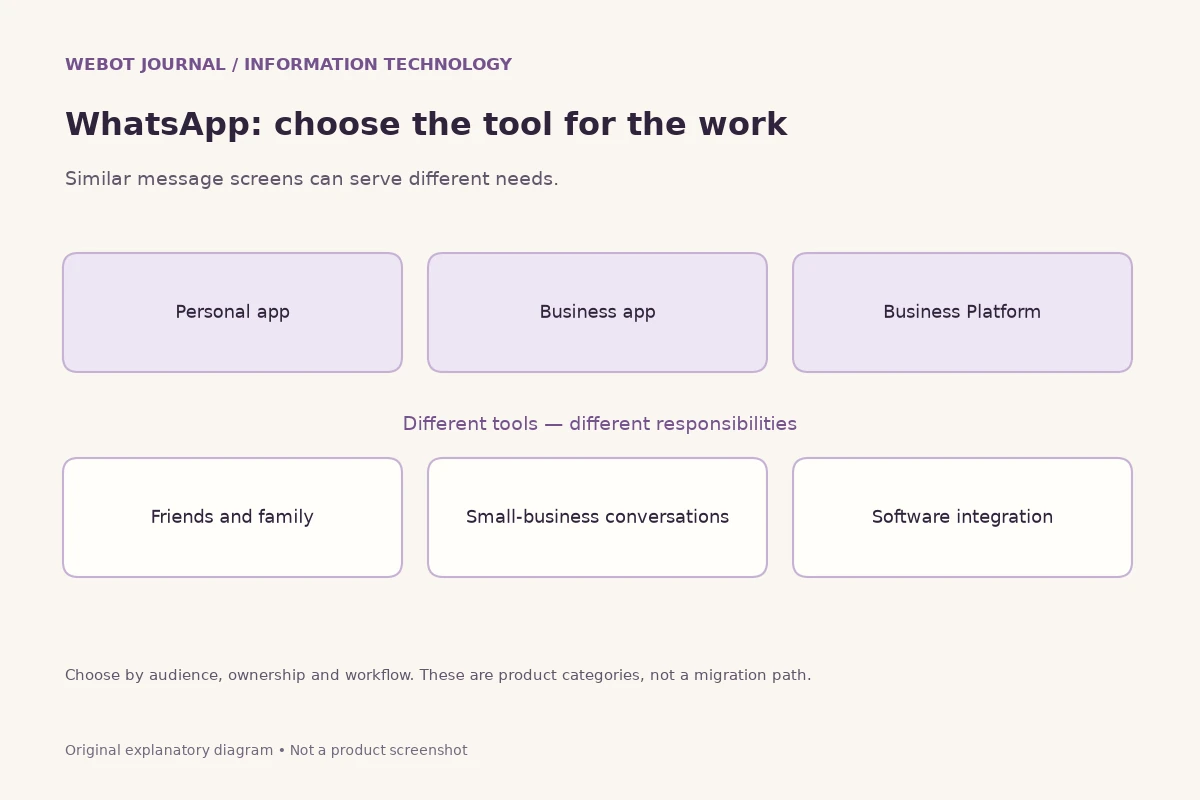
DIDLOO's Business Messaging API should be evaluated as a DIDLOO integration with its own identities, approvals and product rules. It is not a drop-in WhatsApp Business Platform replacement. Compare reach, current documentation, account eligibility, approved content, support needs and operating costs against your actual customer journey. Leave unsupported assumptions out of the comparison, even when a familiar industry term makes the products sound similar.
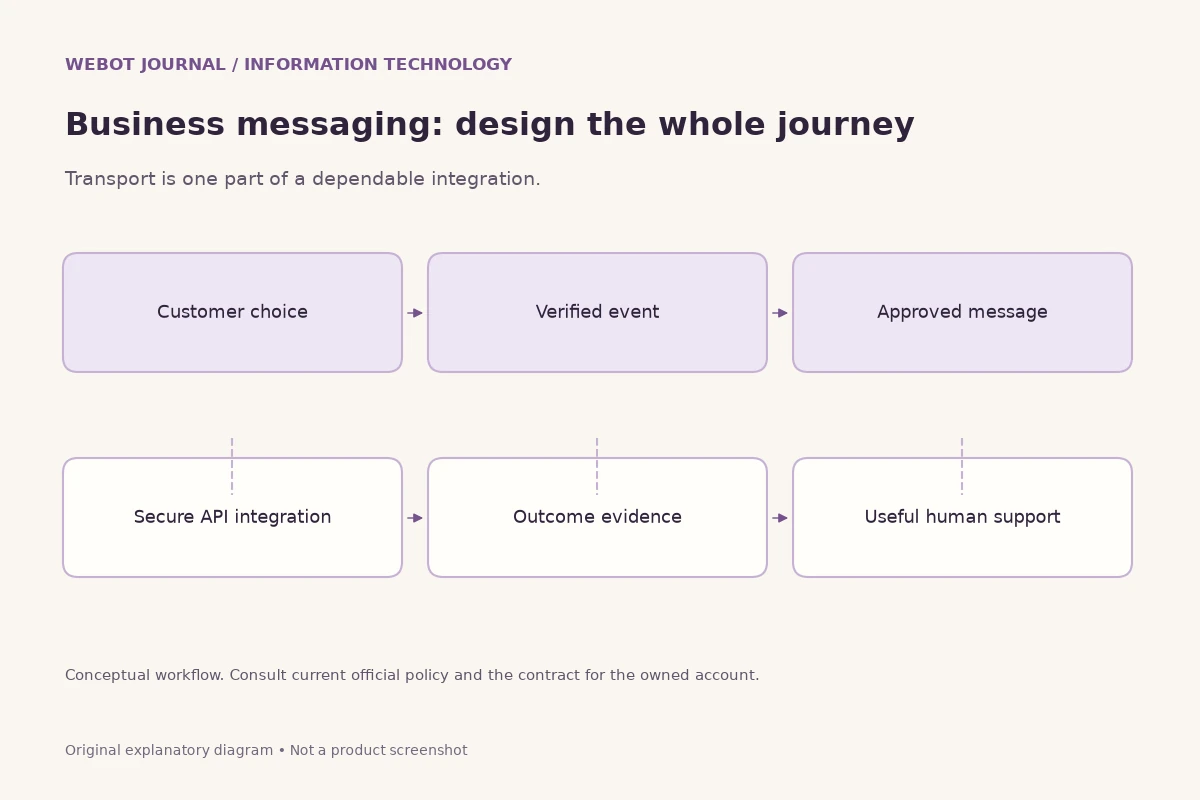
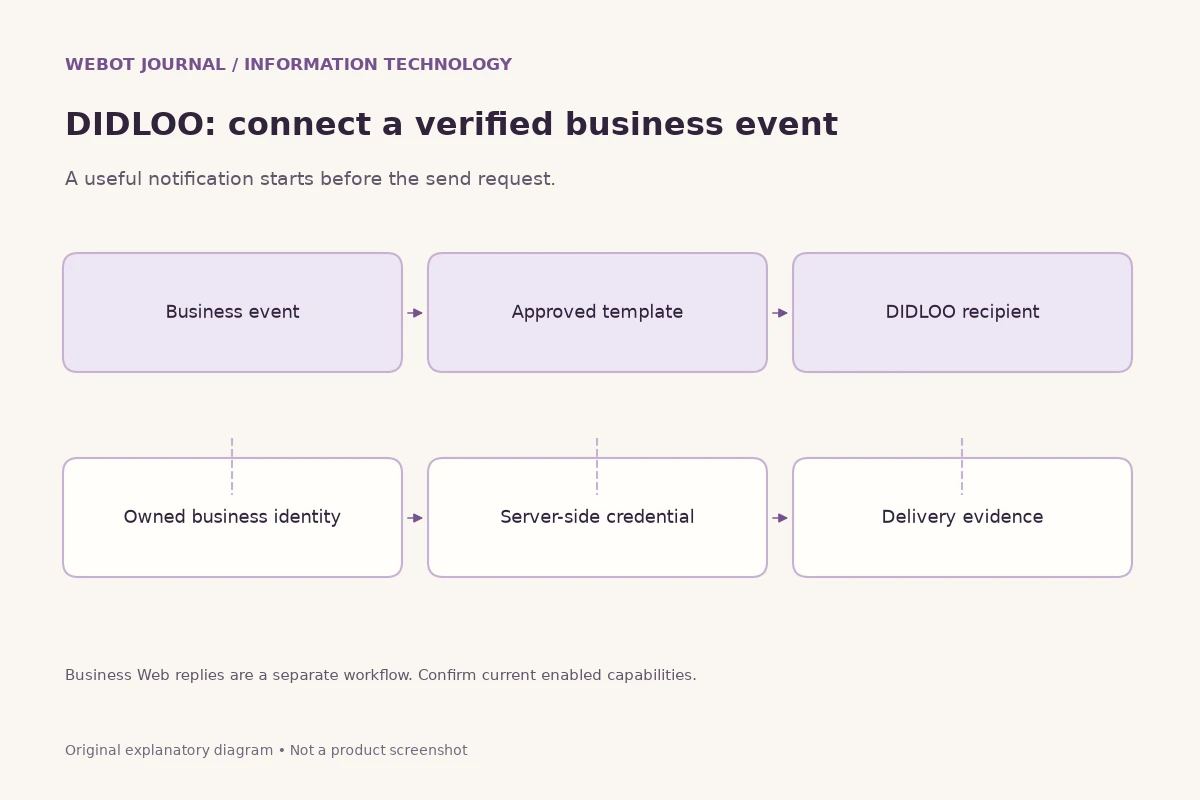
The strongest starting point is a small, expected and useful message flow. Connect a verified business event to an approved template, protect the credential, preserve submission and delivery evidence and give the recipient a clear next step. Expand only when the existing workflow has been tested and its boundaries are understood. That approach turns an API from a source of scattered notifications into a controlled part of customer communication.
Sources and further reading
Explore technology and API guides
Compare messaging, creative model APIs, voice tools and communication workflows through the other independent Information Technology guides.
Explore Information Technology