Relativity
Spacetime Warping Explained: How Gravity Changes Space and Time
The phrase spacetime warping often brings to mind a heavy ball sinking into a rubber sheet. That picture can be a useful introduction, but it can also create the wrong idea that the universe is a material fabric hanging in some larger room. General relativity makes a more precise claim: the geometry used to relate events, distances, clock readings and freely falling motion is affected by the distribution of energy and momentum. The geometry includes time as well as space.
This guide explains curvature without confusing a classroom analogy with a complete physical model. It connects free fall, clock comparisons, light bending and gravitational waves, then distinguishes those established ideas from speculative warp-drive proposals. Most of this article concerns relativity rather than quantum physics. The connection with quantum theory becomes an open research problem when we ask how spacetime geometry should be described in regimes where quantum gravitational effects matter.
1. Understand an event before drawing a grid
An event is something that happens at a particular place and time: a detector clicks, two spacecraft meet or a pulse leaves a transmitter. A coordinate system assigns numbers to events so that we can organise calculations. Those numbers are labels. Changing the coordinate system can change the labels without changing which physical events occurred or what a clock measured between them.
Spacetime brings spatial and temporal relationships into one description. This does not mean that time is interchangeable with an ordinary direction in every respect. The mathematical rules distinguishing timelike, lightlike and spacelike separations are essential. A drawing that places time vertically and position horizontally is a representation of relationships between events, not a claim that time points upward in a hidden physical room.
Start with a concrete question. Which events are we comparing? Are they connected by a moving clock, a beam of light or neither? What can observers actually measure? Those questions keep a spacetime diagram tied to an experiment. Without them, a curved grid can become decorative artwork that looks impressive while saying very little about what a person, clock or telescope would record.
2. Separate coordinates from geometry
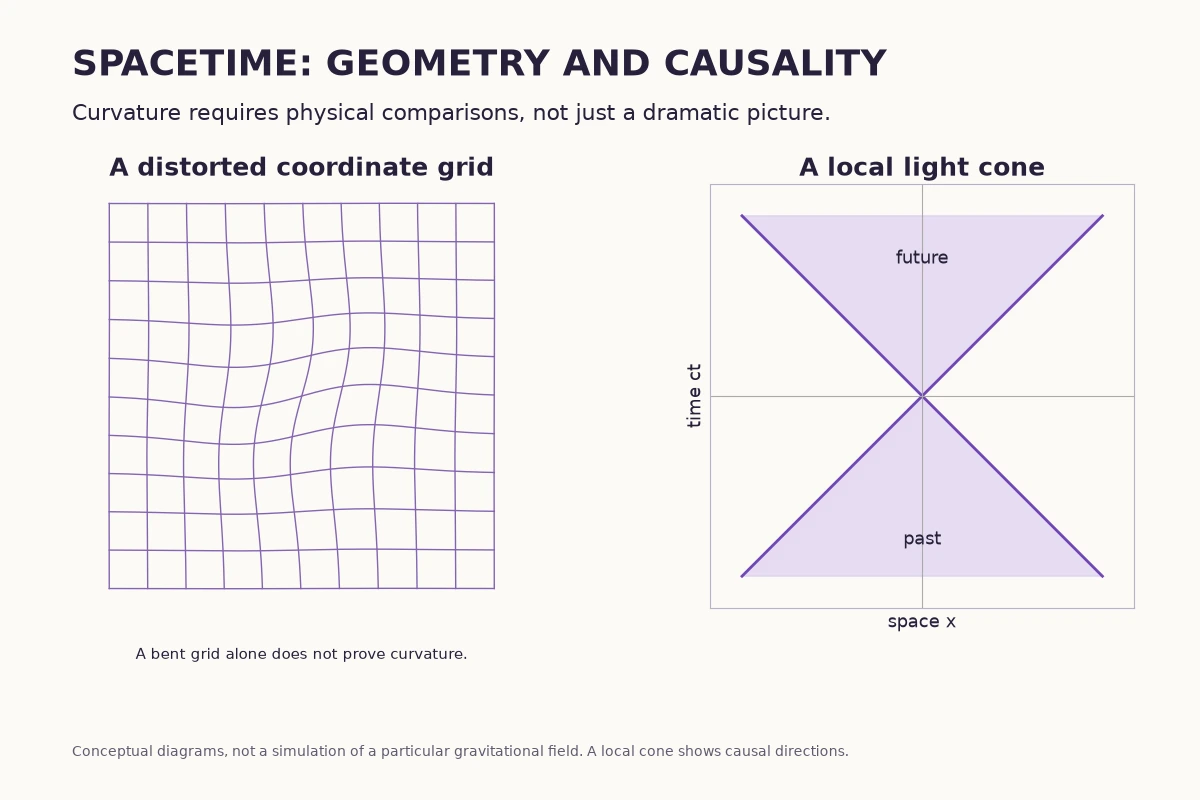
A map can use a convenient grid even when the underlying surface is curved. Conversely, a distorted grid does not automatically prove that the surface itself has intrinsic curvature. We can draw unusual coordinates on a flat plane. Geometry concerns relationships that cannot be removed merely by relabelling positions. This distinction is central when interpreting a diagram of warped spacetime.
On a sphere, for example, local measurements over sufficiently large regions reveal geometric relationships different from those of a flat plane. Triangles built from suitable great-circle segments provide a familiar illustration. The sphere can be studied through measurements within its surface without requiring the observer to step outside into an additional spatial dimension. The embedding picture is helpful, but it is not the definition of intrinsic curvature.
Spacetime has a different mathematical structure from an ordinary two-dimensional sphere, so the analogy must not be applied mechanically. Its purpose is to establish one idea: curvature is something a geometry can possess through measurable internal relationships. A picture of a bent surface is one way to visualise it. A physical higher-dimensional rubber sheet is not a necessary part of general relativity.
3. Use the metric to connect coordinates with measurements
The metric tells us how coordinate differences relate to intervals in spacetime. In the simplest inertial coordinates of flat spacetime, its familiar expression contains a temporal contribution and three spatial contributions with a different sign relationship. That sign structure distinguishes the possible kinds of separation between events. The expression is not simply the ordinary distance formula with one extra positive term added for time.
For a moving clock, the relevant interval gives the proper time recorded along its timelike path. Light follows null paths, for which the spacetime interval is zero, although the light can travel a nonzero spatial distance between events. A zero interval does not mean that the events are the same event or that a photon has a usable rest frame. It describes a particular causal relationship.
In curved spacetime, the metric varies according to the geometry and the coordinates used to describe it. Knowing that variation allows physicists to calculate clock comparisons, light propagation and free-fall trajectories. A diagram can communicate the idea, but it cannot replace the quantitative metric when an exact prediction is needed. The numbers and assumptions connect a visual explanation with a testable physical claim.
ds^2 = -c^2 dt^2 + dx^2 + dy^2 + dz^24. Why free fall is locally special
Imagine a small laboratory falling freely, with air resistance and other nongravitational forces neglected. Nearby freely falling objects can appear to float together for a limited time and over a limited region. This is the starting point for the equivalence principle. It explains why an observer in free fall can experience weightlessness even where a ground-based observer describes a gravitational environment.
The word locally is important. Across an extended region, neighbouring free-fall paths may converge or separate. Those relative changes are tidal effects and reveal information that cannot generally be removed by choosing one freely falling frame for the entire region. A local frame can simplify the immediate description without making all gravitational phenomena disappear everywhere.
Standing on the ground is different from falling freely. The ground exerts a supporting force that prevents the person from following a free-fall path. The sensation of weight is connected with that support. General relativity therefore reorganises the familiar description: the unsupported trajectory is geometrically natural, while the floor maintains a departure from it. This does not invalidate ordinary force calculations; it explains their relationship to a broader framework.
5. Describe geodesics without imagining a downhill pull
A freely falling test object follows a geodesic when other forces can be neglected. Informally, this is the locally natural path supplied by the geometry. It is tempting to say that the object rolls downhill in curved space, but that picture adds a second external gravitational pull to make the explanation work. The relativistic description does not need an extra downward force outside the universe.
A spacecraft travelling freely near a massive body can change its spatial direction because its spacetime path is determined by the geometry. The projected path on a chosen spatial map is only part of that description. Time and the arrangement of events matter too. This is why trying to understand all gravity through a curved spatial bowl can leave out an essential part of the theory.
The familiar phrase shortest path also needs care. Geodesics on an ordinary surface and timelike geodesics in spacetime do not obey an identical positive-distance minimisation rule. Under suitable conditions, a freely falling timelike path locally maximises proper time between nearby comparison events. Rather than stretching a slogan beyond its domain, remember that the metric and the type of path determine the relevant mathematical statement.
6. Learn what the rubber-sheet analogy can show
A stretched sheet with a heavy central object can illustrate that geometry influences nearby paths. It gives a memorable picture of trajectories changing around a central region. For an introductory classroom discussion, that can be helpful. The picture is best used to open a question, not to claim that the demonstration reproduces the complete mechanism of gravity.
The limitations are substantial. The demonstration relies on Earth's gravity to pull the central ball and smaller objects downward. It usually shows only two spatial dimensions, omits the time part of the spacetime geometry and introduces friction that causes rolling objects to spiral inward. Those features belong to the apparatus. They should not be interpreted as literal requirements of the universe or as a prediction that every orbit must decay in the same way.
Our illustration uses a deformed grid only as a conceptual aid. Its caption does not claim an exact gravitational solution. When using any similar image, ask what the grid represents, which quantities are omitted and which apparent effects come from the model itself. A good analogy makes a limited relationship easier to understand while keeping its limitations visible. It becomes misleading when its extra machinery is mistaken for the theory.
7. Recognise the source of curvature as more than mass alone
In general relativity, energy, momentum, pressure and stress enter the relationship between matter and spacetime geometry. Rest mass is an important part of many everyday situations, but it is not the complete list of relevant sources. Light carries energy and momentum despite having no rest mass. A description that says only heavy material can participate leaves out part of the theory.
Einstein's field equations express this relationship between geometry and the stress-energy content. The compact symbolic equation is a summary of a set of connected mathematical relationships. It does not let us solve every situation simply by placing a mass into one universal bowl-shaped drawing. The symmetry, motion, boundary conditions and physical state of a system all matter when finding a useful solution.
There can also be curvature in a region without local matter sitting at every point. The exterior of an idealised spherical mass is an important example. A vacuum region in the relevant mathematical sense is not automatically flat spacetime. This distinction helps explain why an empty-looking region near a massive object can still affect free-fall paths and light. The geometry contains more information than a local count of visible particles.
G_mu_nu + Lambda * g_mu_nu = (8 pi G / c^4) * T_mu_nu8. Connect clock comparisons with spacetime geometry
The proper time recorded by a clock depends on its path and the metric along that path. Two clocks held in different gravitational conditions can therefore accumulate different readings. Near Earth, a small upward change in height produces a small change in the comparison of suitable stationary clocks. Precision experiments can measure effects far smaller than anything a person could feel directly.
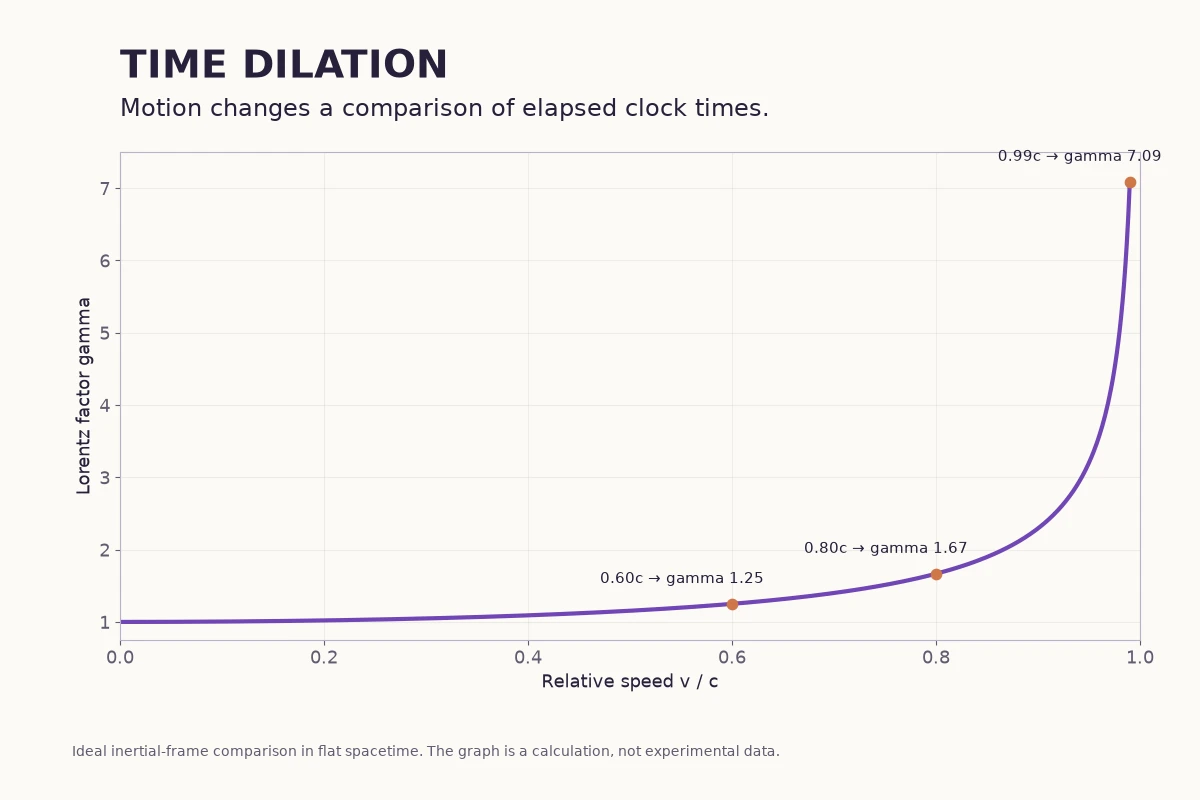
This is not an added optical illusion pasted onto otherwise universal time. The clock readings are part of the physical prediction. At the same time, remote observations still involve signal propagation, so experiments must define how readings are transferred and compared. Our Time Dilation guide separates those issues and gives simple worked examples. The same distinction is useful whenever a colourful spacetime illustration claims that time stops somewhere.
A geometric account also explains why the answer depends on the observer arrangement. A stationary clock, a freely falling clock and a clock moving in orbit need not share the same comparison formula. Saying that they are all at approximately the same distance from a central mass does not fully specify their worldlines. To calculate elapsed time, describe both the location and the motion rather than treating curvature as one universal slowing knob.
9. Understand how light can bend without a local speed change
In general relativity, light follows null geodesics. Its path relative to distant sources and observers can therefore differ from the straight-line expectation of a flat-spacetime approximation. Gravitational lensing is one observational expression of that geometry. A foreground mass distribution can redirect light from a background source, changing the apparent positions, shapes or number of images seen by an observer.
A nearby observer using an appropriate local measurement still measures the vacuum speed of light as the same fundamental value. The distinction is between that local measurement and coordinate descriptions across an extended region. Different coordinate systems can assign different coordinate speeds to light without changing the result of a local laboratory measurement. Mixing those two meanings of speed creates unnecessary paradoxes.
Lensing does not require a photograph of the mass itself in every case. Scientists can infer properties of foreground matter from the pattern it produces in background light, with appropriate modelling and uncertainty. The interpretation depends on the source, lens and observer geometry. A simple curved-ray sketch is useful for learning the idea, but it is not a substitute for the calculations used to analyse an actual astronomical observation.
10. Distinguish static curvature from gravitational waves
A gravitational wave is a propagating change in spacetime geometry, not just a synonym for the gravitational field around a stationary object. Suitable changing systems can generate waves that carry energy away. Compact binaries are especially important sources for current observations because their motion can produce detectable signals. A static curved-grid picture and a travelling wave represent different physical situations.
In a simplified description, a passing wave changes the relative separation of freely falling test masses in a characteristic pattern. Interferometers use precise measurements of light travel and the apparatus response to detect extremely small effects. The full instrument is more complicated than two arrows stretching on a diagram. Its design, noise analysis and agreement between detectors are part of how a signal becomes a credible observation.
General relativity predicts gravitational-wave propagation at light speed in the appropriate regime, and observations test that account. Detecting a classical gravitational-wave signal is not the same as detecting an individual graviton. Quantum ideas can be relevant to measurement technology without turning every measured wave into a direct test of a complete quantum-gravity theory. Keeping those levels distinct prevents a successful experiment from being credited with conclusions it did not establish.
11. Treat horizons as causal structure, not holes in a fabric
A black hole event horizon is defined by which events can send future-directed signals to the distant exterior. It is not a rip in a physical sheet through which matter falls into an external room. The geometry and causal relationships are the essential features. An artistic funnel can suggest strong gravity, but its open bottom is not evidence for a tunnel to another universe.
Light-cone diagrams provide another way to reason about causality. At an event, the cone represents possible directions for light signals, while slower-than-light matter follows allowed timelike directions. In a suitable black hole description, the structure of those allowed futures explains why outward communication to the exterior is unavailable after crossing. The picture still requires careful interpretation of its coordinates.
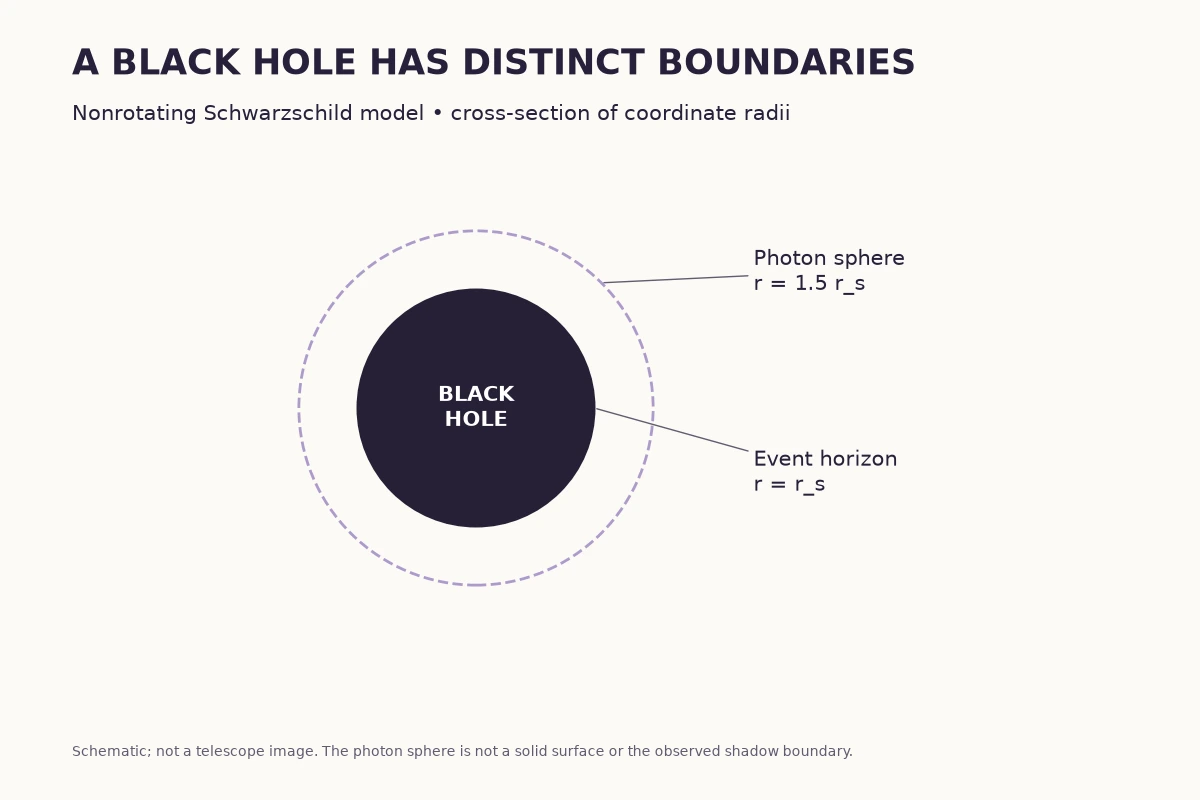
The horizon can be crossed in finite proper time by an idealised infaller, while distant received signals behave differently. That does not make the boundary unreal or imply that every observer can return. Our Black Holes guide explains the distinction between the horizon, photon sphere and shadow. Spacetime geometry is powerful partly because it can describe both local experiences and global limits on communication without turning either one into a literal torn membrane.
12. Ask what a proposed warp drive actually claims
A warp-drive proposal usually describes a specially arranged spacetime geometry intended to alter travel between distant places. It is not the same thing as the ordinary curvature around Earth or a measured gravitational wave. Writing down an interesting metric is a mathematical starting point. Establishing that the required physical conditions can be created, controlled and maintained is a much stronger task.
Some well-known proposals involve unusual stress-energy requirements and raise questions about energy conditions, stability, horizons and causality. Different versions have different assumptions, so a single slogan does not settle every theoretical discussion. What we do not have is an experimentally demonstrated practical faster-than-light transport device. A convincing popular explanation should keep that absence clear rather than describing a speculative metric as an existing engine.
The distinction also protects the interesting science from exaggerated marketing. General relativity allows researchers to ask precise questions about geometry and possible matter content. Those questions are valuable even when a proposed application remains physically unsupported. Learn what a calculation assumes, which constraints it faces and what observation would support it. Do not treat the word warp as a bridge that automatically converts established gravitational physics into unrestricted travel.
13. Place wormholes and quantum gravity among open questions
Wormhole geometries can be explored mathematically, but their existence as traversable structures in nature is not established by ordinary black hole observations. A proposed passage needs a physical account of its matter content, stability and causal behaviour. A diagram with two mouths and a connecting throat cannot supply those conditions by itself. The visual simplicity of a tunnel is not evidence that the universe contains a usable one.
Quantum gravity addresses a different but related challenge: how to describe gravity consistently when quantum effects in the geometry become important. Several research programmes investigate that problem. This article does not present one as an experimentally confirmed final theory. The fact that we need a deeper account in some regimes does not erase the successful tests of general relativity in others.
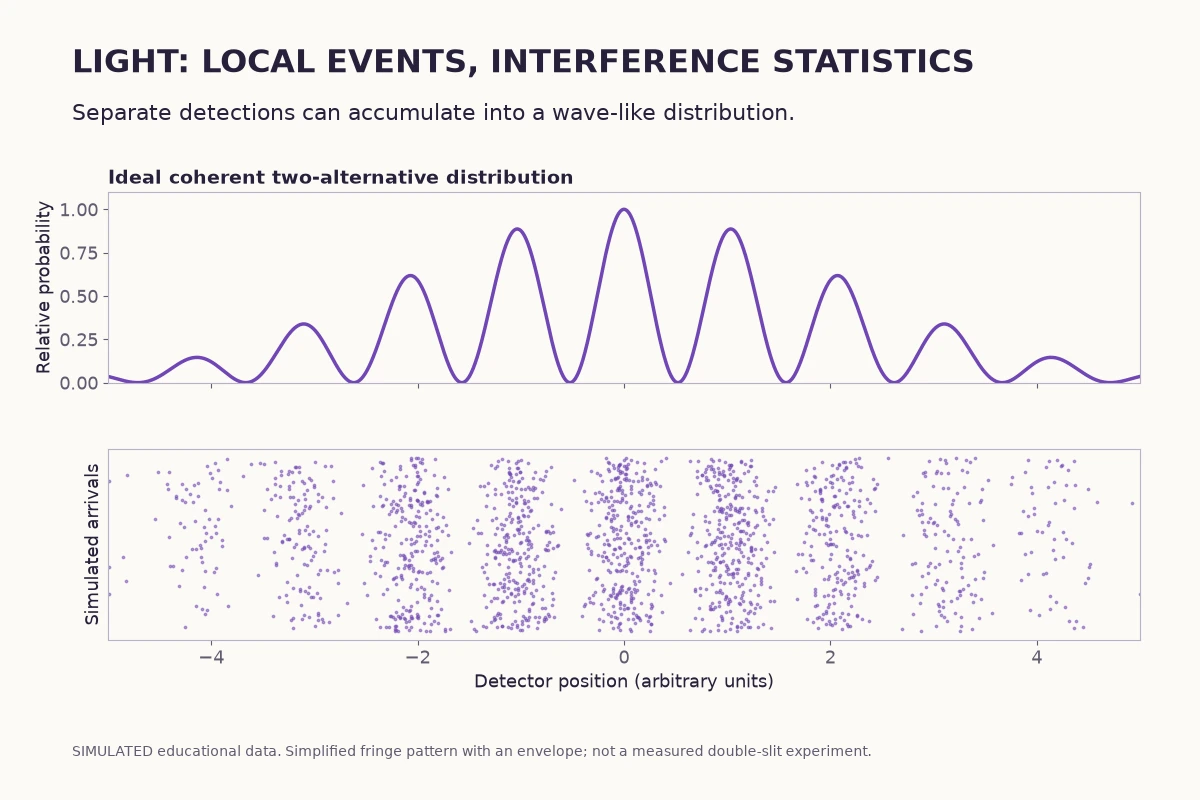
That is why our section deliberately distinguishes relativity from quantum behaviour. A photon interference experiment, a precision clock comparison and a black hole merger can all belong in a modern-physics learning collection without being the same kind of experiment. Connecting ideas is helpful. Collapsing their differences into a single claim that everything mysterious is quantum makes it harder to understand both the established results and the actual frontier of research.
14. Evaluate a spacetime image or video critically
Ask whether the visual is an observation, a numerical simulation, a mathematical diagram or an artistic illustration. Each can be useful, but each supports a different kind of conclusion. An animated grid may simply communicate a qualitative idea. A simulation depends on specified equations and initial conditions. An observation comes from an instrument and an analysis. A polished appearance does not make those categories interchangeable.
Next ask what the axes, colours and shapes represent. Is the picture showing space at one chosen time, a trajectory through spacetime or an embedding of a lower-dimensional geometry? Is the vertical direction a coordinate, an illustrative extra dimension or only a design choice? Are the colours measured wavelengths, false-colour presentation or decoration? If the explanation never answers, the picture may be more suggestive than informative.
Finally, test the implied claim against the limits of the model. A funnel should not be taken as proof of a portal. A curved light path should not be taken as a change in locally measured vacuum light speed. A ripple should not be taken as the detection of a quantum of gravity. These questions let you enjoy a visual explanation while remaining clear about the physical content it actually communicates.
15. Build a connected understanding rather than one giant metaphor
A useful summary begins with events and measurements. Coordinates label events; the metric relates those labels to intervals; geodesics describe suitable free motion; curvature appears in relationships that cannot generally be removed by relabelling. Clock comparisons and light propagation provide ways to test that account. Gravitational waves add the possibility that changes in geometry propagate and carry information about distant changing systems.
Return to a simple practical example. Two clocks at different heights can accumulate slightly different proper times, while a nearby observer beside either clock still performs ordinary local experiments. A light ray can follow a bent path relative to distant objects while its local vacuum speed remains unchanged. Those examples are less visually dramatic than a torn cosmic sheet, but they connect the theory with things that can actually be measured.
Spacetime warping is therefore best understood as a precise geometric description with successful experimental consequences, not a physical cloth or an automatic promise of faster-than-light travel. The remaining questions are genuinely deep: what happens in extreme regimes, how quantum theory and gravity fit together and which mathematical possibilities are physically realised. Clear distinctions make those questions more interesting because we can see exactly what is established and what still needs evidence.
Sources and further reading
Continue exploring physics
Connect this explanation with the other guides on time, gravity, black holes and light.
Explore Quantum Physics