Quantum physics
Light: Wave or Particle? A Clear Guide to Photons, Interference and Measurement
Light produces interference patterns associated with waves, yet a sensitive detector records separate energy-transfer events. These observations belong to one quantum description. Calling light a wave on Monday and a particle on Tuesday does not explain how the evidence fits together. We need to ask what is prepared, what is measured and what the mathematical model predicts.
This guide starts with familiar optics and then introduces photons, the double slit and the photoelectric effect. The aim is a useful understanding without pretending that photons are miniature cricket balls, or that human attention changes physical laws. Quantum theory predicts probabilities for experimental outcomes with extraordinary success. Questions about its interpretation deserve careful discussion, but they do not give permission to replace experiments with mystical claims.
1. Why the familiar either-or question is incomplete
A classical particle has an imagined position and trajectory, while a classical wave spreads through space and can overlap another wave. Both pictures help with particular observations. Neither supplies a complete account of light. Quantum theory uses states and measurement rules that differ from both everyday categories. The phrase wave–particle duality is a reminder of this limitation, rather than a mechanism that switches between two ordinary objects.
An interference experiment tells us that adding classical probabilities for separate paths can fail. A photon-counting experiment tells us that energy exchanges can be registered as discrete events. These statements concern observable arrangements and outcomes. They do not require us to imagine a tiny solid object secretly following a fully specified route while simultaneously behaving like water on a pond.
A useful habit is to replace the question “What costume is light wearing?” with three more concrete questions. What properties did the source prepare? Which alternatives remain coherent in the apparatus? What does the detector actually distinguish? Answers to these questions make apparently contradictory claims much easier to assess. They also expose descriptions that leave out a crucial polariser, filter or coincidence-selection step.
2. What the electromagnetic-wave picture explains
Classical electromagnetism describes light through electric and magnetic fields. These fields can propagate through a vacuum; they do not need air or a material substance resembling water. In vacuum their propagation speed is the constant conventionally called c. The exact defined value is 299,792,458 metres per second. Light travels differently through materials, where interaction with matter affects propagation and dispersion.
The wave description explains reflection, refraction, diffraction, polarisation and much interference. Engineers can design lenses, radio antennas and many optical systems without assigning an individual photon trajectory to every bit of energy. A successful approximation remains valuable within its domain. Quantum theory does not make ordinary cameras or Maxwell's equations useless; it clarifies when their classical description needs a deeper account.
The fields themselves are not necessarily literal coloured ripples like those drawn in animations. A sinusoidal diagram often plots a field component against position or time. The line on the page is a graph, rather than the winding path of a photon through space. Keeping that distinction in mind prevents a common misunderstanding: light does not have to wiggle along a longer geometric route simply because a textbook draws a wave-shaped curve.
3. Frequency, wavelength and the energy of a photon
Frequency counts oscillations per second, and wavelength describes spatial repetition. For a simple monochromatic wave in vacuum, their product is c. A photon associated with frequency f has energy h multiplied by f, where h is Planck's constant. This relation connects the wave vocabulary of frequency with the quantum vocabulary of energy exchange. Greater frequency means greater photon energy.
For example, take vacuum light with a wavelength of approximately 500 nanometres. Dividing c by that wavelength gives a frequency near 6.00 times ten to the fourteenth hertz. Multiplying by h gives about 3.97 times ten to the minus nineteenth joule, or roughly 2.48 electronvolts. These rounded values describe the example's photon energy; they are not the total energy of an arbitrary green laser beam.
A real light pulse can contain a range of frequencies, and a photon state need not have one perfectly sharp energy. The simple calculation is therefore a useful idealisation, not a universal claim that every pulse has a single wavelength. Also specify whether a quoted wavelength is in vacuum or inside a material. Frequency and wavelength are related, but exchanging them casually without stating the propagation conditions can lead to incorrect numerical conclusions.
c = f * lambdaE = h * f4. Brightness and colour answer different questions
At a fixed frequency, increasing the number of photons increases the transported energy without increasing the energy assigned to each photon. This is a first approximation for understanding why a brighter beam and a higher-frequency beam are different changes. A large collection of lower-energy photons does not automatically become a smaller collection of higher-energy photons simply because the total energy is the same.
The quantum state matters too. Laser light, thermal light and specially prepared single-photon light have different statistical properties. It is not generally correct to say that every faint beam emits one neatly spaced photon at a time. Reducing the average intensity of a source can still leave occasional multiple-photon events. Experiments that need a single-photon source must characterise those statistics rather than infer them from dimness alone.
In everyday photography, perceived brightness also depends on exposure, detector response and human vision. Colour perception involves the spectrum and the eye's sensitivity, not a direct photon-energy display. When reading a quantum experiment, look for a physical description of the source and its spectrum. Words such as bright, dim, red or blue are useful introductions, but the experiment usually needs a more precise account of frequency distribution, intensity and detection efficiency.
5. What a detector click establishes
A photon-counting detector produces a recorded event after an interaction in its sensitive material. The event may be amplified into an electrical pulse that electronics can count. On a screen or sensor, separate detections can appear at particular locations. This locality of recorded energy transfer is a central reason particle language remains useful, even when the overall distribution reflects interference.
However, a localised record does not by itself establish a classical trajectory extending backwards through the apparatus. A measurement provides evidence about the actual measurement interaction. Deducing a unique unobserved path requires additional assumptions, and different quantum interpretations treat such assumptions differently. It is more reliable to state what was recorded than to present a convenient animation as an experimental photograph of the photon's entire history.
Real detectors also have finite resolution, imperfect efficiency, background counts and recovery times. A missing click need not mean no light was present, and every electrical pulse is not automatically a genuine photon from the intended source. Experimental calibration separates signal from these complications. Quantum explanations become stronger when they acknowledge the detector's physical operation rather than treating it as a magical, perfectly efficient box that reveals an object's hidden classical identity.
6. How a double slit builds an interference pattern
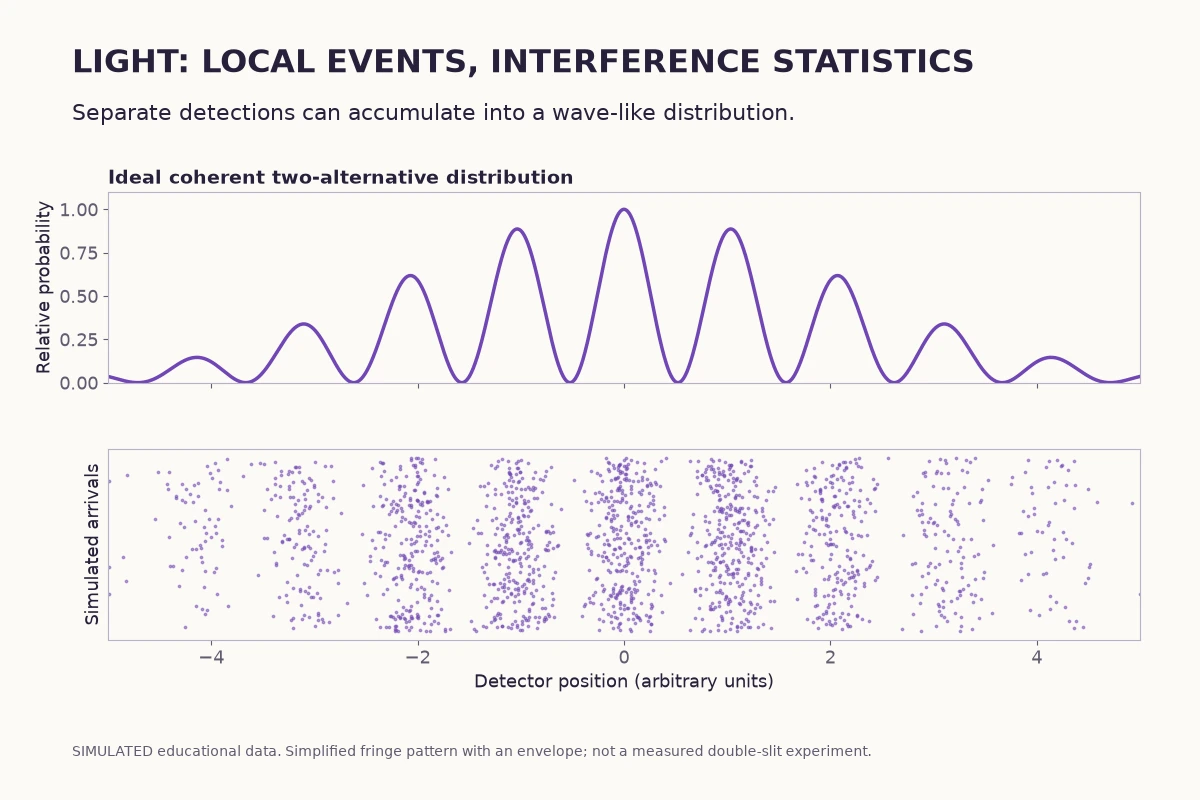
Prepare light with suitable coherence, allow two alternatives through an apparatus and measure arrival positions. Repeating the preparation many times can produce bright and dark bands in the detection distribution. Under appropriate conditions, the experiment can be run with detections sufficiently separated that collisions between a crowd of photons do not explain the pattern. Individual records accumulate into a statistical structure.
The pattern depends on the geometry, wavelength, coherence and what other information is available. With two coherent alternatives, the probability is calculated from a combined amplitude. Closing one slit changes that arrangement, so the two-slit pattern is not generally the simple sum of separately measured one-slit distributions. Diffraction from each finite slit also shapes the envelope around the interference fringes.
Avoid saying that an apparatus has photographed one photon splitting into two classical half-energy balls. Quantum amplitudes associated with alternatives are not little fragments of material. Similarly, a few randomly placed clicks do not establish an interference pattern. The claim requires enough events, a defined setup and comparison with predictions. The educational diagram accompanying this article uses simulated positions to explain accumulation; it is not a measurement from a laboratory or proof obtained by drawing dots.
7. The photoelectric effect and a threshold frequency
In the photoelectric effect, light can eject electrons from a material. A basic single-photon model relates the maximum electron kinetic energy to photon energy minus the material's work function. The work function is the minimum energy needed for the relevant electron-removal process under the model's conditions. If the photon energy is too low, increasing intensity does not repair the energy shortfall for that simple single-photon process.
Above threshold, greater intensity can increase the emission rate, while greater frequency raises the maximum available kinetic energy. These are different experimental changes. Actual measurements depend on the surface, experimental geometry and collection conditions. Modern intense-field experiments can also involve multiphoton processes, so a classroom threshold explanation should not be stretched into a claim about every possible light–matter interaction.
The effect strongly motivates quantised energy exchange and was historically decisive. It is still important to distinguish that useful lesson from a complete derivation of every feature of quantum electrodynamics. A good explanation identifies what this experiment tests and how its predictions compare with alternatives. The simple equation is an entry point, and the surrounding physical assumptions tell us when applying it is justified. Memorising the equation without those assumptions can produce an apparently confident but incorrect answer.
K_max = h * f - Phi8. Momentum without a rest mass
Light carries momentum as well as energy. For a photon in vacuum, momentum magnitude equals energy divided by c, and it is also related to wavelength through Planck's constant. Radiation pressure and scattering provide ways to observe momentum transfer. Compton scattering is an important example in which photon–electron energy and momentum relations explain a change in the scattered radiation's wavelength.
A photon has zero rest mass. This does not mean it has zero energy, zero momentum or no gravitational relevance. Rest mass is one physical quantity, and energy is another. Nor can we take a massive observer, accelerate it to c and ask for its ordinary rest-frame view of a photon. Such a photon rest frame is not part of special relativity's family of valid inertial frames.
Popular phrases such as “a photon experiences no time” should therefore be treated with caution. A lightlike path has a zero spacetime interval in relativity, but assigning a photon's personal experience or ordinary clock is a separate and misleading step. Understanding this boundary connects the present article with time dilation while keeping the two subjects distinct. Quantum light and relativistic motion share important mathematics, but neither supplies a licence for inventing an impossible observer.
9. Probability amplitudes explain the missing ingredient
For two coherent alternatives, quantum theory adds amplitudes and then takes the squared magnitude to obtain a probability or probability density, with the appropriate normalisation. The amplitudes can carry phase. Their relative phase produces an interference contribution that can reinforce some outcomes and reduce others. Simply adding two positive classical probabilities loses that contribution and can predict the wrong pattern.
The symbols in the displayed equation represent a simplified two-alternative description. They are not two independently observed trajectories. A complete calculation must specify the state, propagation, detector and relevant degrees of freedom. Depending on the experiment, an amplitude might describe a position distribution, a polarisation outcome or a joint result involving more than one system. The mathematical objects have a defined role within that calculation.
An amplitude can cancel another amplitude at a location without implying that two measured negative probabilities have annihilated. Observable probabilities remain nonnegative. This distinction is one reason ordinary language struggles with quantum theory. The wave analogy helps us visualise phase and interference, but the final prediction concerns measurement statistics. If a demonstration omits phase stability, normalisation or the difference between amplitudes and probabilities, its attractive picture can conceal the very feature that makes the experiment quantum.
P = |psi_1 + psi_2|^210. Measurement is a physical interaction
A path-marking device can correlate the light with another degree of freedom, such as polarisation or an environment. When the alternatives become distinguishable in the relevant physical state, interference in the observed distribution can be reduced or lost. An analysis must specify which outcomes are measured together and which information is ignored. It is not enough to announce that someone could theoretically look somewhere.
The crucial process is physical correlation, not a person's awareness. A detector can leave a record while every scientist is asleep. Conversely, a person staring at an apparatus does not automatically mark a path if no suitable interaction supplies that information. Quantum measurement raises serious foundational questions, but standard predictions do not require the observer's consciousness to choose an outcome or reshape a distant past.
Real experiments can show partial interference visibility and imperfect path distinguishability. This continuous behaviour is more informative than a cartoon switch labelled wave on one side and particle on the other. Source noise, environmental coupling and limited detector resolution also matter. When evaluating a claim, ask what physical system stores the correlation and how the measurement reads it. A concrete answer is much more useful than a vague assertion that “looking changes reality.”
11. Quantum erasers do not send messages backwards in time
Some experiments correlate two systems and then sort one system's detections using a measurement outcome from the other. Conditional subsets can show different interference patterns, even when the unsorted detections do not. The word eraser refers to a carefully defined treatment of distinguishing information and correlations. It does not mean a scientist deletes an already received classical message or rewrites a recorded laboratory event.
The sorting operation is essential. Without comparing the appropriate records through an ordinary communication channel, a distant observer cannot choose a useful message from the local unsorted results. These experiments therefore do not provide faster-than-light signalling. An animation that presents only selected subsets can make the result appear much stranger by hiding the full distribution and the later comparison of data.
Delayed choices likewise need a precise account of timing, correlations and the apparatus. They do not establish that a human decision changes yesterday's completed history. The experiments test quantum predictions in ingenious arrangements, and their real significance is interesting enough without that addition. Before accepting a spectacular explanation, look for the total data, the rule used to select coincidences and the distinction between joint correlations and information available to one observer alone.
12. Wave packets, localisation and uncertainty
A perfectly monochromatic travelling wave is an idealisation with unlimited extent. A localised pulse involves a combination of frequencies or wave vectors, so different descriptions trade sharp localisation against sharp momentum or frequency. Quantum uncertainty relations express constraints on the state distributions of specified observables. They are not merely a complaint that laboratory equipment is too clumsy to uncover an otherwise perfectly sharp classical description.
For position and the corresponding momentum component, a familiar uncertainty relation involves their standard deviations and the reduced Planck constant. Applying that relation requires care about the state, the chosen component and the meaning of the measured distributions. It should not be used as a universal excuse for imprecise reasoning, or as a claim that every conceivable measurement result is equally likely.
A photon's wavelength is also not a simple universal diameter of a tiny sphere. Its spatial mode, bandwidth and interaction geometry matter. We can discuss a beam waist or a pulse duration without claiming to have found a hard physical edge around every photon. These distinctions help reconcile practical optical measurements with quantum language. They also explain why asking “How big is one photon?” needs a more specific operational definition before it can receive a useful answer.
13. A quantum field connects the pictures
In a modern field description, photons are quanta of the electromagnetic field. This language helps connect discrete energy exchanges with field behaviour. Some field states have a useful classical approximation; others reveal nonclassical statistics that the same approximation cannot capture. The choice is governed by the preparation and the observable, rather than by a decision to ignore inconvenient experimental outcomes.
Interference is not unique to light. Matter systems can also display quantum interference when suitably prepared and isolated. That broader evidence shows why quantum theory is more than a story invented to repair an odd feature of optics. At the same time, demonstrating wave-like statistics for an object does not imply that every everyday property of a water wave applies to that object.
Different interpretations offer accounts of what the quantum formalism means. They can disagree on underlying pictures while sharing many tested predictions. A beginner need not settle every interpretive debate before learning to calculate an interference pattern or distinguish photon energy from beam intensity. Be clear when a statement is an experimentally tested prediction, a convenient approximation or an interpretation. Treating all three categories as interchangeable creates unnecessary confusion about what physics has actually established.
14. Where these ideas matter in technology
Photodetectors translate light–matter interactions into useful electrical signals. Imaging, spectroscopy and optical communication use both classical and quantum descriptions at different levels. Engineers may model a beam's propagation classically while accounting for photon-counting noise at detection. The appropriate model depends on the question, required precision and operating conditions, rather than a rule that one vocabulary must replace every other vocabulary everywhere.
Single-photon sources and detectors also support quantum-information experiments. However, the presence of a photon does not automatically make a device a quantum computer, and an optical communication link is not automatically secure against every attack. Claims about performance or security require an explicit protocol, assumptions, hardware characterisation and evidence. General quantum terminology cannot substitute for those details.
For a reader evaluating a product or headline, ask what observable benefit is demonstrated. Does the apparatus resolve weaker signals, produce a characterised nonclassical state or implement a verified communication procedure? Are losses and error rates reported? These concrete questions connect the physics with genuine applications. They also protect against marketing that borrows the mystery of wave–particle duality while providing no measurements relevant to the advertised capability.
15. How to read the evidence without losing the wonder
Begin with the experimental arrangement and the complete dataset. Identify the source, any filters or path markers, the detector and the comparison being made. Check whether an image shows actual observations, a calculation or a schematic. Our accompanying figure deliberately labels its detections as simulated: it explains how a distribution accumulates, while the cited experimental literature supplies independent evidence about real light.
Next, separate the claims. Localised detection is one observation; interference statistics are another. Neither alone supplies every detail of a hidden trajectory. Ask which prediction changes when the apparatus changes, and whether the author distinguishes amplitude from probability. Watch particularly for claims involving consciousness, backwards messages or a photon's rest frame. Such claims often arrive through language that exceeds what the experiment establishes.
The most useful answer to “wave or particle?” is therefore a quantum description with clearly defined limits. Light can generate wave-like interference and discrete detection events in one consistent framework. We retain classical optics where it works, use quantum states when needed and identify open questions honestly. That approach preserves the subject's surprise while giving the reader something stronger than a slogan: a way to connect an explanation to a measurable physical result.
Sources and further reading
Continue exploring physics
Connect this explanation with the other guides on time, gravity, black holes and light.
Explore Quantum Physics