Numerology
Numerology Number 9: Birth Number, Destiny Number and Courage with Purpose
A strong response can be useful when something needs to change, but strength alone does not tell us which response is appropriate. Number 9 in numerology is often explored through courage, service and a concern that extends beyond the immediate self. Those themes raise practical questions. Whose needs are being heard? What action would actually help? When does conviction support a shared purpose, and when does it become impatience with anyone who sees the situation differently?
This guide explains number 9 as a birth number and as a complete-date destiny number. It includes worked arithmetic, the traditional Mars association, original situations involving work, relationships, community life and completion, and the limits of symbolic interpretation. Numerology is a cultural framework rather than a reliable forecast or a test of character. The examples invite reflection without claiming that a date determines a person's abilities, obligations or future.
1. Define birth number and destiny number clearly
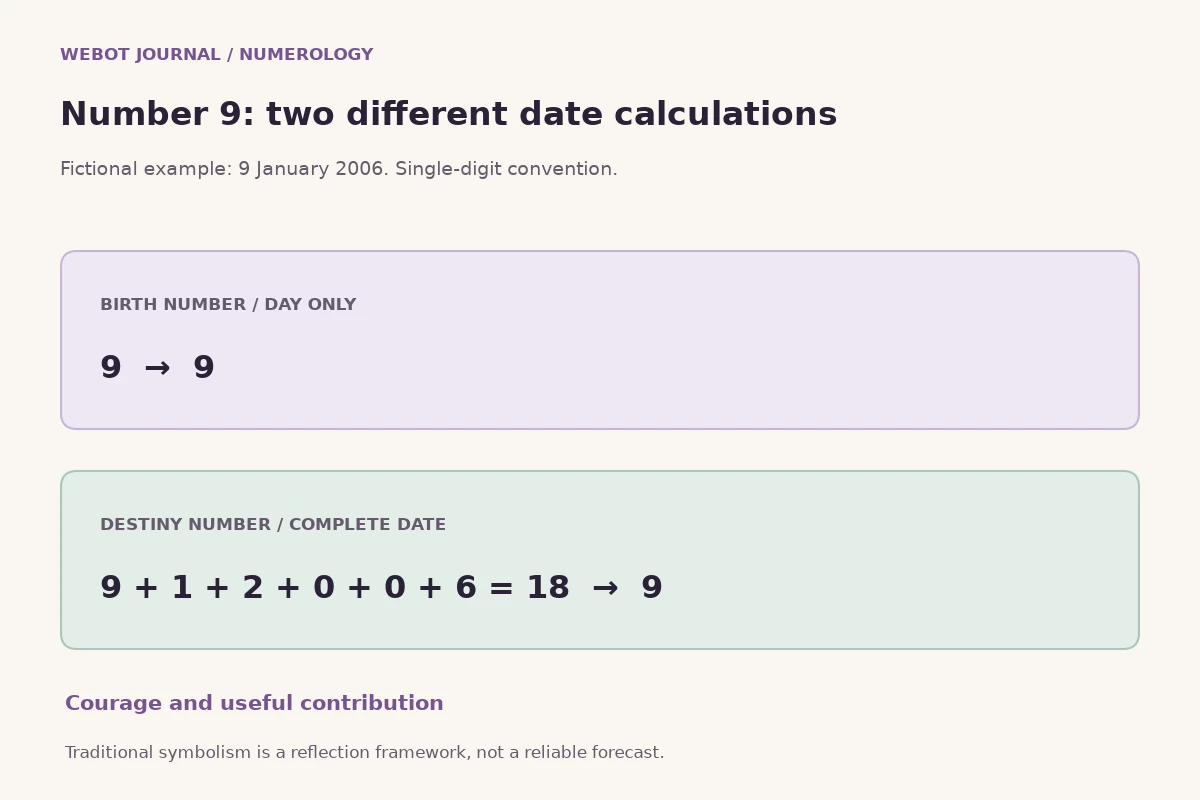
In this series, the birth number or Mulank is the day of birth reduced to a single digit. The destiny number or Bhagyank uses all the digits in the full date. Because the inputs differ, a person can have birth number 9 with another destiny number, or destiny 9 while being born on a day that reduces differently. Neither calculation ranks a person's worth.
This is a single-digit date convention. Other schools may retain master totals or use destiny for a number calculated from a name. Those methods need their own explanation and cannot be mixed silently with this one. State the convention and show the addition before discussing symbolism. The guide does not require a birth time, calculate a horoscope or claim that every numerology tradition uses identical terminology.
2. Birth number 9: the 9th, 18th and 27th
The three calendar days that reduce to 9 are 9, 18 and 27. Eighteen gives 1 plus 8, and twenty-seven gives 2 plus 7. Nine already has one digit. The month and year do not affect this day-based calculation. A reader can check it directly, without a specialised tool or additional personal information.
Keep the original day beside the reduced number. Shared membership in a category does not establish shared character, experience or opportunity. Some practitioners add compound-number interpretations, but those are additional readings rather than a reason to erase individual differences. The simple arithmetic defines a place within a chosen symbolic framework. It does not provide a complete account of the people whose dates happen to reach the same digit.
3. Destiny number 9 with two worked dates
For the fictional date 9 January 2006, add 9 plus 1 plus 2 plus 0 plus 0 plus 6 to obtain 18. Reduce 18 to 9. This example therefore has both birth and destiny number 9. Showing the intermediate result makes the method understandable and allows another reader to identify an arithmetic mistake if one occurs.
For contrast, use 18 July 1990. The day gives birth number 9, while the full date adds to 1 plus 8 plus 7 plus 1 plus 9 plus 9 plus 0, or 35. Thirty-five reduces to 8. The pair is birth 9 and destiny 8 under this convention. The dates demonstrate the difference between the calculations; they do not predict how a real person born on either date will live.
4. Mars and the traditional image of directed energy
The Indian numerology account used as a cultural reference associates number 9 with Mars. Courage, directness and service appear among its themes. These are traditional correspondences, not an established cause of behaviour. The symbolic association does not prove that a person is aggressive, unusually brave or meant to undertake a particular kind of work.
An original way to explore the theme is through directed energy. An immediate reaction may be powerful while still missing the actual problem. A considered response identifies what needs to change and what action is proportionate. Someone reflecting through 9 can ask how conviction becomes useful rather than merely visible. The question leaves room for patience, preparation and listening as forms of strength rather than treating forcefulness as the only expression of courage.
5. Birth number 9 and the first impulse to respond
As a birth-number prompt, 9 can highlight an immediate reaction when something seems unfair or unfinished. Imagine a group task where one person's contribution is repeatedly overlooked. Another participant speaks up and names the work accurately. The constructive feature is not simply boldness; it is attention to a specific situation and a response that gives the overlooked person room to participate.
If this scene resonates, examine how you decide when to act. Do you understand what the affected person wants, or assume that your preferred response must be theirs? A useful reading can connect courage with consultation. It does not establish that every quick intervention is helpful or that someone with a different number is less willing to act when an appropriate response is needed.
6. Destiny number 9 and a purpose beyond a personal image
A complete-date interpretation can frame 9 as a continuing question about whom an effort serves. A person may want to contribute to a community, teach a useful skill or finish work that others can rely on. The theme need not involve a public role or an impressive label. A modest contribution can have a clear purpose.
Ask whether the intended beneficiaries recognise the contribution as helpful. A project may sound generous while addressing a problem its audience does not actually have. Listening and revision keep purpose connected with experience. The number offers an optional lens for asking that question; it does not assign a duty to rescue everyone or establish that a person with 9 is inherently more ethical than others.
7. When both birth and destiny reduce to 9
Matching values may be described within numerology as emphasis on a theme. For 9, consider the relationship between an immediate wish to act and the continuing work of serving a purpose. Those are different stages. Someone may respond strongly to an issue but struggle with the quieter tasks needed afterwards. Another may work steadily without a dramatic first gesture.
Review one contribution you made recently. What prompted it, who helped define the need and what happened after the visible moment? Include what remained unfinished. This gives the repeated theme a concrete subject and avoids treating recognition in a profile as proof of character. A thoughtful reflection allows mixed evidence rather than requiring every action to confirm a flattering account of courage or generosity.
8. Birth 9 alongside another full-date result
Different results can be discussed as complementary questions rather than a contest between fixed identities. With destiny 2, ask how conviction makes room for consultation. With destiny 4, consider how a generous intention becomes a workable process. With destiny 8, examine the responsibility needed to sustain an effort beyond the first response. These are original prompts, not forecasts.
The fictional 18 July 1990 example gives birth 9 and destiny 8. Imagine someone proposing a neighbourhood learning event and then arranging who will maintain the materials afterwards. Initiative and sustained responsibility can support one another when the needs are clear. The date does not establish that the event will succeed. The plan, the participants' experience and the follow-through provide the relevant evidence.
9. Courage can be quiet and specific
Courage is often pictured as a dramatic confrontation, but it can also involve admitting an error, asking for clarification or declining a request that cannot be fulfilled honestly. These actions may receive little attention while still requiring a clear decision. A symbolic reading becomes richer when it does not restrict strength to one outward style.
Choose a situation where speaking accurately felt uncomfortable. Did you exaggerate certainty, avoid the issue or state what you knew and what you did not? Consider one sentence that would have made the response clearer. This is an original practical use of the courage theme. It does not imply that a numerical category guarantees bravery or that a person must seek conflict to demonstrate the quality.
10. Directness works better when its purpose is clear
A direct statement can reduce confusion, but bluntness is not automatically honesty at its best. A person may communicate a valid concern in a way that makes it harder for others to respond constructively. The useful question is what the statement should enable: a correction, a decision, an explanation or a boundary.
Instead of saying that a whole project is useless, identify the part that fails its purpose and ask how it could be improved. This preserves clarity while giving the conversation somewhere to go. Someone reflecting through 9 can examine whether their directness addresses the task or mainly expresses frustration. The number does not excuse disregard for the listener, nor does consideration require hiding a relevant concern.
11. Service begins with the other person's actual need
Helping can become centred on the helper's preferred action. Someone wants to organise an event when the community needs a reliable schedule, or offers advice when the recipient needs a practical introduction. A sincere intention is valuable, but it does not by itself identify what would be useful. The person receiving help should have a voice.
Ask what has already been tried, what remains difficult and what kind of contribution is welcome. Accept that the answer may be smaller or different from the role you imagined. This is an original application of service as attention rather than self-image. A number-9 reading should not turn generosity into permission to take over decisions that belong to someone else.
12. Boundaries allow a contribution to remain dependable
A wish to help widely can produce commitments that no one person can sustain. Saying yes to every request may feel generous at first, but others may then rely on work that is delayed or abandoned. Clear limits can make a contribution more useful because people understand what they can expect.
Describe the task you can own, the time it requires and what lies outside the agreement. If you can review one document, do not imply that you can manage an entire project. Within a number-9 reflection, a boundary is not a rejection of service. It is a way to connect intention with dependable action. The number does not require self-erasure or make every need your personal responsibility.
13. Completion includes an honest account of what remains
Nine is the final digit in the reduced sequence used by this series, and completion can therefore serve as an editorial reflection theme. That observation is not a claim that every tradition gives it an identical meaning. A useful ending does more than announce that work is finished; it leaves the next person with a clear account of the result and any remaining limits.
Imagine finishing a shared guide. Check that the instructions work, record the source of uncertain information and explain who will update it. A polished appearance is not enough if the content remains incomplete. This practical example connects purpose with completion without treating the number as a guarantee that a project has reached its proper end.
14. Letting go is different from ignoring an obligation
Ending a project or stepping back from a role can be appropriate, but the way it is done matters to the people affected. A person may need a handover, notice or a clear explanation of unfinished work. Simply disappearing and calling it a new chapter leaves others to manage the uncertainty.
If you decide to stop, identify what you agreed to do and what can reasonably be transferred or concluded. Communicate the change in terms others can act on. Someone exploring the completion theme of 9 can use this as a concrete question. The symbolic idea does not establish when an ending is required, and it should not be used to avoid an existing responsibility or pressure someone else into a decision.
15. Work themes should not become a prescribed career
Traditional numerology profiles may connect 9 with organising, teaching or serving a wider group. Such associations do not establish professional qualifications or determine a suitable occupation. Skills, interests, experience and opportunities need direct consideration. A reduced date should not be used to decide someone's access to employment or education.
Reflect on an actual contribution instead. Did you clarify a purpose, support a newcomer, complete a handover or make a shared resource easier to use? What shows that it helped? Concrete examples can support a useful discussion about preferences. The symbolic theme remains a prompt, not proof that you must pursue a public role or that one category of birthdays is naturally better suited to leadership or service.
16. Study: understanding grows when explanations are checked
Explaining a subject to someone else can reveal what you understand and where your account becomes vague. Yet teaching a mistaken explanation confidently does not make it correct. A useful learning exchange needs room for questions, checking and revision. The wish to be helpful should support accuracy rather than replace it.
Choose a small topic, prepare a worked example and ask the learner to explain the reasoning back in their own words. Notice where the account needs improvement. This is an original study exercise available to anyone. It does not predict academic success or teaching ability from number 9. The relevant evidence is whether both people understand the subject more clearly after the exchange.
17. Relationships need the individual as well as the larger purpose
A person may devote considerable attention to a community or cause while overlooking the practical needs of a close relationship. The wider purpose can matter deeply, but it does not automatically settle every disagreement about time and responsibility. People nearby should not be expected to accept an arrangement without a conversation simply because the aim sounds generous.
Discuss which commitments are shared and which are personal, and explain changes before they affect agreed plans. A number-9 reflection can ask whether concern for many people leaves room to hear one person carefully. This is not a prediction that someone will neglect relationships. It is a practical question about balance, and the answer comes from actual behaviour rather than a profile.
18. Compatibility prompts with numbers 1 through 9
With 1, discuss how initiative serves a purpose; with 2, how the affected people are consulted; with 3, how an inspiring message stays accurate; with 4, how an idea becomes workable; with 5, how change is communicated; with 6, how care reaches the immediate relationship; with 7, how conviction remains open to evidence; with 8, how responsibility is sustained; and with 9, how two people share rather than compete over a mission.
These are original conversation prompts, not compatibility scores. A date cannot establish trust, certify a marriage or prove that a partnership will fail. A favourable chart does not excuse harmful conduct, and an unfavourable label does not justify rejecting someone automatically. Discuss expectations directly and consider the real relationship, including consent, conduct and the circumstances that shape it.
19. Family life should not depend on one permanent rescuer
A family can become accustomed to one person resolving every urgent problem. That person may be praised for courage or generosity while receiving little opportunity to step back. A symbolic label can reinforce the expectation if it says the person is meant to sacrifice for others. The arrangement deserves a practical discussion rather than a numerical justification.
Identify recurring situations and ask which responsibilities can be shared before they become emergencies. Record useful information so it is not held by only one person. Someone reflecting through 9 can use the service theme to strengthen collective participation. The goal is not to prove that you can do everything; it is to help create an arrangement that remains workable when you are unavailable.
20. Children should not have to perform a heroic identity
Calling a child brave or generous can be encouraging when it refers to a particular action. Turning it into a permanent role can make ordinary hesitation, frustration or personal preference feel unacceptable. A child whose date reduces to 9 does not owe exceptional service or courage to the adults around them.
If a family enjoys numerology, discuss the symbolism through optional stories and age-appropriate activities. Let the child say which parts they like and which do not fit. Appreciate a helpful act without expecting the same response in every situation. Educational opportunities and support should follow the child's actual needs and interests, not a prediction that the number makes them destined for a special public or moral role.
21. Traditional Tuesday, red and coral correspondences
The Indian reference account associates 9 with Tuesday, red and coral, with copper also appearing among its correspondences. These belong to the cultural framework and do not establish that a colour, object or weekday changes events. They create no requirement to buy jewellery or organise important choices around a symbolic preference.
A reader might use red in a personal illustration about directed energy, while another might choose a completely different palette. Either can understand the tradition without adopting it as a rule. This guide does not prescribe gemstones, promise protection or assess a purchase. Keep personal meaning separate from the evidence needed for consequential choices about health, work, relationships or resources.
22. Patience can make a strong response more effective
An urgent feeling does not always require an immediate conclusion. A short pause may allow you to identify the actual request, check a fact or choose a response the other person can understand. Patience need not mean passivity. It can be the preparation that makes an eventual action more accurate and proportionate.
Choose a recent disagreement and separate what you observed from what you inferred. Which part needed a direct response, and which part needed a question? Write one alternative sentence that would have made the distinction clearer. This is an original practical application of the courage theme. It can help anyone examine a response and is not a claim that number 9 causes impatience or supplies a remedy for it.
23. Common questions about number 9
Does the 27th give birth number 9? Yes, because 2 plus 7 equals 9 under this method. Can a person have destiny 9 with a different birthday category? Yes, the complete-date sum is separate. Does the Mars association prove aggression or bravery? No. Does 9 require a life of public service? No, the symbolism does not prescribe an occupation or obligation.
Are two people with 9 automatically compatible? No. Is a person with 9 more ethical than someone with another number? A date cannot establish that. Is red or coral necessary? This guide makes no such prescription. Does the final digit mean every project must end now? No; the completion theme is a reflection prompt, not evidence that an actual decision has already been made for you.
24. Give courage a purpose you can explain
Number 9 can be an engaging image for action that serves something beyond a momentary reaction. Its useful questions concern listening, proportion, boundaries and completion. Courage may appear in a clear objection, a patient explanation or an honest account of unfinished work. None of those possibilities needs to become an identity that removes the person's freedom to choose.
Keep the arithmetic you checked, the tradition you consulted and the personal meaning you chose in separate parts of the reading. Accept what helps describe experience and leave aside what does not. If the reflection supports one more considerate intervention or a clearer handover, it has produced a practical insight. It does not need to predict the future or decide the scale of the life you should lead.
Sources and further reading
Explore Astrology
Explore traditional numerology, dream symbolism, head-to-toe Til Vichar and home Vastu, with practical explanations and a clear distinction between belief, reflection and evidence.
Explore Astrology