Numerology
Numerology Number 3: Birth Number, Destiny Number and Meaningful Expression

A good explanation can change what a group is able to do. It can turn a confusing subject into a question someone feels ready to ask, or give an unfinished idea a form other people can discuss. Number 3 in numerology is often connected with expression, learning and enthusiasm. Those themes are interesting because they involve more than speaking well: they involve deciding what deserves to be said and taking responsibility for whether it is understood.
This article explores number 3 as a birth number and as a date-based destiny number. It explains the arithmetic, the traditional association with Jupiter, and original examples involving study, creative work, teaching, relationships and commitments. Numerology is an interpretive tradition rather than a reliable way to predict ability or events. Read the symbolism as an optional framework for reflection, with room to disagree, rather than as a judgment made by your date of birth.
1. Define birth number and destiny number before interpreting either
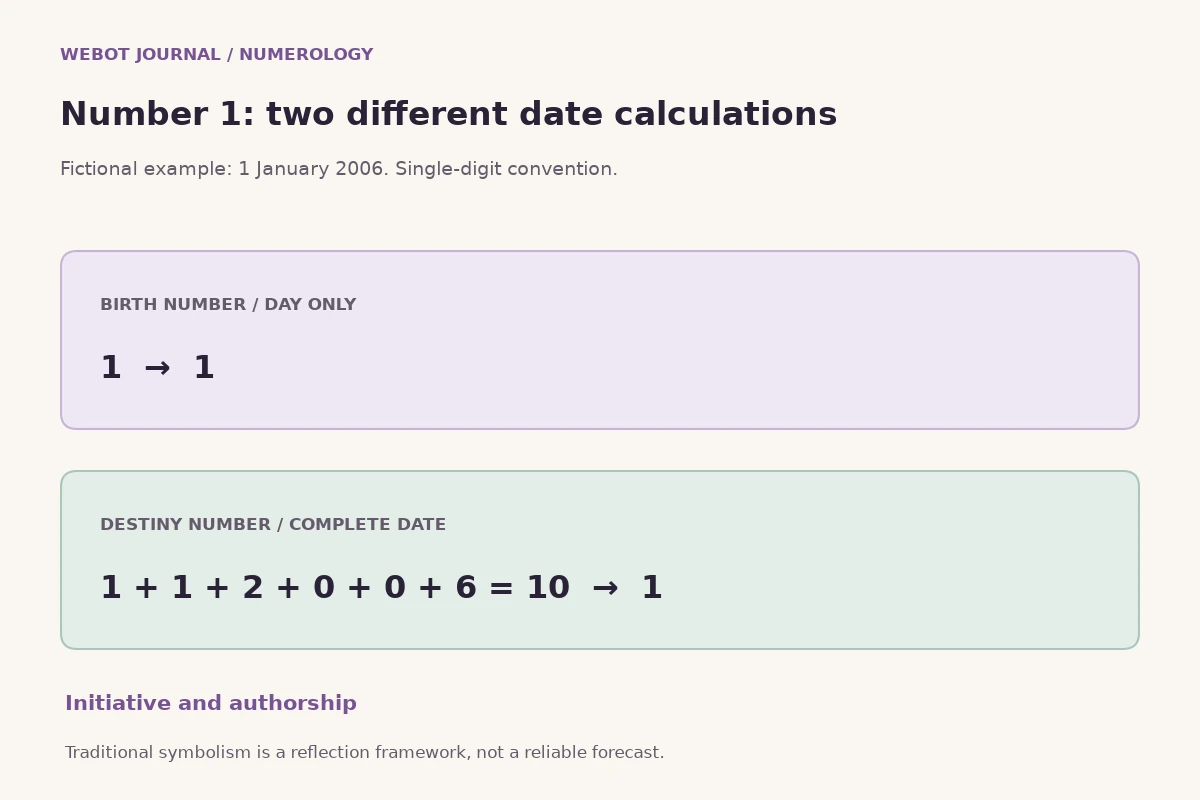
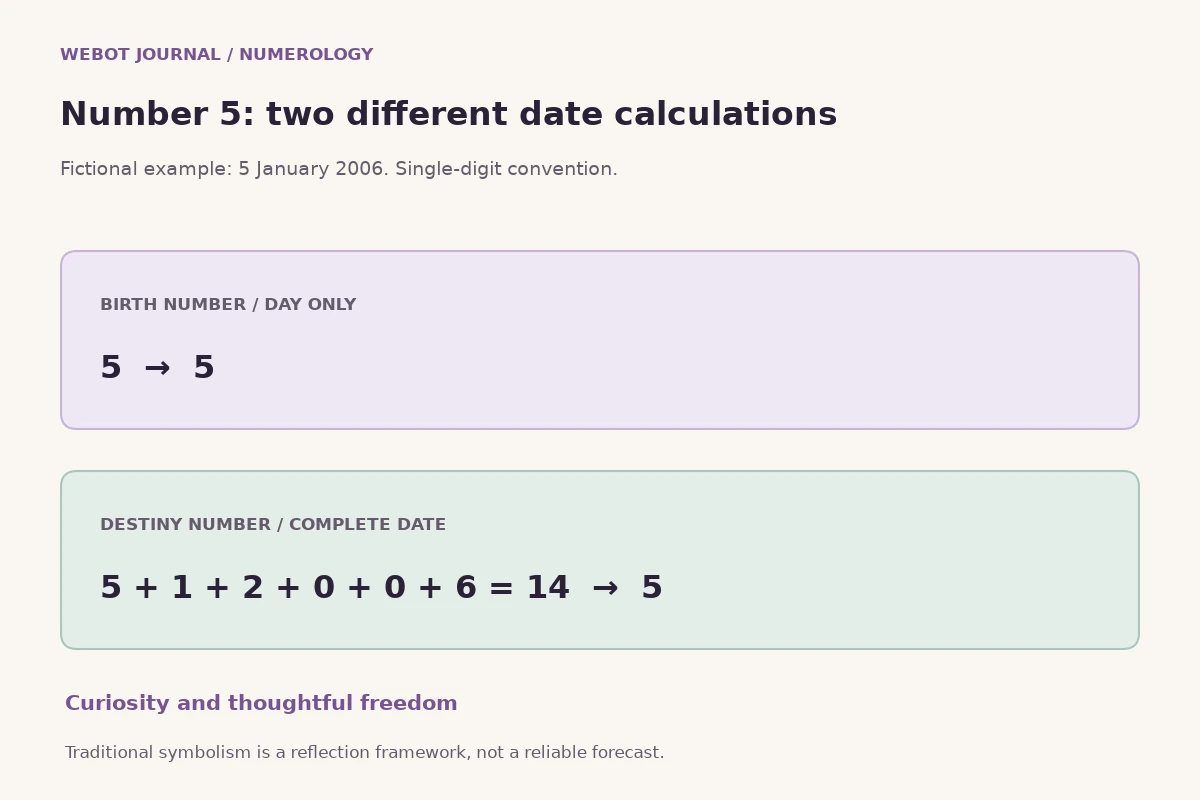
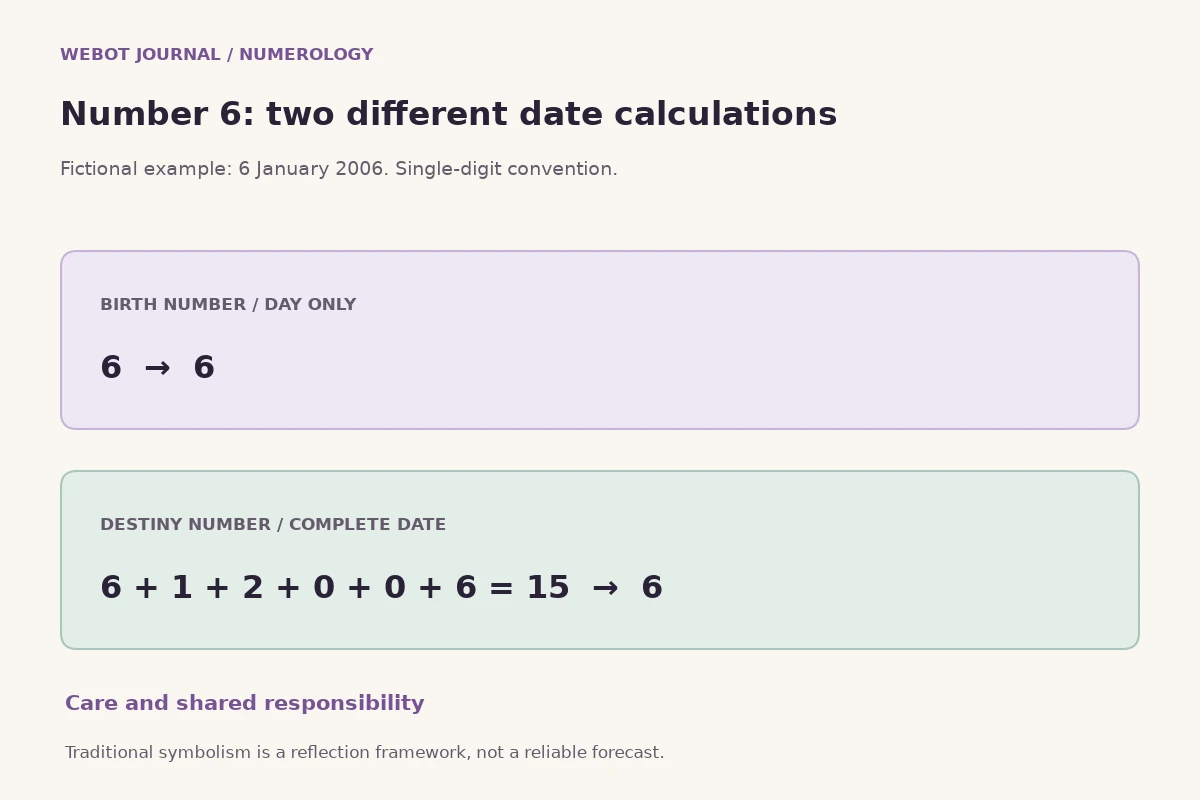
The birth number in this series is the day of birth reduced to one digit. In the Indian convention used here, it is called Mulank and is sometimes described as the psychic number. The destiny number, or Bhagyank, reduces all the digits in the complete birth date. A reader needs to know both the input and the reduction rule before comparing results.
This is a date-based system. It does not calculate a number from a person's name, and it reduces totals such as 11, 22 and 33 to a single digit. Other schools may preserve some totals or use destiny to mean a name-based expression number. Their vocabulary does not make this arithmetic interchangeable with theirs. State the method clearly and keep any symbolic interpretation separate from the calculation that produced the final digit.
2. Birthdays that reduce to 3
Under this convention, birth number 3 includes the 3rd, 12th, 21st and 30th of a month. Twelve becomes 1 plus 2; twenty-one becomes 2 plus 1; thirty becomes 3 plus 0. The day 3 needs no further reduction. Month and year are irrelevant to the birth-number result, though they will matter when calculating the complete-date value.
Record the original date as well as the reduced digit. The category does not erase the difference between being born on the 3rd and the 30th, and it certainly does not erase differences in education, experience or personality. Compound-number interpretations exist in some traditions, but they are additional readings. This guide focuses on the shared reduced value and does not present numerical membership as evidence that people must think or behave alike.
3. Calculate destiny number 3 with two fictional examples
For 3 January 2006, add 3 plus 1 plus 2 plus 0 plus 0 plus 6. The total is 12, and 1 plus 2 gives 3. This fictional example therefore has both birth and destiny number 3. Show the intermediate total rather than skipping straight to the answer; doing so makes the method easier to check and explain to someone else.
A contrasting date is 21 June 1990. The day reduces to 3, while the full date gives 2 plus 1 plus 6 plus 1 plus 9 plus 9 plus 0, or 28. Reduce 28 to 10, then to 1. The resulting pair is birth 3 and destiny 1. Neither example supplies a prediction. Their purpose is to show why the same birthday category can appear alongside different complete-date readings.
4. Jupiter and the traditional image of a teacher
In the Indian numerology account discussed by Sanatan Society, number 3 is associated with Jupiter. Learning, expansive expression and enthusiasm are prominent themes in that account. These correspondences belong to the tradition; they are not evidence that Jupiter determines the abilities of people whose dates reduce to 3. The cultural image should not be confused with an established causal explanation.
The image of a teacher offers an original way to reflect on the theme. Teaching is not merely possessing information or enjoying an audience. It involves selecting a useful starting point, noticing confusion and changing an explanation when necessary. Someone who likes the symbolism of 3 can ask whether their enthusiasm helps another person understand, or whether the pleasure of explaining has become more important than the listener's actual question.
5. Birth number 3 as the impulse to give an idea a voice
As a birth-number prompt, 3 can highlight an immediate wish to express, interpret or contribute. Imagine a group considering a community event. One person quickly gives the idea a memorable name and describes how it might feel to attend. Their contribution can make an abstract proposal easier to imagine, even though important practical questions remain unanswered.
If this example resonates, consider where your expression has helped others engage. Perhaps you explain a difficult concept, write a clear invitation or make a sketch that reveals a possibility. Also consider where the expression outran the substance. A persuasive description is not the same as a workable plan. A useful reading notices the relationship between the two rather than treating eloquence as proof that the idea behind it must be sound.
6. Destiny number 3 and the longer task of communicating responsibly
A destiny-number reading can use 3 as a recurring question about what you communicate and how you develop it. The emphasis need not be public attention. A carefully written guide, a patient explanation to a colleague or a thoughtful contribution to a family discussion can all involve meaningful expression. Visibility is one possible setting, not the definition of the theme.
The continuing challenge is to connect expression with responsibility. Can you correct an earlier explanation when you discover an error? Can you finish a piece of work after the first enthusiasm fades? Can you distinguish what you know from what you merely find attractive? These are practical questions for anyone. The number offers an optional organising image, not proof that a particular role has been assigned to you for life.
7. When both birth and destiny are 3
Matching results may be described within numerology as a repeated theme. For 3, explore whether the desire to express and the willingness to develop an expression support each other. Someone can enjoy sharing new ideas but find the revision process frustrating. Another person may speak little at first while gradually producing an unusually clear finished explanation. A repeated digit does not settle which pattern applies.
Choose a completed project and examine its stages. What generated the first interest? What did you remove, check or simplify? Whose feedback changed the result? This gives the reading more substance than a statement that you are naturally creative. The most informative evidence is the work itself. Repetition can invite closer reflection while leaving open the possibility that a description fits only part of your experience.
8. Different numbers can ask complementary questions
A birth number of 3 alongside destiny 1 might prompt a discussion about turning expression into an owned decision. Alongside destiny 2, the question could concern listening while speaking. Alongside destiny 8, it could concern the practical responsibility that supports a public promise. These are invented interpretive combinations, not a table that determines outcomes or ranks one pairing above another.
Return to the fictional 21 June 1990 example. A student could use expressive confidence to explain a project and then use the theme of initiative to take responsibility for finishing it. Equally, the student may find a completely different way to describe their experience. The calculation does not compel agreement with the story. Good reflective writing makes that freedom visible instead of interpreting every disagreement as hidden proof of the number.
9. Enthusiasm needs an accurate description of the work
Enthusiasm can help someone begin, especially when a task feels intimidating. It can also lead to promising a result before understanding the effort required. A person may sincerely believe that a large event can be arranged quickly, then discover that the invitation, venue, materials and follow-up each need separate attention. Optimism is helpful when it remains in conversation with those details.
One original exercise is to write two versions of a proposal: the inviting description and the practical description. The first explains why the idea matters; the second names what must happen for it to work. Compare them before making commitments. If the practical version is missing, the expressive work is not finished. This approach gives enthusiasm a useful structure without treating it as a fault or a guarantee.
10. Explanation begins with the reader's question
An explanation can be accurate yet answer the wrong question. Someone asks how to begin a task and receives a long history of the subject; another asks why a result changed and receives instructions they already understand. The difficulty is not necessarily a shortage of knowledge. It may be a failure to identify what the listener needs next.
For a number-3 reflection, try asking the listener what they already know and where the uncertainty begins. Give one relevant example before expanding. Then invite a question that could reveal whether the explanation helped. This practice values understanding over performance. It also allows a knowledgeable person to say that they do not yet know an answer, which is often more useful than supplying a fluent but unsupported response.
11. Creative range without abandoning every unfinished idea
Having several interests can enrich creative work. A visual idea may improve a written explanation; a musical rhythm may suggest the structure of a scene. The difficulty arises when every fresh possibility becomes a reason to abandon the work already underway. The person accumulates beginnings while rarely experiencing the decisions required to finish.
An original method is to keep a separate place for new ideas while giving the current project a limited, explicit finish line. A short article might be complete when one clear question is answered with an example and a revision. Completion does not require exploring every possible direction. Someone interested in the expressive symbolism of 3 can use that limit to protect curiosity while still producing work that another person can actually read or use.
12. Feedback is information about a piece of work
When expression feels personal, criticism of a draft can feel like criticism of the person who made it. A reader saying that a paragraph is unclear may be heard as saying that the writer has no ability. Those are different claims. Separating them makes it easier to decide what to change and what to retain.
Try asking for feedback on a particular question: where did the explanation become hard to follow, or which example felt least convincing? Specific feedback is easier to use than a general request for approval. You remain responsible for the final choice, including the choice not to adopt a suggestion. The point is not to become agreeable about everything. It is to let the work improve without making every revision a referendum on personal worth.
13. Teaching includes acknowledging the edge of your knowledge
A person who enjoys explaining may feel pressure to answer immediately. Yet an honest boundary can make an explanation more trustworthy. Saying that you understand one part but need to check another identifies what the listener can rely on. It also demonstrates a useful habit for anyone learning from you: uncertainty can be handled openly rather than hidden behind confident language.
Imagine a friend asking why a technical process failed. You can describe the steps you understand and identify the missing evidence before proposing a cause. That is a stronger contribution than inventing a convincing story. Within the teacher symbolism of 3, the important quality is care for understanding, not an obligation to appear knowledgeable about every subject brought into the conversation.
14. Work and study: expression must meet the actual requirements
Communication can matter in many fields, from explaining a design decision to preparing a handover or presenting research. Traditional numerology profiles may associate 3 with learning or public expression, but they do not establish a person's qualifications. Interests, demonstrated skills and the requirements of a role remain essential. A numerical label is not a method for choosing or awarding an opportunity.
For study, practise explaining a concept in more than one form: a short account, a worked example and a question that tests the reasoning. Notice which form exposes a gap in your own understanding. This is a practical use of the theme because it produces something you can evaluate. It does not predict marks or make a student naturally superior to someone with a different birthday.
15. Relationships need conversation beyond the performance of conversation
Being entertaining can make an interaction enjoyable, but a relationship also needs room for ordinary concerns, unfinished thoughts and silence. Someone may be good at telling stories while finding it harder to say that a plan disappointed them. The ability to hold attention and the ability to communicate a need are related only partly.
A reflective question for 3 is whether expression makes mutual understanding easier or helps avoid a more vulnerable subject. Try stating one preference plainly without turning it into a joke or a long explanation. Give the other person time to respond. The exercise does not assign a communication style from a number; it offers a way to examine a style you recognise in your own experience.
16. Compatibility as nine useful conversations
With number 1, discuss who turns an idea into a decision; with 2, how both people are heard; with 3, how conversation makes room for quieter concerns; with 4, how imagination meets a workable structure; with 5, how variety is balanced with continuity; with 6, how promises become care; with 7, how thinking time is respected; with 8, how public commitments are supported; and with 9, what purpose the expression serves.
These are original prompts, not compatibility scores. They do not establish whether a friendship, marriage or working partnership will succeed. People need to understand each other's conduct, circumstances and expectations directly. A seemingly favourable numerical match cannot excuse disregard, and an unfavourable label cannot prove that a relationship is unsuitable. The conversation matters because of what people actually learn from one another.
17. Promises should have a size and a finish line
A cheerful willingness to help can create more commitments than a person can honour. Saying yes may feel generous in the moment, but the other person may then rely on work that is never completed. The relevant question is not whether the promise was sincerely meant. It is whether its scope was understood and whether the person remained able to deliver it.
Before agreeing, describe the smallest clear contribution you can make. For example, offering to edit one page by Friday is different from offering to fix an entire website. If circumstances change, communicate early rather than waiting for the deadline to expose the problem. This is a practical way to connect the expressive theme with dependable action, without claiming that any number causes overcommitment.
18. Family stories and the responsibility of telling them
Families often have a person who tells the stories at gatherings. Those stories can preserve affection and shared memory, but they can also repeat an embarrassing incident long after the subject has stopped finding it funny. Enjoying an audience does not remove responsibility for how another person is represented. A familiar story can still deserve reconsideration.
Someone reflecting through 3 might ask whether everyone in a story would be comfortable hearing it told. Is a child being fixed in the role of the clumsy one? Is a relative's difficulty being reduced to a punchline? Choosing a different story can be a creative act. Expression becomes more thoughtful when its effect on the people described matters alongside the response of the audience.
19. Children can express themselves in many forms
A child who enjoys performing may also need opportunities to observe, make things privately or change interests. A child who speaks little may have a rich imaginative life expressed through drawing, building or careful questions. Numerology cannot determine which form of expression a child will prefer, and a label such as naturally gifted can create unnecessary pressure to perform.
If the tradition is part of family conversation, invite the child to interpret the symbol in their own way. They may connect 3 with three colours, three characters or something entirely unrelated to the adult profile. Keep the discussion playful and optional. Educational choices should respond to the child's actual interests and needs, not a prediction of talent inferred from the reduced date.
20. Traditional Thursday, yellow and gemstone associations
The Indian account used as a cultural reference associates 3 with Thursday, yellow and yellow sapphire or topaz. Such correspondences can be described without claiming that they improve luck, learning or financial outcomes. They are features of an interpretive tradition, not a requirement to purchase an object or arrange important decisions around a weekday.
A reader might enjoy using yellow in an artwork about the number, just as an illustrator chooses a colour to express a theme. That is a creative preference. It does not establish a protective or causal power. This guide does not prescribe gemstones, assess their suitability or promise benefits from wearing them. Understanding a symbolic association does not oblige anyone to adopt it.
21. The difference between inspiration and evidence
An inspiring account can make an idea feel true before it has been examined. A vivid personal anecdote may be memorable while leaving other explanations unconsidered. When discussing numerology, separate the feeling of recognition from evidence that the system predicts events. Recognising yourself in a description can be meaningful without establishing a universal law.
Try noting a passage that fits and a passage that does not. Also consider whether the useful advice could apply to someone with another number. This does not prevent enjoyment of the tradition. It makes the kind of claim clearer. A symbolic framework can support a creative conversation while remaining different from a tested account of personality or a reliable forecast.
22. A practical project for the expression theme
Choose something small you understand and prepare a short explanation for a specific reader. Define the question in one sentence, give a relevant example and remove one paragraph that does not help answer it. Ask the reader what they understood. Their response may reveal that a detail you considered obvious needed to be stated explicitly.
Revise once using that response. The finished piece might be a note, a diagram or a brief recording; it does not need a public audience. The exercise gives the expressive theme a tangible outcome and a way to learn. Its success is measured by whether the explanation became more useful, not by a claim that a birth number guaranteed a particular talent.
23. Frequently asked questions about number 3
Is everyone born on the 12th birth number 3? Under the single-digit day method used here, yes: 1 plus 2 equals 3. Does destiny number 3 require being born on one of the four listed days? No, because the complete date is a separate calculation. Does Jupiter symbolism mean a person must teach? No; the association does not prescribe a profession.
Can an introverted person use this reading? Yes, expression does not require enjoying public attention. Does a repeated 3 guarantee creativity or success? No. Is Thursday the only suitable day for an important activity? This guide makes no such claim. Do colour or gemstone associations need to be followed? No; they are optional cultural correspondences rather than requirements.
24. Let expression become clearer through practice
Number 3 can be an engaging image for the movement from an idea to an explanation someone else can understand. The constructive questions concern attention, accuracy, revision and follow-through. Those questions remain useful even when a reader decides that the numerical label does not describe them. No date calculation replaces the experience of making and improving actual work.
Keep a clear distinction between the arithmetic you checked, the tradition you consulted and the personal meaning you chose. That distinction allows curiosity without surrendering judgment. If the reading encourages one clearer explanation or one more dependable promise, it has supported a practical reflection. It does not need to become a prediction, a fixed identity or a limit on what you can learn next.
Sources and further reading
Explore Astrology
Explore traditional numerology, dream symbolism, head-to-toe Til Vichar and home Vastu, with practical explanations and a clear distinction between belief, reflection and evidence.
Explore Astrology