Numerology
Numerology Number 6: Birth Number, Destiny Number and Care with Balance
A welcoming room is more than an attractive room. Someone has thought about where people will sit, what they may need and whether they will feel able to participate. Number 6 in numerology is often described through care, home, beauty and responsibility. These themes connect because they concern the experience of others, but they also raise a question: how does care remain generous without becoming an obligation to organise everyone else's life?
This guide explores number 6 as a birth number and as a complete-date destiny number using a stated Indian date convention. It includes worked calculations, traditional Venus symbolism, relationships, creativity, home life and original practical situations. Numerology is a cultural interpretation, not a reliable way to diagnose character or forecast events. The examples invite reflection while leaving decisions with the person and the real circumstances involved.
1. The two calculations use different information
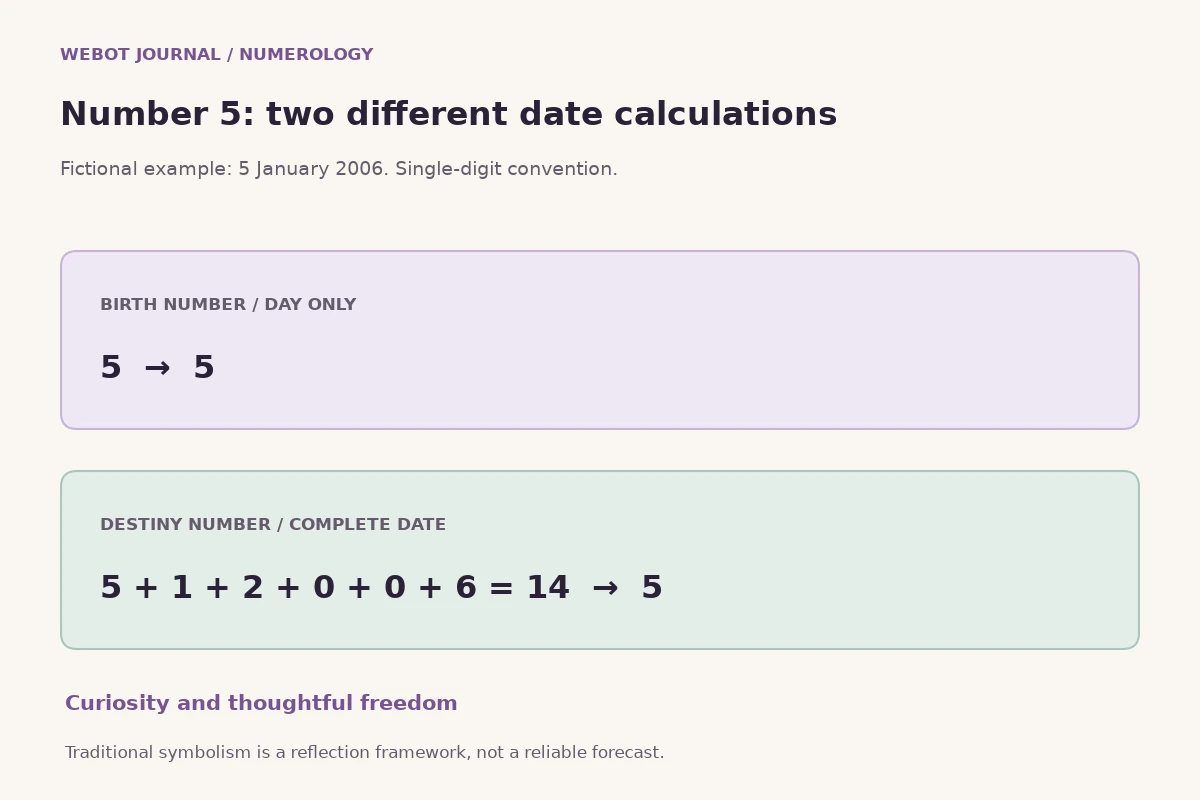
The birth number, or Mulank, reduces the day of birth to one digit. The destiny number, or Bhagyank in this series, reduces all digits in the full birth date. A person therefore needs two separate sums, even if the final answers happen to match. Neither number measures kindness, ability or the value of someone's contribution to a family.
Numerology terms vary between traditions. Some sources use destiny for a number derived from a name, and some retain master totals. This series uses a single-digit date method consistently. Explain the convention when sharing an example so that a difference in vocabulary is not mistaken for a mathematical contradiction. This guide does not calculate names, require birth time or turn the result into a horoscope.
2. Birth number 6 includes the 6th, 15th and 24th
The calendar days that reduce to 6 are 6, 15 and 24. Fifteen gives 1 plus 5; twenty-four gives 2 plus 4. Six already has one digit. The month and year do not affect this day-based result, though they will enter the separate destiny-number calculation. Writing the steps makes the method clear for someone encountering numerology for the first time.
Keep the original day beside the reduced value. Shared membership in the category does not establish that people have identical preferences, relationships or responsibilities. Some practitioners discuss compound numbers as an additional layer, but this article focuses on the reduced digit. The result identifies a place within the chosen symbolic system rather than a complete description of the person whose date supplied it.
3. Calculate destiny number 6 step by step
For the fictional date 6 January 2006, the digits add to 6 plus 1 plus 2 plus 0 plus 0 plus 6, or 15. Reducing 15 gives 6. Both birth and destiny number are therefore 6 in this example. Include the intermediate total so the calculation can be checked without relying on the confidence of the person presenting it.
A different date, 24 February 1990, gives birth number 6 while the complete date adds to 2 plus 4 plus 2 plus 1 plus 9 plus 9 plus 0, or 27. Twenty-seven reduces to 9. The pair is birth 6 and destiny 9 under this method. The arithmetic demonstrates why the two readings can differ; it does not predict that anyone born on the example date will follow a particular life pattern.
4. Venus in the traditional symbolic account
The Indian numerology account used as a reference associates number 6 with Venus. Care, beauty, comfort and relationships are prominent themes in that account. They are traditional correspondences rather than an established explanation of personality. The astronomical planet and its cultural use as a symbol should not be treated as interchangeable kinds of evidence.
One original way to explore the image is through the difference between appearance and experience. A beautifully arranged event may still leave participants confused, while a simple gathering can feel thoughtful because people know what is happening and feel welcome. Someone reflecting through 6 can ask whether their care reaches the actual needs of others or remains focused on how the result looks from outside.
5. Birth number 6 and the impulse to make something comfortable
As a birth-number prompt, 6 can highlight an immediate response to another person's discomfort. Perhaps you notice that someone needs a clearer explanation, a place to sit or a chance to speak. The constructive feature is attention followed by appropriate action. It is not an automatic ability to know what someone needs without asking.
Imagine a newcomer arriving at a group activity. One person introduces them, explains the plan and checks whether they have the necessary materials. That small intervention can make participation easier. If the caring theme resonates, identify the specific act rather than assuming a permanent role as everyone's caretaker. A thoughtful response can be modest, and it can respect the other person's ability to decide what help they want.
6. Destiny number 6 and dependable care over time
A complete-date reading can frame 6 as a continuing question about responsibility. Dependable care is not always dramatic. It may involve remembering an agreement, communicating a change or completing a small task before someone else has to ask again. The theme concerns consistency as much as warmth.
A useful reflective question is whether the care can be sustained under ordinary conditions. An elaborate gesture may be enjoyable, but a simpler arrangement maintained reliably could be more helpful. Consider what the recipient actually values. The numerology interpretation offers a way to examine the pattern; it does not assign an unavoidable duty to support everyone or establish that a person with another number is less capable of care.
7. When birth and destiny both reduce to 6
Matching values may be described as emphasis on a theme. For 6, explore whether the immediate wish to help and the longer responsibilities you accept remain in balance. A person may be quick to notice a need while finding it difficult to share the work. Another may be reliable in practical matters but less comfortable expressing affection. Repetition does not determine either pattern.
Look at a recent shared responsibility. Who noticed it, who planned it and who completed it? Did everyone agree about what was needed? These questions provide a fuller picture than a label such as naturally nurturing. A repeated number can prompt more detailed reflection while leaving room for mixed evidence and for the possibility that some parts of the description do not fit.
8. Combining birth 6 with another destiny number
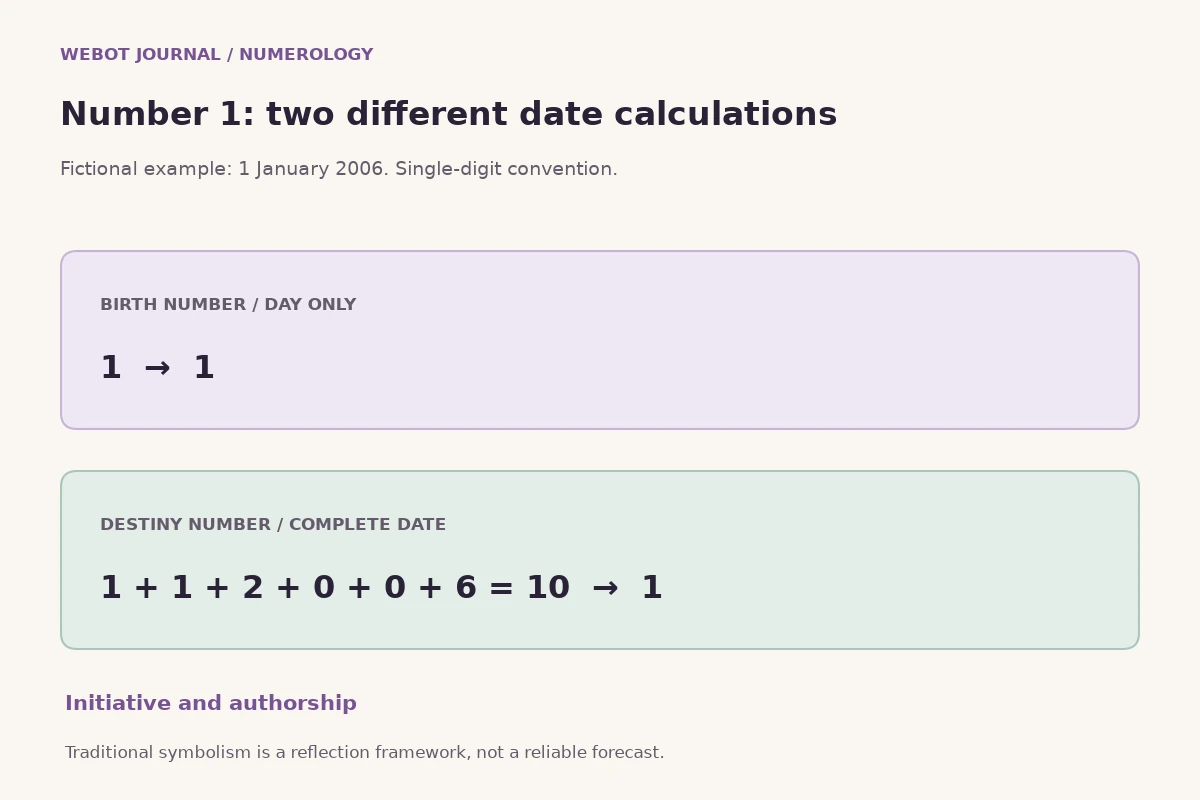
A birth-6 reading can be discussed alongside another complete-date result as a pair of questions. With destiny 1, ask how care includes a clear personal choice. With destiny 5, consider how responsibility leaves room for exploration. With destiny 9, ask how concern for a close circle relates to a wider purpose. These are original prompts rather than rules predicting a person's future.
The fictional 24 February 1990 example gives birth 6 and destiny 9. Imagine someone organising a neighbourhood event who wants both the volunteers and the visitors to have a good experience. The useful task is to clarify what each group needs, not assume that a generous intention solves every practical problem. The date does not establish the person's motives or guarantee that their plan will work.
9. Help begins with understanding the request
It is possible to offer help that creates more work. Someone reorganises a friend's materials without asking, replaces a working routine or makes a decision that the other person wanted to make independently. The intention may be caring, but the recipient experiences a loss of control. A useful response begins by checking what would actually help.
Try asking whether the person wants practical assistance, suggestions or simply time to explain. If they decline, respect that answer unless a different responsibility clearly applies. Someone exploring the theme of 6 can examine how they receive a refusal. Care does not become less meaningful because it is not accepted, and the recipient does not owe agreement merely because the offer was well intended.
10. Responsibility and control are different
Taking responsibility for a shared task does not mean deciding every detail for everyone else. A person can coordinate while still asking for preferences and explaining limits. Control becomes a concern when others are expected to accept an arrangement mainly because the organiser has worked hard on it.
Imagine preparing a celebration. You may enjoy making it special, but the person being celebrated may prefer something quieter. The thoughtful choice is to discuss what they want before building an elaborate plan. A number-6 reflection can focus on the difference between care for the recipient and attachment to your own idea of caring. That distinction is practical and does not require a claim that the number causes either behaviour.
11. Shared work should include the planning work
Some responsibilities are visible only when they are missed. Remembering supplies, anticipating a schedule conflict or arranging a handover can take effort before the obvious task begins. If one person always performs that preparation, the work may look evenly shared while feeling uneven to the people involved.
A useful exercise is to list the stages of a recurring task, including noticing, planning, doing and checking. Discuss ownership of the whole task rather than only the final action. This makes the arrangement easier to review. The caring symbolism of 6 can be used to ask for fairness as well as generosity. It should not become a reason why one person silently carries every detail because they are supposedly the responsible one.
12. Beauty can support use instead of competing with it
A pleasing environment can make an activity enjoyable, but decoration should not obstruct its purpose. A beautiful sign with unreadable text fails the person trying to find a room. An elegant seating plan may be awkward if people cannot move comfortably. Thoughtful design brings appearance into a relationship with the people who will use it.
Choose one small item you have arranged and ask another person to use it without guidance. Notice whether they understand what to do. Their response may reveal a simple improvement that matters more than another decorative detail. This is an original practical application of the beauty theme. It does not imply that number 6 guarantees artistic taste or that one person's preferred appearance is universally correct.
13. Comfort does not have to become excess
Comfort can mean a quiet place, clear information or materials that work reliably. It need not mean the most elaborate or expensive version of an experience. When appearance becomes a way to prove care, a person may feel that an ordinary thoughtful gesture is never enough. The recipient may not share that expectation.
Before improving something, ask what difference the improvement would make to the person using it. A better reading lamp might matter more than an ornamental object; a clear invitation might matter more than complex packaging. This keeps attention on purpose. The reflection does not offer financial advice or use numerology to assess a purchase. It simply separates the experience you hope to create from the assumption that more elaborate always means more caring.
14. Relationships need care that can travel in both directions
A person may be comfortable providing support and uncomfortable receiving it. They become the organiser, listener or problem solver while rarely stating their own needs. Over time, the arrangement can make mutual understanding harder. Others may not realise support is wanted because the person has become skilled at appearing self-sufficient.
An original exercise is to make one modest, clear request in a relationship where doing so is appropriate. Ask for help with a defined task or explain a preference before a shared plan is settled. Notice whether the request can be discussed openly. A number-6 reading should allow this reciprocity. Being associated with care does not mean being expected to need nothing from the people around you.
15. Affection should not depend on fixing everything
It can be difficult to remain present when someone has a problem you cannot solve. Offering one more suggestion may feel easier than acknowledging that the situation is uncertain. Yet companionship can have value without an immediate solution. The person may need to be heard rather than managed.
Ask what kind of support would be welcome and be honest about what you can provide. Do not promise a result simply to make the moment feel less uncomfortable. Within the symbolism of 6, care can include patience with limits. A birth date does not establish that someone must rescue another person or that failure to fix a difficult situation proves a lack of love.
16. Compatibility conversations with numbers 1 through 9
With 1, discuss autonomy within care; with 2, how needs are expressed; with 3, whether promises match practical support; with 4, how routines remain welcoming; with 5, how freedom fits shared commitments; with 6, how two caregivers share rather than compete; with 7, how privacy is respected; with 8, how responsibility is distributed; and with 9, how concern for others includes the immediate relationship.
These prompts are an original framework for conversation, not a compatibility test. Numerical agreement cannot establish trust or justify ignoring a serious concern. Numerical difference cannot prove that a friendship, marriage or partnership is unsuitable. People need to examine actual behaviour, consent, expectations and circumstances. A useful reading leaves those judgments where they belong rather than presenting a date calculation as authority over them.
17. Work themes without prescribing a profession
Traditional descriptions may connect 6 with care, art or creating comfortable environments. Those themes can appear in many activities, but they do not assess professional ability. A person requires the relevant skills and qualifications for a role, and their date is not evidence of suitability. Do not use a numerology category to make decisions about someone's employment or education.
Instead, reflect on a completed task. Did you make instructions easier to understand, improve a design for its users or help a team manage a responsibility fairly? Describe the contribution and the evidence that it helped. This turns a broad theme into something concrete. The reflection can inform a personal conversation about interests while remaining separate from any claim that a particular profession is destined.
18. Study and the temptation to do another person's work
Helping someone learn is different from completing the task for them. An immediate answer can remove frustration while also removing the opportunity to understand the process. A supportive response may involve a question, a smaller example or time to think rather than a finished solution.
Imagine studying with a friend who is stuck. Ask them to describe the last step they understood, then work from that point. Let them explain the next step in their own words. This is an original application of care that preserves the learner's participation. It does not predict academic ability from number 6. The important evidence is whether the person becomes more able to work independently after the exchange.
19. Home is an experience shared by different people
A home can be meaningful without resembling a single ideal. People may differ about noise, visitors, decoration, privacy and daily routines. The person who enjoys arranging the space does not automatically represent everyone's preferences. A welcoming home leaves room to discuss those differences rather than treating one person's taste as the measure of care.
Choose one shared area and ask what each user needs from it. The answers may suggest a practical division, such as a quiet period or separate storage, rather than a complete redesign. The symbolism of 6 can help frame the conversation around experience. It should not create a rule that a person must marry, become a parent or maintain a particular kind of household to live meaningfully.
20. Children should not become the family caretaker
A child who is considerate may receive praise for being unusually responsible, then be expected to manage situations that belong to adults. Numerology should not reinforce that pressure by declaring the child born to care for everyone. Kindness can be appreciated without assigning an adult role or making affection depend on constant helpfulness.
Allow a child to have preferences, make mistakes and ask for support. If number symbolism is part of family tradition, discuss it as an optional story rather than a duty. A child may enjoy caring for a plant or making a welcome card while also needing time for unrelated interests. Their actual needs and development should guide expectations, not a reduced date used as a permanent description.
21. Traditional Friday, silver and diamond associations
The Indian reference account links 6 with Friday, silver and diamond through its Venus symbolism. These correspondences can be presented as cultural information without claiming that they change outcomes. Readers do not need to buy jewellery or arrange significant decisions around a weekday in order to understand the symbolic framework.
A designer might use a silver accent in an illustration about 6, while another reader might find the colour association uninteresting. Both responses are compatible with understanding the tradition. This guide does not prescribe gemstones, promise protection or evaluate a purchase. Aesthetic preference and personal meaning remain different from evidence about what will happen in a relationship, career or future event.
22. A practical exercise in balanced care
Choose one recurring responsibility that has begun to feel heavier than expected. Write what the task includes, who benefits and which parts you have agreed to own. Separate an explicit agreement from an assumption that developed because you happened to do the task several times. That distinction may reveal a useful conversation to have.
Propose one clear adjustment, such as sharing a preparation step or simplifying an unnecessary detail. Explain the purpose and invite the affected people to respond. Judge the change by whether the responsibility becomes clearer and more workable. This is an original reflection exercise available to anyone, not a ritual for changing a number. Its value depends on the actual agreement people create.
23. Frequently asked questions about number 6
Are people born on the 15th and 24th both birth number 6? Yes, using the stated single-digit day method. Can a person have destiny 6 with another birth number? Yes, because the complete-date calculation is separate. Does Venus symbolism establish artistic talent? No; ability and preference must be understood through actual experience and practice.
Does 6 require marriage or parenthood? No. Is providing care always the person's responsibility? No; responsibilities need appropriate agreements. Are two number-6 people automatically compatible? No. Is diamond necessary for a favourable reading? This guide prescribes no purchase. Does a caring description excuse controlling behaviour? No; the actual effect on the other person matters more than the label attached to the intention.
24. Let care remain considerate of everyone involved
Number 6 can be a useful image for care that includes practical thought, aesthetic attention and dependable effort. Its strongest reflective questions concern balance: what is wanted, what is agreed, what can be sustained and whose needs remain unheard? Those questions allow care to be generous without making self-erasure or control part of its definition.
Keep checked arithmetic separate from traditional symbolism and from your own interpretation. A person is not required to agree with every description or organise a life around the number. If the reading helps make one responsibility fairer or one environment more welcoming, it has supported a practical insight. It does not need to become a forecast or a fixed obligation in order to have meaning.
Sources and further reading
Explore Astrology
Explore traditional numerology, dream symbolism, head-to-toe Til Vichar and home Vastu, with practical explanations and a clear distinction between belief, reflection and evidence.
Explore Astrology