Relativity
Black Holes Explained: Horizons, Light and What We Can Actually Know
A black hole is a region of spacetime from which signals cannot reach the distant outside once they pass the event horizon. It is not an empty tunnel, a universal vacuum cleaner or a confirmed gateway to another universe. Its defining feature is a causal boundary. Understanding that boundary makes many other questions easier: why the surrounding gas can shine, why a dark central region appears in an image and why an infalling clock need not stop at the horizon.
This guide introduces the simplest useful model, then separates that model from rotating astrophysical objects and unresolved quantum questions. Black hole geometry is primarily a subject of general relativity. Quantum physics becomes especially important in questions about radiation, information and the limits of the classical description. Those connections are fascinating, but they are not permission to treat every speculative idea as an established observation.
1. Start with a region, not a mysterious material
Ordinary objects can be classified by their material composition: a rock, a cloud of gas or a metal sphere. A black hole is identified differently. Its defining description concerns which events can communicate with the outside. The event horizon marks the boundary of the region whose future-directed light signals cannot escape to distant observers. That is a statement about spacetime and causality, not a label for a newly discovered substance.
The boundary is also not a solid surface like the ground beneath your feet. In an idealised large black hole, an observer falling freely through the horizon need not encounter a material wall at that location. This does not mean that the overall journey is harmless. Tidal forces, surrounding radiation and the inability to return are separate physical issues, and they depend on the object and the chosen trajectory.
Thinking in terms of a region helps prevent a common mistake: imagining that the horizon is simply where a powerful force grabs photons by their rest mass. Photons have no rest mass, but their propagation follows spacetime geometry. Inside the relevant boundary, future-directed routes do not lead back to the distant exterior. The full relativistic description is deeper than an ordinary object pulling harder on a tiny classical ball.
2. Explain escape speed carefully
A familiar introduction compares a black hole with an object whose escape speed exceeds the speed of light. That analogy can suggest why a sufficiently compact mass is unusual. In Newtonian mechanics, escape speed is calculated from the mass and the starting distance. Equating that expression with light speed happens to produce the same radius as the horizon of the simplest relativistic black hole model.
The agreement is useful, but the Newtonian argument is not the complete explanation. Light is not a projectile that slows to a stop, turns around and falls back in the ordinary way. General relativity describes the allowed paths of light and matter through spacetime. The event horizon is a causal boundary within that geometry. The simple escape-speed picture should therefore be introduced as a motivation, not as a substitute for the theory.
This distinction matters when asking whether an extraordinarily powerful rocket could escape after crossing. The issue is not merely that current engines are too weak. In the classical black hole geometry, no future-directed timelike or lightlike path from inside the horizon reaches the distant exterior. A more powerful engine does not supply the missing causal route. Any proposal that changes this conclusion must specify physics beyond the ordinary model.
3. Distinguish collapse from a photograph of collapse
One important route to a black hole involves the collapse of the core of a sufficiently massive star. The details depend on stellar evolution and the state of the collapsing material. Not every star ends as a black hole, and not every black hole formation scenario is the same. Supermassive black holes raise additional questions about growth, mergers and early formation that should not be reduced to a single simple recipe.
The physical collapse and the signals received far away are different descriptions. Light emitted from material approaching a horizon can arrive increasingly redshifted and delayed. A distant observer's received image does not need to show a brightly visible object sitting forever at the boundary. The signal can become so weak and stretched that it is no longer observable in practice.
Avoid reasoning that combines the distant appearance with the infalling material's proper time and then declares collapse impossible. Coordinates and signal reception have to be handled consistently. General relativity supplies models of horizon formation and infall, while observations test the external consequences. A cartoon of an object freezing on a screen is not, by itself, a complete argument about the entire spacetime of a collapsing star.
4. Use the Schwarzschild radius as a model calculation
The simplest standard example is an isolated, nonrotating, electrically uncharged black hole. Its horizon radius is called the Schwarzschild radius. The expression depends on the mass, the gravitational constant and the vacuum speed of light. Doubling the mass doubles this radius in the model. It is a useful first scale because it connects an abstract causal boundary with a distance that can be calculated.
For one solar mass, the Schwarzschild radius is approximately three kilometres. That does not mean the Sun is currently a black hole: its actual radius is vastly larger. The comparison says how compact that same mass would have to be in this idealised model. Similarly, quoting an Earth-mass horizon size is a hypothetical compactness calculation, not evidence that an ordinary planet already contains such a horizon.
Do not use the formula as a claim that every observed black hole is nonrotating or that every radius in a rotating geometry means the same thing. Astrophysical black holes can rotate, and the geometry then has additional structure. The simple calculation is valuable because its assumptions are explicit. Start there, understand its boundaries and then ask which extra features are required for a particular astronomical system.
r_s = 2 G M / c^25. Why mass does not make a cosmic vacuum cleaner
From a large distance, a compact object's gravitational influence is governed mainly by its mass and other relevant large-scale properties. Becoming a black hole does not create an unlimited suction effect throughout the universe. In a simplified thought experiment, replacing the Sun with a black hole of the same mass would not suddenly pull every planet inward merely because a horizon had formed.
That thought experiment changes many other conditions: there would no longer be the Sun's ordinary light and heat, and real formation could involve mass loss or disturbance. Its purpose is only to isolate the gravitational misconception. At sufficiently large distances, the same central mass does not acquire a magical new attraction. Existing orbital motion still matters, and a suitable trajectory can pass a black hole without falling into it.
Close approaches are a different problem. The geometry becomes strongly relativistic, stable orbits have limits and tidal effects can be severe. Distinguish this local strong-field behaviour from the claim that a black hole indiscriminately eats everything nearby. The actual fate of surrounding material depends on its motion, interactions and environment. Matter often has to shed energy and angular momentum before it can move inward through an accretion flow.
6. Separate the horizon, photon sphere and shadow
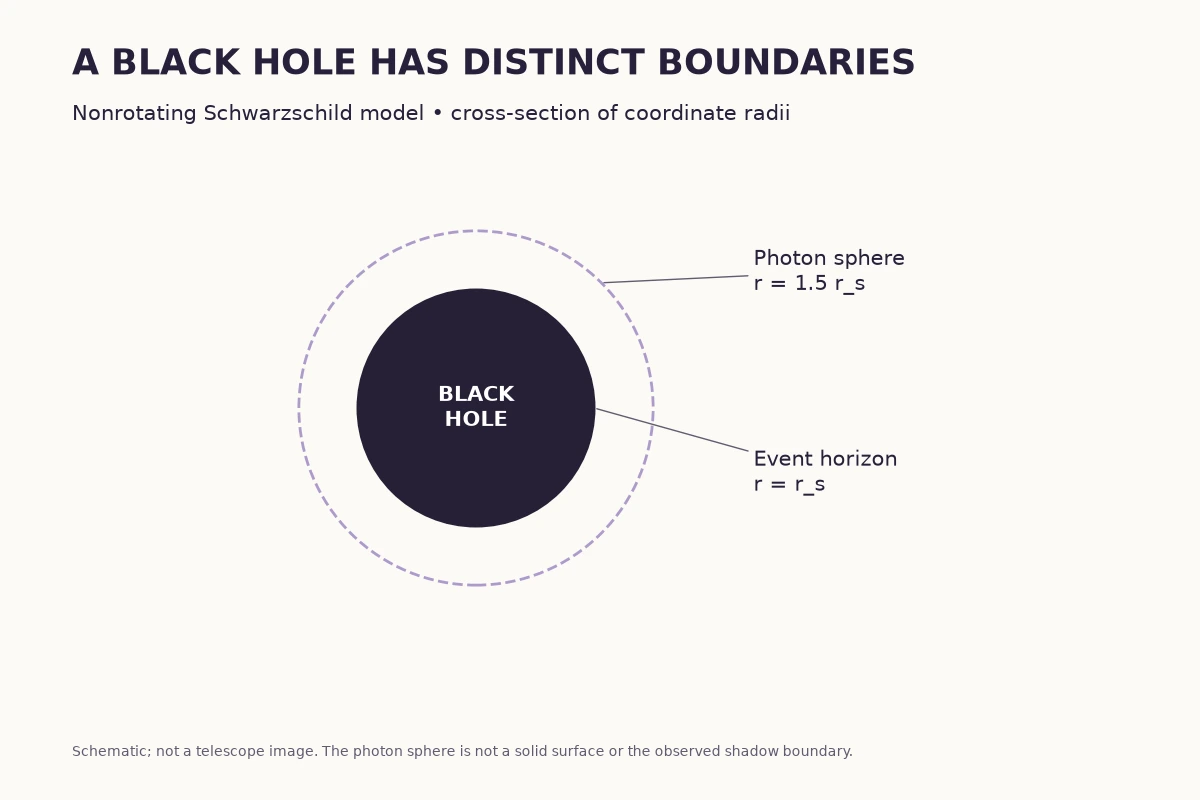
Several different boundaries or structures can appear in a black hole explanation. The event horizon is the causal boundary. In the simple Schwarzschild model, the photon sphere lies outside it and contains unstable circular light paths. A small disturbance changes such a path, so this is not a safe racetrack where a beam can be parked indefinitely without further qualification.
The apparent dark region in an image is another concept. Light rays reaching the observer have been bent, captured or emitted by surrounding material. The resulting shadow can look larger than a simple drawing of the horizon. Its appearance depends on the geometry, the emitting matter, the observer and the imaging process. A bright ring around a dark region is not a photograph of a solid horizon surface.
Our diagram distinguishes these ideas schematically and is not an observed telescope image. In real interpretation, astronomers model both the spacetime and the emitting plasma. That modelling is necessary because an image combines geometry with a particular source of light. Treating the shadow, photon sphere, accretion disk and event horizon as four names for the same visible circle obscures the physics that makes the observation informative.
r_photon = 3 G M / c^2 = 1.5 r_s7. Understand why the surroundings can be bright
The black hole region does not send ordinary light outward from inside its horizon. Surrounding material can nevertheless shine intensely before crossing. Gas moving in an accretion flow heats through processes involving its motion, interactions and magnetic environment. The radiation comes from that exterior material. There is no contradiction between a dark causal region and a bright neighbourhood.
The word disk is a useful description of many flows, but an actual accretion environment is not necessarily a thin, smooth, perfectly uniform ring. Its thickness, temperature and structure depend on the physical situation. Some black holes have very little nearby emitting material and are difficult to detect. A dramatic luminous disk is not a compulsory accessory supplied by every black hole.
Viewing geometry also matters. Light from parts of the flow behind the black hole can be redirected toward the observer, producing unfamiliar-looking shapes. Relativistic motion can make one side appear different from the other. An educational illustration may exaggerate these features for clarity. The scientific task is to connect an observed signal with a justified physical model, rather than assuming every striking artistic rendering is a direct view of nature.
8. Keep jets outside the event horizon
Some accreting black hole systems produce narrow, powerful jets extending far beyond the immediate environment. The important point for a beginner is where the outgoing material is launched: it does not first escape from inside the event horizon. The central black hole, surrounding plasma and magnetic fields form an interacting system, and the relevant outward flow originates outside the causal boundary.
A drawing can make the jet appear to emerge from the middle of a dark circle. That is a limitation of a projected illustration. It should not be read as evidence that the horizon permits ordinary matter to shoot outward from the interior. The physics of jet formation is a detailed research topic, and simplified diagrams need captions that distinguish a geometric centre in the picture from an actual launch location.
Not all black holes produce obvious jets, and not every bright astronomical jet has an identical physical configuration. Avoid turning one characteristic image into a universal checklist. When reading a claim about a jet, ask which system is being observed, what wavelengths are measured and which physical model is proposed. The existence of an outward jet does not cancel the causal meaning of the event horizon.
9. Describe tidal forces rather than saying gravity is strong
Tidal forces describe differences in gravitational influence across an extended object. If the near side and far side of a body tend to follow significantly different paths, the body can be stretched or squeezed. This is more informative than treating gravity as one number at a location. The gradients matter when discussing whether an object can remain intact during a close approach.
For comparable positions measured relative to their horizon sizes, more massive black holes can have weaker horizon-scale tidal effects than small ones. The horizon radius grows with mass, and that changes the relevant gradient. Consequently, crossing the horizon of an idealised supermassive black hole need not involve the same immediate tidal disruption as crossing near a much smaller black hole.
That observation is not a safety recommendation. A real system may contain intense radiation, rapidly moving matter and other hazards long before an observer reaches the horizon. Once inside, the ordinary classical geometry does not provide a return route. Distinguish the statement that a boundary need not be locally marked by a fatal tidal jump from the much stronger, unsupported claim that a black hole journey would be harmless or reversible.
10. Ask how astronomers infer a dark object
An invisible object can be studied through its effects. The motion of surrounding stars or gas can constrain the mass concentrated in a region. Radiation from nearby material can reveal rapid motion and a compact environment. These measurements are interpreted through models and assessed against competing explanations. They do not require ordinary light to have travelled from the hidden interior.
Gravitational waves offer another route. A changing, compact binary system can produce a signal whose pattern carries information about the source. Observations of merger signals are compared with relativistic predictions, including the later behaviour of the remnant. The strength of the case comes from quantitative agreement and the consistency of different kinds of evidence, not merely from a dramatic name attached to an event.
A useful reading habit is to separate measurement, model and inference. The measurement may be a spectrum, stellar position, interference visibility or detector time series. The model translates that information into physical parameters. The inference concerns the kind of object consistent with the observations. Good science makes those steps visible and states uncertainty. It does not claim that every property of an inaccessible interior has been directly photographed.
11. Interpret black hole images as scientific reconstructions
A black hole image is not produced in the same way as a close-up phone photograph. Instruments collect signals, and an analysis reconstructs a representation of the source under explicit assumptions and observational limits. Understanding that process does not diminish the result. It explains what the image can establish and which features require careful modelling.
The ring-like emission and darker central region constrain the compact object and its surroundings. They are evidence about light propagation and emitting matter close to the object, rather than a view through the horizon. The colour used in a published presentation may also be a display choice for data taken at wavelengths outside ordinary visible vision. Read the observation's description instead of treating every colour as a natural visual appearance.
Our educational diagrams deliberately avoid pretending to be such observations. They are schematic aids for learning the vocabulary. A useful diagram can clearly label the horizon and photon sphere, while a real observation tests whether a particular source behaves as predicted. Confusing those roles makes both the diagram and the evidence harder to interpret. Look for source attribution, wavelength information and a clear statement of how an image was produced.
12. Explain the singularity without claiming certainty about infinity
Classical general relativity predicts singular behaviour in familiar black hole solutions. Roughly speaking, the mathematical description reaches a limit where continuing ordinary physical interpretation becomes problematic. It is common to summarise this as an infinitely dense centre. That phrase should not be presented as a direct observation of a tiny physical object whose material properties have already been measured.
The singularity is one reason physicists expect a more complete account of gravity and quantum physics to matter in extreme conditions. Different theoretical approaches explore possible resolutions, but the existence of an open problem does not validate any particular replacement story. We do not have observational access to the hidden interior that would let a popular illustration settle the question.
Keep two levels of knowledge separate. General relativity can make highly successful predictions about the exterior and many aspects of black hole dynamics, while still having an unresolved limitation in an extreme regime. A theory need not explain every conceivable condition to be useful in its tested domain. Equally, success outside the horizon is not proof that every extrapolation to a singular centre is the final physical description.
13. Place Hawking radiation and information in their proper category
Quantum field theory applied to black hole backgrounds leads to the prediction called Hawking radiation. It is not ordinary radiation emitted by hot material in an accretion disk. Nor is the best explanation a literal photograph of particles springing out from inside the horizon. Popular paired-particle stories can be suggestive, but they are limited illustrations of a more careful calculation.
For astrophysical black holes, this predicted radiation is extremely weak and has not been established as a direct detection of their evaporation. Laboratory analogues can investigate related physical ideas, but an analogue system is not an astronomical black hole with every property of the original problem. Distinguish the prediction, the analogue and the observational claim before deciding what an experiment has demonstrated.
The information problem asks how the evaporation description fits with quantum principles about the evolution of states. There are important theoretical proposals and continuing debates. A beginner's guide should acknowledge that work without pretending to deliver an experimentally confirmed final answer. Black holes connect established relativity with profound quantum questions; their importance comes partly from showing where our otherwise successful descriptions need a deeper synthesis.
14. Keep wormholes and warp travel separate from black holes
A black hole is not automatically a traversable wormhole. Mathematical spacetimes can contain structures with unfamiliar global properties, but a mathematical extension is not a demonstration that a realistic collapsing star creates a safe transport tunnel. Conditions, stability and physical realisability matter. An ordinary black hole observation does not establish travel between distant locations or different universes.
Similar caution applies to claims about time travel. Strong gravitational timing differences can be analysed within relativity, yet they do not by themselves provide a round trip into an already observed past. A proposed device needs a complete physical argument and evidence that its required conditions can occur. Borrowing the words quantum, singularity or wormhole does not supply that evidence.
The sensible distinction is between an established class of compact objects, a useful idealised solution and a speculative application. All three can be discussed, but they should not be blended into one level of certainty. Our Spacetime Warping guide examines related language more closely. Here, remember the central boundary: the black hole model does not offer ordinary outgoing causal paths from inside the event horizon.
15. Read a black hole claim with a practical checklist
Identify the object and the kind of evidence being reported. Is the claim based on orbital motion, radiation, a reconstructed image or a gravitational-wave signal? Ask whether a quoted radius refers to the horizon, an emitting region or an apparent shadow. Check whether the discussion assumes a nonrotating model or includes spin. Those questions often resolve apparently conflicting statements before any advanced mathematics is needed.
Then examine the certainty of the language. A measured exterior signal, a model-dependent parameter and an unresolved interior question should not be reported as interchangeable facts. Look for uncertainty and alternatives. An explanation that admits its boundaries is usually more informative than one that uses the mystery of black holes to promise unrestricted travel, infinite suction or a final answer to quantum gravity.
Finally, connect the ideas. The horizon concerns causality; accretion explains much of the light; tidal gradients describe stretching; observations test the exterior; quantum questions expose limits of our current account. Together, those distinctions form a powerful understanding of black holes without requiring a fictional tunnel or a magical material. The universe remains remarkable when the explanation is careful about what is known and what is still being investigated.
Sources and further reading
Continue exploring physics
Connect this explanation with the other guides on time, gravity, black holes and light.
Explore Quantum Physics