AI Agents
AI Voice Bots for Customer Support: Calls with Clear Boundaries
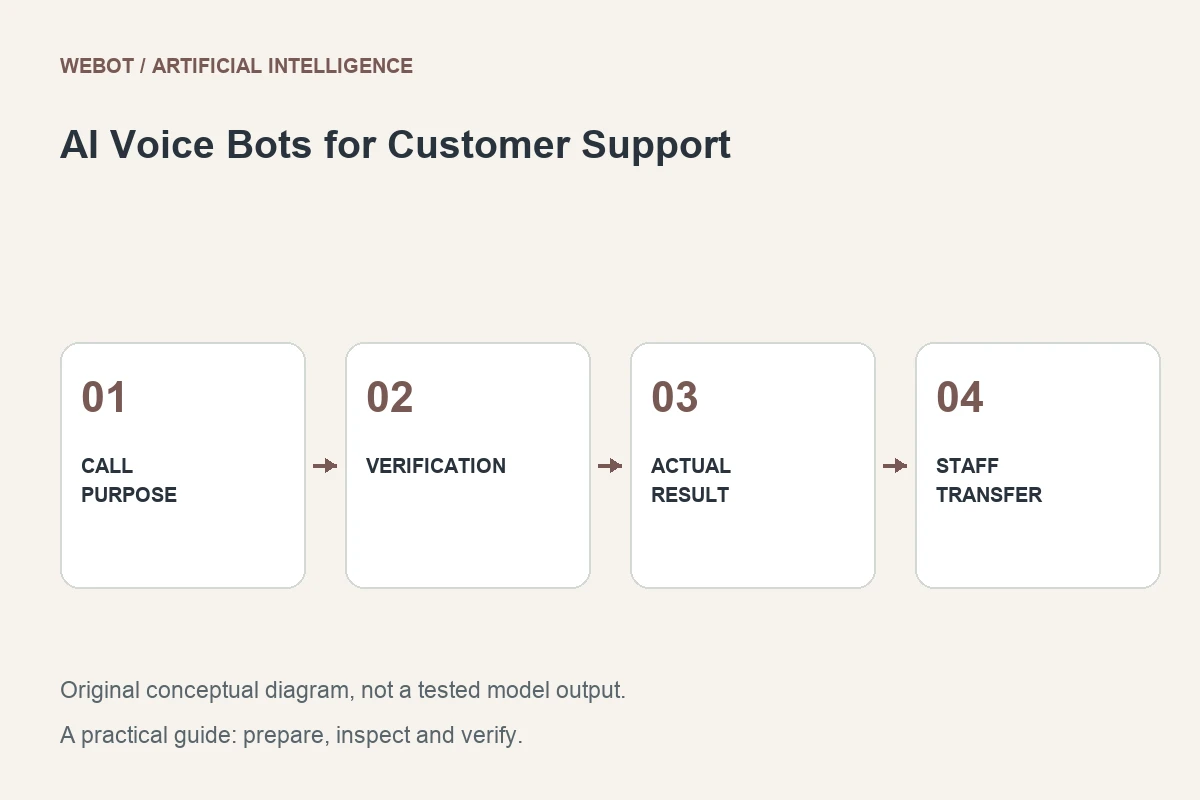
A customer-support voice bot is a conversation connected to an operational process. It must hear the caller, understand the request, use authorised information and distinguish a requested action from a completed one. Imagine a fictional appliance service centre that wants to handle opening-hours questions and collect repair requests. Complex complaints and uncertain technical problems still go to staff. This example explains how to plan the service before a public launch. It does not assume that all telephony integrations or account features are available automatically, and it does not promise that automation will remove the need for people.
1. Pick a bounded support task
Begin with one call type whose expected outcome is clear. Explaining the service area may be suitable; diagnosing an electrical fault from an uncertain description is a different responsibility. Write the information the bot may provide and the circumstances requiring a person. A realistic scope helps you evaluate whether the conversation actually succeeds.
For our service centre, the bot can collect a repair request for staff confirmation. It cannot promise that a technician will arrive at a particular time unless an authorised scheduling system confirms it. Prepare examples of successful, incomplete and escalated calls. These categories prevent an attractive conversation from being counted as success when the customer's practical need remains unresolved.
2. Make the opening understandable
A caller should understand what service they reached and what the assistant can help with. Use a short opening and avoid a long menu disguised as friendly speech. Consider whether identifying the automated assistant is necessary for transparency and applicable requirements. The caller should not need to guess whether a person is currently listening.
Test the greeting on an ordinary telephone connection, including background noise and a caller speaking before it finishes. Voice interaction differs from reading a chat message: people interrupt, pause and change their request. Decide how the system responds when it cannot hear clearly. Repeating the same question indefinitely is not an effective recovery strategy or a pleasant customer experience.
3. Ground answers in maintained business information
Prepare approved hours, service descriptions and escalation contacts. Give each important fact an owner who can keep it current. Avoid connecting contradictory documents and expecting the bot to determine which one represents the business. A support agent is only as dependable as the information and permissions available to it.
Test a changed opening time and an unavailable service area. The correct response should reflect the saved business information rather than a plausible answer generated from general knowledge. Keep private customer records separate from public questions. The fact that a caller knows someone's name should not grant access to that person's repair history, address or telephone number.
4. Verify callers before protected actions
Specify which questions can be answered publicly and which require an owned verification process. Explaining a general service does not need the same permission as changing a customer's booking. Do not accept persuasive conversation as proof of identity. Use the authentication and ownership controls appropriate to the actual system handling the action.
If a tool returns failure or uncertainty, the bot should describe that state accurately. A request accepted for later review is not a confirmed appointment. Ask for explicit confirmation where a meaningful change requires it, and report the verified result. Keeping these states distinct protects both the caller and the employee who may later need to resolve a misunderstanding.
5. Design interruptions and human transfer
A useful voice bot allows the caller to correct information and ask for a person. Plan how it handles interruptions, silence and a change of subject. The person who speaks slowly should not be cut off simply because an overly short timeout treats their pause as the end of the conversation.
For difficult cases, pass useful context to the employee while protecting private information. Explain if staff are unavailable and offer the business's actual alternative rather than pretending that a transfer succeeded. Test a caller who asks for a human immediately and one who becomes frustrated after a misunderstanding. Good escalation is part of the service, not an admission that the whole project failed.
6. Review privacy, permissions and retention
Decide what information is necessary for the repair request. Avoid collecting unrelated personal details merely because a model can store them. Review applicable call, consent, recording and disclosure requirements for the business and the places involved. Platform settings should reflect the agreed purpose rather than maximum collection by default.
Control who can access recordings or transcripts and define how long relevant material is retained. Test with fictional data where possible. Do not publish real customer calls as a demonstration without the required permission. The team operating the service needs a clear way to respond when a caller asks about their information or when an employee identifies a privacy problem.
7. Evaluate outcomes rather than pleasant voices
Create a test set containing ordinary questions, unclear speech, wrong identity details and unavailable tools. Define the expected action for each case before listening to the response. Measure whether the caller received correct information and whether connected operations reached the right state. A fluent voice can make a failed action sound more convincing.
Review latency and comprehension on actual call conditions rather than only a clean desktop preview. Record why calls escalate and whether staff receive enough context. Repeat affected tests after changing prompts, knowledge or connections. Provider documentation such as ElevenAgents describes configuration and evaluation capabilities, but the business still has to decide what acceptable behaviour means for its own service.
8. Pilot with staff supervision
Start with a limited service window or call type and employees who know how to pause the system. Review misunderstandings and compare them with the original task definition. An increase in conversation length is not automatically engagement; it could indicate that callers struggle to obtain a simple answer.
Inspect the voice-agent options and displayed estimates actually available on WeBot, including the supported telephony route. Preserve records of submitted and pending operations rather than assuming an interrupted connection means nothing happened. Expand when the service can explain its limits, protect customer information and hand off effectively. The valuable result is dependable support, not merely the ability to sustain an artificial conversation.
Assign an employee to review the first pilot calls and document unexpected outcomes. That ownership makes an escalation policy operational rather than merely a sentence included in the bot instructions.
Sources and further reading
Put the guide into practice
Browse available workflows, review their supported inputs and choose a workspace for your next project.
Explore AI models