AI Agents
AI Agents Explained: Goals Tools and Verified Actions
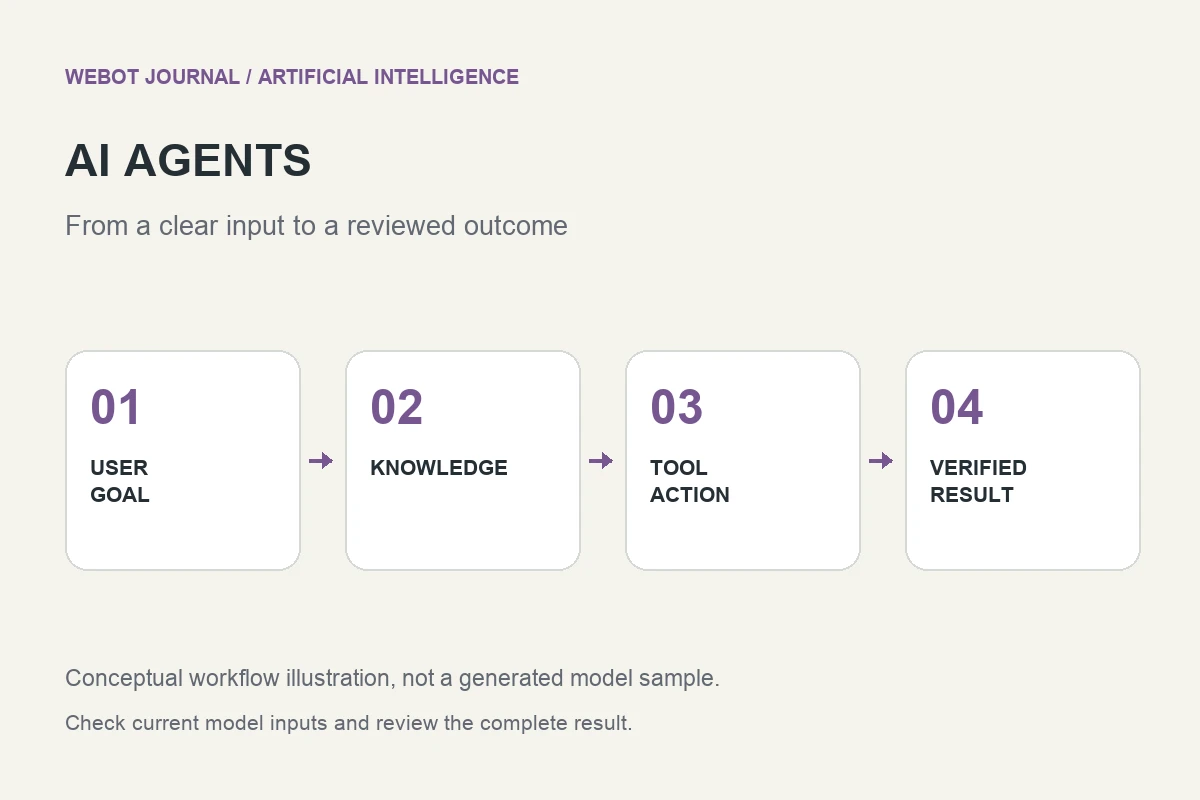
An AI agent combines a model’s ability to interpret a request with a controlled way to use information and tools toward a goal. The useful distinction is action: an assistant may explain how to make an appointment, while an agent can potentially check availability and request a booking through an authorized system. The word potentially matters because a confident conversational answer is not proof that an external action succeeded.
Consider a fictional service business building an appointment assistant. Its customers need answers about opening hours, suitable services, and available times. This guide explains the artificial intelligence components behind that workflow, how agentic AI differs from a basic chatbot, and which design decisions turn a plausible demo into a service you can evaluate.
1. Define the goal and the operating boundary
Start with a narrow outcome: help a customer find a suitable appointment and confirm a booking only after the booking system accepts it. That goal is clearer than handle everything for the business. List what the agent may explain, which information it may retrieve, and which actions require customer approval or a human handoff.
A boundary also includes what happens when information is missing. The assistant should ask for a needed detail or transfer the request instead of inventing availability. Write these behaviors as observable requirements. A team can test whether the assistant confirms a real booking identifier; it cannot meaningfully test a vague instruction to always be excellent. Clear boundaries make the agent more useful, not merely more restricted.
2. Separate the language model from the tools
The language model helps interpret the conversation and decide what information or action is needed. A tool provides a defined interface to another capability, such as retrieving appointment slots or submitting a booking request. The external system remains authoritative about its own records. The model should not manufacture a booking outcome from the words it just generated.
ElevenAgents documentation describes tools that connect conversations with external capabilities. The architectural lesson is broader than a product feature list: each tool needs explicit inputs, meaningful outputs, and a way to report failure or uncertainty. A calendar lookup and a booking write should not be treated as interchangeable. Reading an available slot does not reserve it, and a slot may change before the final booking operation completes.
3. Give knowledge and live state different jobs
A knowledge base can provide relatively stable information such as service descriptions, preparation instructions, or published business hours. It should have an owner and an update process. If a document is outdated, retrieval can faithfully repeat information that is no longer useful. Adding more documents does not automatically improve the quality of the answer.
Live availability belongs in the appointment system rather than a static article. Account-specific information should come from an authorized request tied to the correct customer. Keep these distinctions clear in the design. The assistant can explain a service from an approved knowledge source, then use a separate tool to check a current time slot. The conversation should indicate uncertainty whenever the relevant source cannot establish an answer.
4. Design a small and understandable action sequence
A practical flow gathers the requested service and date, checks suitable availability, presents options, asks the customer to choose, and submits the booking through the correct tool. Only a verified successful response should trigger a confirmation. If the customer changes the request, the agent should use the new details rather than silently carrying old values into the final action.
Avoid unnecessary planning complexity. A simple sequence with clear state can be easier to test than an open-ended agent that repeatedly reinterprets its own goal. Record which details have been confirmed and which remain tentative. The customer should be able to distinguish a proposed time from a booked appointment. That difference is a core service behavior, not just a wording preference.
5. Keep authorization outside persuasive language
A user’s request in a conversation does not establish access to every account or record. The application must verify identity and enforce ownership when a tool reads or changes protected information. Tool parameters should not grant themselves permission merely because the model supplied a customer identifier. The receiving system must check whether the caller may perform the requested operation.
Instructions found in documents, web pages, or tool results also need a defined trust boundary. A retrieved paragraph can provide information without becoming authority to change system behavior. Design the agent so untrusted content cannot expand its tools or permissions. Use the application’s established authentication and validation controls rather than relying on a prompt that simply tells the model to be careful.
6. Handle uncertainty without creating duplicate actions
Tool calls can time out or return an ambiguous response after a remote system has accepted the request. Repeating the action immediately may create a duplicate appointment. Use the integration’s supported idempotency and saved operation evidence to determine what happened. The assistant should say that confirmation is pending when that is the known state, rather than inventing success or failure.
Design user-facing recovery messages before deployment. Explain which action is unresolved and what the customer can do next. A human handoff should include the relevant confirmed details and operation reference without exposing unnecessary private information. Agentic AI becomes easier to trust when its uncertainty is understandable and its recovery behavior protects the customer from repeated or contradictory actions.
7. Evaluate conversations and external outcomes together
Create representative tests: a normal booking, no available slots, a changed date, a tool error, an ambiguous acceptance, and a request beyond the assistant’s scope. Check the conversation wording and the external state. A polite answer is not a successful test if it confirms a booking that the system never created.
Review the evidence with explicit criteria: correct service details, appropriate questions, authorized tool use, accurate confirmation, and a useful handoff when needed. Include difficult examples from real operation after removing unnecessary personal data. Version prompts and tool contracts so you can connect a behavior change with the configuration that produced it. A successful demo is the beginning of evaluation, not the end.
8. Choose the right level of automation
Not every process needs an agent. A fixed form or deterministic workflow may be clearer when inputs and actions are simple. A chatbot may be enough when the main task is explanation. An agent becomes useful when interpreting conversation and selecting authorized actions genuinely improves the customer journey.
WeBot’s public agent pages are an entry point for exploring available services; current configuration and supported integrations determine what a specific agent can do. Keep capabilities separate from promises. Begin with one measurable goal, give tools clear contracts, verify external outcomes, and expand only after evaluation shows that the workflow behaves reliably. That approach makes AI agents practical assistants rather than conversational systems that merely sound as if they completed a task.
Sources and further reading
Put the guide into practice
Browse available workflows, review their supported inputs and choose a workspace for your next project.
Explore AI models