Astrology
Til Vichar: 140 Body Locations, Traditional Context and Symbolic Reflection
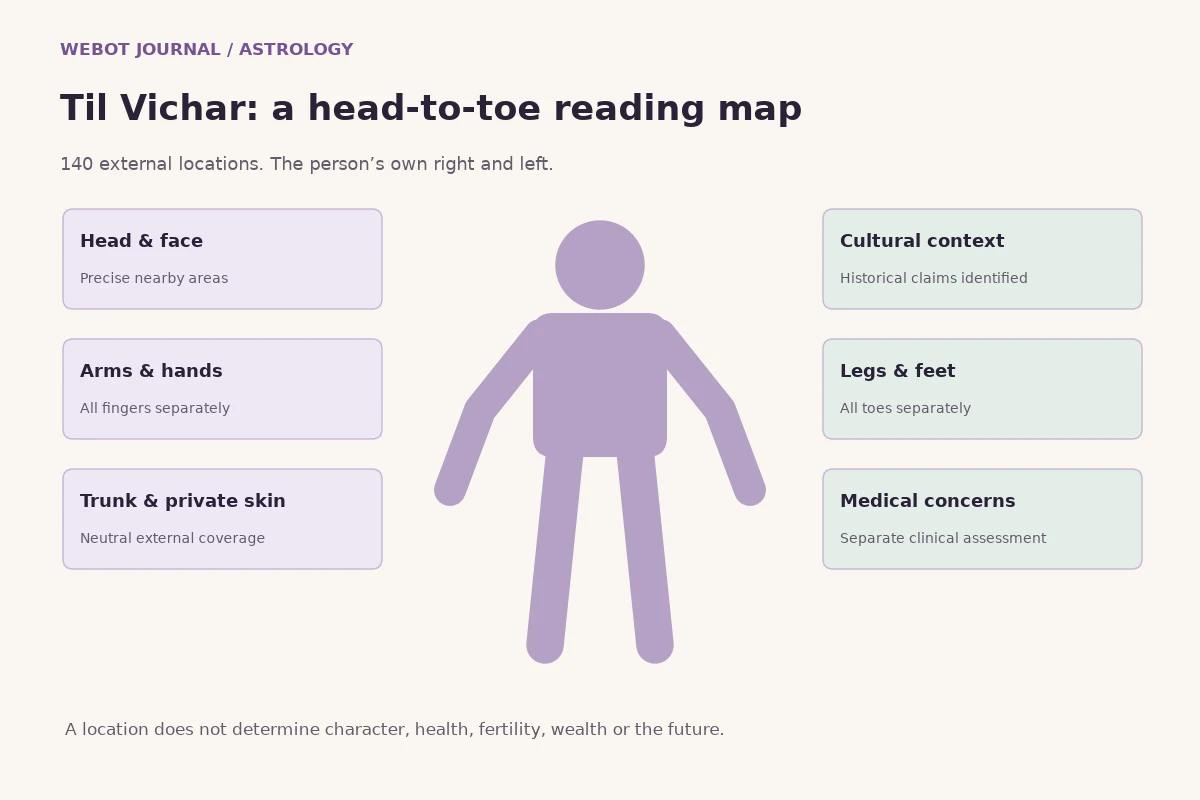
Til Vichar discusses the cultural symbolism attached to moles and other visible marks. This head-to-toe guide covers 140 distinct external skin locations, including the scalp, face, trunk, limbs, individual fingers and toes. It explains how to read a location clearly while keeping cultural curiosity separate from medical assessment and judgments about a person.
The location entries below are original editorial reflection prompts. They are not authenticated predictions and are not presented as 140 rules copied from a classical text. A skin mark cannot establish wealth, virtue, fidelity, fertility, sexual identity, professional ability or future events. A person should remain free to enjoy, question or decline the symbolism without being assigned a fixed character.
Use the person's own right and left, rather than the side that appears on your screen or in a mirror. The guide distinguishes nearby areas because an eyebrow, eyelid and cheek are not the same location. Its head-to-toe organisation describes external skin only; it is not an instruction to inspect someone, request private photographs or make an assessment without their consent.
A historical reference requires careful wording. Chapter 52 of the Brihat Samhita in the cited translation discusses pimples and other marks and attaches different omens to body locations. That provides evidence of a historical interpretive practice. It does not make every modern mole catalogue identical to that chapter, nor establish that the chapter's predictions are medically or scientifically reliable.
For an actual new or changing skin spot, use medical guidance rather than a symbolic reading. The American Academy of Dermatology describes asymmetry, irregular borders, varied colour, diameter and evolution as features to discuss with a dermatologist; a concerning spot can be smaller than six millimetres. Seek appropriate clinical assessment for a changing, itching or bleeding mark. Do not delay that assessment because a location is described as favourable in a folk reading.
Matching entries:
No entries match this search.
1. Scalp and forehead
The scalp and forehead invite different metaphors about attention and visibility. No position establishes intelligence, status or a promised outcome.
Centre of the scalp
The centre of the scalp can serve as a metaphor for private thought. What deserves attention even when other people cannot see the work?
Crown of the head
The crown offers an image of visibility and position. Consider the difference between being noticed and accepting responsibility for a contribution.
Back of the scalp
The back of the scalp suggests what lies outside your immediate view. Ask which assumption would benefit from another person's perspective.
Right side of the scalp
For the right scalp, use a prompt about a chosen direction. What decision have you made, and what information might revise it?
Left side of the scalp
For the left scalp, consider a possibility still being explored. Give an unfinished idea time without treating uncertainty as a personal flaw.
Front hairline
The hairline marks a visible boundary. Reflect on how much of your thinking you choose to share in a particular setting.
Centre of the forehead
The forehead can suggest planning in an editorial metaphor. Describe one intended action clearly instead of reading ambition from a skin mark.
Right forehead
The right forehead can prompt a review of a plan already underway. Is the next step still useful under current circumstances?
Left forehead
The left forehead can prompt reflection on an alternative plan. Compare the actual options rather than assigning good or bad fortune to a side.
Lower forehead
The lower forehead sits near expression and attention. Ask whether your response to a situation communicates what you actually mean.
2. Brows and skin around the eyes
Brows, eyelids and the skin around the eyes are distinct locations. The prompts concern observation and expression; they are not assessments of eye health.
Between the eyebrows
The space between the brows can suggest focused attention. Choose one question to examine without claiming that a mole establishes insight.
Right eyebrow
The right eyebrow can become a prompt about visible reactions. What might another person reasonably understand from the way you respond?
Left eyebrow
The left eyebrow can invite reflection on an unspoken question. Consider asking directly rather than expecting your expression to explain it.
Right upper eyelid skin
For right upper-eyelid skin, use a prompt about pausing observation. What benefits from being reconsidered after a short break?
Left upper eyelid skin
For left upper-eyelid skin, reflect on the limits of a first impression. A visible mark does not establish intuitive accuracy.
Below the right eye
Below the right eye, consider the difference between noticing a detail and interpreting it. What did you actually observe?
Below the left eye
Below the left eye, ask what feeling accompanies an observation. Keep the emotion distinct from a conclusion about another person.
Outer right eye area
The outer right eye area can suggest a wider view. Which part of a situation has remained outside your immediate focus?
Outer left eye area
The outer left eye area can prompt reflection on context. What changes when you consider the people around the central event?
Inner eye-area skin
The inner eye-area skin can serve as a metaphor for close attention. This is a writing prompt, not an assessment of eyesight or health.
3. Temples, nose and cheeks
Temple, nose and cheek labels describe location precisely. Right and left are not used here to rank people or assign favourable and unfavourable destinies.
Right temple
For the right temple, consider a decision that needs both thought and action. What would make the reasoning clearer to someone affected?
Left temple
For the left temple, reflect on a question you have kept private. Does it need more thought or an appropriate conversation?
Bridge of the nose
The nose bridge can suggest connection between two views. Identify the point of agreement before describing the remaining difference.
Tip of the nose
The nose tip offers a metaphor for what is immediately apparent. Ask which less visible detail might change your first judgment.
Right side of the nose
The right side of the nose can prompt attention to a familiar preference. Is it a considered choice or simply a habit?
Left side of the nose
The left side of the nose can prompt curiosity about an unfamiliar preference. Explore it without assuming unfamiliar means unsuitable.
Skin beside the nostrils
Skin beside the nostrils can suggest the ordinary details we overlook. Choose a practical question rather than a prediction about prosperity.
Right cheek
The right cheek can invite reflection on public presentation. How do you want to participate, and what action would express that intention?
Left cheek
The left cheek can prompt a question about comfort with being seen. A mole does not establish confidence, shyness or social ability.
Cheekbone area
The cheekbone area can serve as a metaphor for a supporting structure. What makes your contribution easier for others to understand?
4. Lips, jaw and chin
Mouth and jaw metaphors can prompt questions about speech and resolve. A mark does not prove honesty, appetite, stubbornness or relationship prospects.
Skin above the upper lip
Above the upper lip, consider the moment before speaking. Which part of a response deserves checking before it becomes a claim?
Right upper-lip border
The right upper-lip border can prompt reflection on a promise. State what you can actually provide instead of offering reassurance without a clear basis.
Left upper-lip border
The left upper-lip border can invite attention to a question left unsaid. Is there a respectful way to ask it directly?
Lower-lip border
The lower-lip border can suggest the response after listening. Consider whether your reply addresses what the speaker actually asked.
Below the lower lip
Below the lower lip, reflect on what remains after a conversation. Which agreement needs to be remembered or clarified?
Right corner of the mouth
The right mouth corner can prompt reflection on humour. Does a familiar joke remain enjoyable for the person it describes?
Left corner of the mouth
The left mouth corner can invite attention to an ambiguous response. Clarify meaning instead of assuming a smile always signals agreement.
Centre of the chin
The chin can become a metaphor for holding a position. What evidence supports your view, and what would make you reconsider?
Right jawline
The right jawline can prompt a question about resolve. Is continuing the present approach still serving the purpose you intended?
Left jawline
The left jawline can prompt reflection on flexibility. Changing a position after learning something relevant need not undermine your integrity.
5. Ears and neck
Ear and neck imagery can be used for reflective questions about listening and speaking. These associations do not reveal another person's inner character.
Right outer ear
The right outer ear can suggest receiving a direct message. What did the speaker say, rather than what did you expect to hear?
Left outer ear
The left outer ear can prompt attention to another perspective. Listening carefully does not require agreeing with every conclusion.
Right earlobe
The right earlobe can invite a reflection on a familiar saying. Does the advice still fit the situation in which you use it?
Left earlobe
The left earlobe can prompt consideration of inherited customs. Keep the meaning you value distinct from claims that require evidence.
Behind the right ear
Behind the right ear, consider information that reaches you indirectly. Check a relevant fact before repeating a story about someone.
Behind the left ear
Behind the left ear, reflect on a conversation you have not fully understood. Ask for clarification rather than supplying a confident interpretation.
Front of the neck
The front of the neck can suggest giving a thought a voice. Describe a preference plainly without turning it into a prediction.
Back of the neck
The back of the neck can prompt attention to an overlooked obligation. Identify the actual task instead of attributing tension to a mark.
Right side of the neck
The right neck can serve as a metaphor for turning toward a decision. What information is needed before choosing the direction?
Left side of the neck
The left neck can suggest making room to look again. Consider whether another viewpoint changes the question you are trying to answer.
6. Shoulders, chest and breast skin
Chest and breast locations are described neutrally. Avoid claims about virtue, fertility or gender roles, and keep any actual skin concern separate from symbolism.
Right shoulder
The right shoulder can prompt a review of responsibility. Which task did you agree to own, and which did you merely assume?
Left shoulder
The left shoulder can invite reflection on sharing work. Another person's contribution need not look identical to yours to be valuable.
Right collarbone area
The right collarbone area can suggest a visible commitment. Is the promise clear enough for someone else to understand its limits?
Left collarbone area
The left collarbone area can prompt attention to quieter commitments. Name work that is important even when it receives little recognition.
Centre of the chest
The centre of the chest can become a metaphor for personal priorities. This does not establish character, courage or a medical condition.
Right chest skin
Right chest skin can prompt a question about acting on a value. Which small behaviour would make the value visible in practice?
Left chest skin
Left chest skin can invite reflection on receiving care. Is there a modest request you have found difficult to express?
Breast skin
Breast skin should not be used to judge virtue, fertility or relationships. An appropriate reflective theme is care that respects the person's own choices.
Nipple or areola area
The nipple or areola area is private anatomy, not evidence of sexual character or future parenthood. Keep any cultural discussion descriptive and respectful.
Under-breast fold
The under-breast fold can prompt reflection on comfort and privacy. A symbolic reading does not determine the significance of an actual skin change.
7. Back, waist and abdomen
Trunk locations can support metaphors about support, origins and privacy. A catalogue cannot establish what an actual mark means medically.
Upper back
The upper back can suggest support that is easy to overlook. Who helps a shared task continue without becoming the visible organiser?
Right shoulder blade area
The right shoulder-blade area can prompt reflection on carrying a plan forward. What support would make the next step more workable?
Left shoulder blade area
The left shoulder-blade area can invite a question about receiving support. Have you explained what kind of assistance would actually help?
Middle of the back
The middle back can become a metaphor for continuity. Which small maintenance task keeps a larger arrangement dependable?
Lower back
The lower back can prompt a review of foundations. Identify the practical support a plan needs rather than inferring endurance from a mole.
Right waist or flank
The right waist or flank can suggest room to adjust a routine. What change would make an existing commitment easier to maintain?
Left waist or flank
The left waist or flank can prompt attention to a neglected preference. Consider discussing it before an unspoken expectation becomes resentment.
Upper abdomen
The upper abdomen can serve as a metaphor for what you take in. Which information deserves examination before you accept its conclusion?
Navel area
The navel area can invite reflection on origins and belonging. A mark cannot establish ancestry, fertility or a promised family outcome.
Lower abdomen
The lower abdomen can prompt a question about privacy and personal limits. Let the person decide which subjects they wish to discuss.
8. Pelvis, buttocks and private external skin
Private external skin is included for complete descriptive coverage, not for sexual predictions or intrusive inspection. Consent and appropriate clinical care remain essential.
Right hip
The right hip can suggest preparing to move in a chosen direction. What practical step would make the decision clearer?
Left hip
The left hip can invite reflection on changing direction thoughtfully. An alternative deserves consideration without being declared lucky or unlucky.
Right groin fold
The right groin fold is private external skin. A respectful reading avoids claims about sexual behaviour and centres the person's boundaries.
Left groin fold
The left groin fold should not be treated as a prediction about intimacy. If discussing symbolism, keep consent and privacy explicit.
Right buttock
The right buttock can prompt a neutral reflection on rest and support. It is not evidence of wealth, fidelity or moral character.
Left buttock
The left buttock can suggest the value of a pause in a writing exercise. Avoid turning body location into a judgment about someone.
External genital skin
External genital skin is not a basis for predicting relationships, fertility or sexual identity. No one owes an image or personal disclosure for a reading.
Vulval external skin
Vulval external skin should be discussed without stereotypes or forecasts. Questions about an actual mark belong with an appropriately qualified clinician.
Penile or scrotal external skin
Penile or scrotal external skin does not reveal sexual character or future children. Keep cultural curiosity separate from personal medical assessment.
Perineal or external anal-area skin
Perineal or external anal-area skin is private anatomy. A symbolic catalogue cannot diagnose a mark or justify an intrusive request to inspect it.
9. Armpits, arms and wrists
Arms and wrists offer ordinary metaphors for action and assistance. The reading should not become a claim that physical appearance determines ability.
Right armpit
The right armpit can suggest work occurring outside public view. Which preparation deserves clearer recognition within a shared responsibility?
Left armpit
The left armpit can prompt a question about personal space. Consider where an agreement would make participation more comfortable.
Right upper arm
The right upper arm can invite reflection on putting intention into action. What task is genuinely yours to begin?
Left upper arm
The left upper arm can suggest accepting practical help. Is there a clear way another person could contribute without taking over?
Right elbow
The right elbow can serve as a metaphor for changing an approach. Which part of a method needs adjustment rather than abandonment?
Left elbow
The left elbow can prompt attention to flexibility in a discussion. Can you preserve the purpose while revising the proposed steps?
Right forearm
The right forearm can suggest a task within immediate reach. Choose a small useful action instead of making an undefined promise.
Left forearm
The left forearm can invite reflection on preparing before acting. What material or explanation would make the action more effective?
Right wrist
The right wrist can prompt a question about a repeated habit. Does the routine still serve its original purpose?
Left wrist
The left wrist can suggest making room for a new method. Compare the actual result rather than assuming change is automatically improvement.
10. Hands and palms
Hands can suggest giving, receiving and coordination in a writing exercise. Mole location is not proof of wealth or a measure of trustworthiness.
Centre of the right palm
The centre of the right palm can prompt reflection on what you are offering. Is the contribution wanted and clearly described?
Centre of the left palm
The centre of the left palm can invite attention to receiving. Accepting help need not remove your ability to make your own decisions.
Back of the right hand
The back of the right hand can suggest a visible action. What might another person reasonably understand from what you do?
Back of the left hand
The back of the left hand can prompt reflection on work whose purpose is unclear. Explain the intention rather than expecting others to infer it.
Right palm below the thumb
The right palm below the thumb can suggest the support behind an action. What makes your chosen task easier to complete?
Left palm below the thumb
The left palm below the thumb can invite a question about a manageable commitment. Define the part you can sustain rather than accepting everything.
Right palm outer edge
The right palm's outer edge can prompt attention to a boundary. Which responsibility belongs elsewhere, even when you are willing to help?
Left palm outer edge
The left palm's outer edge can suggest respect for another person's limits. A declined offer does not require a negative judgment.
Right finger-web skin
Right finger-web skin can become a metaphor for coordination between small tasks. Which handover needs a clearer explanation?
Left finger-web skin
Left finger-web skin can prompt reflection on a connection between contributions. Check that the people involved understand the same arrangement.
11. Individual fingers
Each finger receives a separate prompt so nearby labels remain distinct. The themes are editorial questions rather than a system for judging relationships or character.
Right thumb
The right thumb can suggest a deliberate choice in an editorial exercise. What would make your decision more informed?
Left thumb
The left thumb can prompt attention to a choice not yet made. Give it an appropriate question instead of treating delay as destiny.
Right index finger
The right index finger can invite reflection on giving direction. Is your instruction clear enough to follow without guessing?
Left index finger
The left index finger can suggest questioning a direction. Name the specific concern rather than rejecting the whole plan automatically.
Right middle finger
The right middle finger can prompt a review of a central commitment. Which part of the work must remain dependable?
Left middle finger
The left middle finger can suggest maintaining balance between commitments. Identify an actual conflict before accepting another task.
Right ring finger
The right ring finger can invite reflection on an explicit promise. What did both people understand when the agreement was made?
Left ring finger
The left ring finger can prompt a discussion of shared expectations. A mark does not predict marriage, fidelity or a partner's character.
Right little finger
The right little finger can suggest attention to a small message. Has an important detail been omitted because it seemed obvious?
Left little finger
The left little finger can invite reflection on a quieter contribution. What becomes visible when you ask someone who has not spoken?
12. Thighs, knees and lower legs
Leg locations can suggest pace and follow-through. These metaphors do not assess mobility, endurance or the likelihood of an actual journey.
Right front thigh
The right front thigh can prompt a question about beginning a journey or task. What preparation makes the first step workable?
Left front thigh
The left front thigh can suggest considering your pace. Another person's timetable does not automatically define what is appropriate for you.
Right inner thigh
The right inner thigh is private skin, not evidence of a secret personality. A neutral reflective theme is respecting personal boundaries.
Left inner thigh
The left inner thigh should not be used to infer intimacy or morality. Let any discussion remain optional and free from intrusive inspection.
Back of either thigh
The back of either thigh can suggest support during movement. Which resource helps you continue without carrying the whole task alone?
Right kneecap area
The right kneecap area can prompt reflection on adjusting to an obstacle. What can change while the main purpose remains intact?
Left kneecap area
The left kneecap area can invite a question about a pause. Is waiting providing useful information or avoiding a necessary conversation?
Behind either knee
Behind either knee can suggest a less visible point of flexibility. Consider a small change before declaring that an arrangement cannot work.
Right shin or calf
The right shin or calf can prompt attention to follow-through. What step remains after the first enthusiastic action?
Left shin or calf
The left shin or calf can suggest noticing the effort behind progress. Describe the work rather than assuming an easy or difficult destiny.
13. Ankles, heels and feet
Ankles, heels and soles have different descriptive labels. A mark on the foot should not be treated as proof of future travel or misfortune.
Right ankle
The right ankle can invite reflection on stability during change. Which practical agreement supports the next move?
Left ankle
The left ankle can prompt a question about adapting your stance. What information would make a different approach reasonable?
Right heel
The right heel can suggest a dependable starting support. Identify the routine that helps you begin without unnecessary confusion.
Left heel
The left heel can invite reflection on returning to a familiar place. Which part of the old arrangement still helps?
Back of the heel
The back of the heel can prompt attention to what is left behind. A transition may need a clear handover rather than a prediction.
Top of the right foot
The top of the right foot can suggest a visible direction. Have you explained where the shared activity is meant to go?
Top of the left foot
The top of the left foot can invite reflection on an alternative route. Compare its actual advantages instead of assigning luck by side.
Right sole and arch
The right sole and arch can suggest support beneath ordinary movement. What practical foundation does your plan rely on?
Left sole and arch
The left sole and arch can prompt attention to overlooked support. A mark here does not establish future travel, wealth or misfortune.
Skin between the toes
Skin between the toes can become a metaphor for small neglected details. Choose a practical reminder without interpreting a skin condition symbolically.
14. Individual toes
Individual toes complete the head-to-toe inventory. The prompts describe possible metaphors and should not be used as predictions or judgments about a person.
Right big toe
The right big toe can suggest a first deliberate step. Which action would move the plan beyond an attractive description?
Left big toe
The left big toe can invite reflection on checking direction before beginning. A pause can support a more informed choice.
Right second toe
The right second toe can prompt attention to the step after the beginning. What makes your initial effort repeatable?
Left second toe
The left second toe can suggest reviewing an expectation after experience. Does the original plan still fit what you have learned?
Right third toe
The right third toe can invite reflection on several parts moving together. Which responsibility needs coordination with another person's work?
Left third toe
The left third toe can prompt a question about balance among tasks. Is one small obligation being repeatedly overlooked?
Right fourth toe
The right fourth toe can suggest continuity through an ordinary sequence. What helps you complete the less interesting middle stage?
Left fourth toe
The left fourth toe can invite attention to sharing the route. Ask whether the people involved need a different pace.
Right little toe
The right little toe can prompt respect for a small contribution. An apparently minor detail may still deserve a clear place in the plan.
Left little toe
The left little toe can suggest finishing with attention rather than haste. What final check would make the handover easier for someone else?
Sources and further reading
Explore Astrology
Explore traditional numerology, dream symbolism, head-to-toe Til Vichar and home Vastu, with practical explanations and a clear distinction between belief, reflection and evidence.
Explore Astrology