Numerology
Numerology Number 8: Birth Number, Destiny Number and Responsible Ambition
Some achievements become visible only after a long period of ordinary work. A reliable service, a well-kept record or a project that survives a difficult handover may depend on effort that receives little attention. Number 8 in numerology is often discussed through responsibility, endurance and ambition. These themes deserve a more thoughtful treatment than a promise of wealth or a warning that difficulty is unavoidable.
This guide explains number 8 as a birth number and as a complete-date destiny number, using a clearly stated Indian date convention. It covers the calculation, traditional Saturn symbolism, work, relationships, commitments and original practical examples. Numerology is an interpretive cultural practice rather than a reliable prediction or an assessment of personal worth. The number does not establish a person's financial prospects, health, character or future, and none of the fictional examples should be read as such a forecast.
1. Identify the input before discussing the result
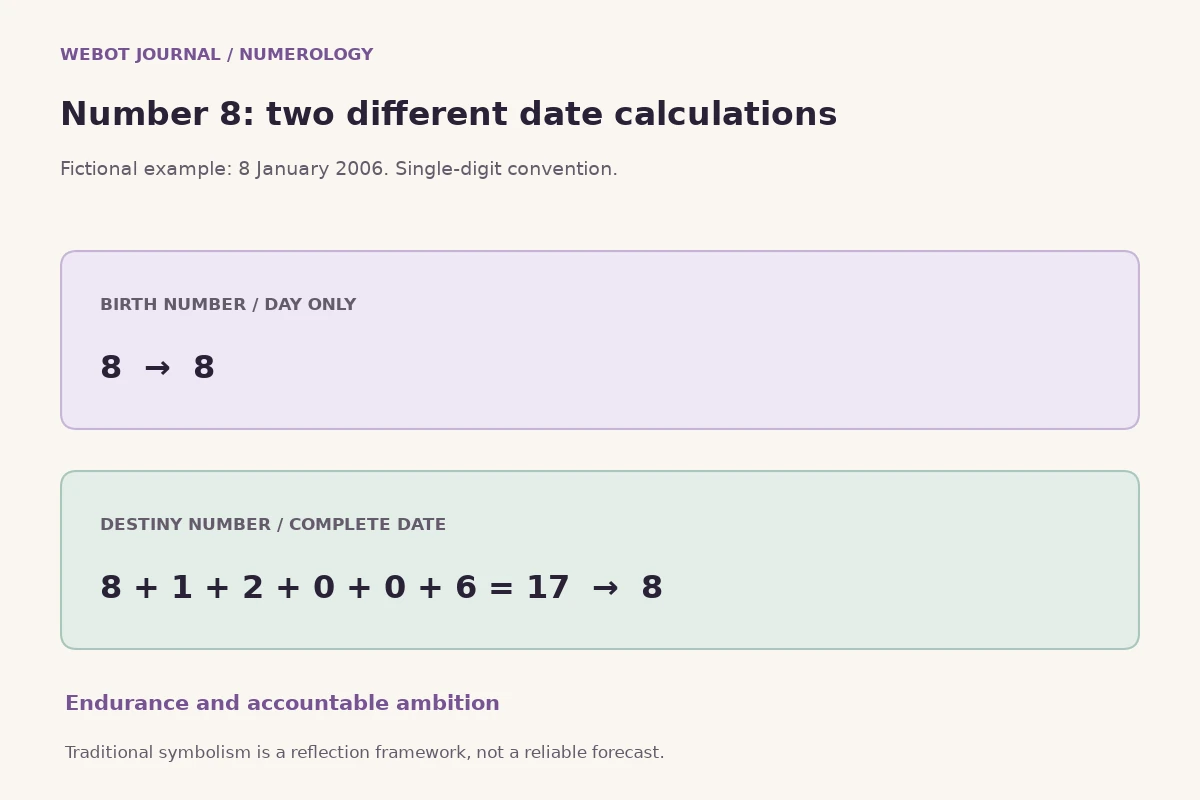
Birth number, also called Mulank in the convention used here, reduces the day of birth to a single digit. Destiny number or Bhagyank reduces every digit in the complete birth date. These are separate calculations, so a person can receive 8 from one and a different value from the other. Neither is a score or a ranking among people.
This series uses single-digit reduction consistently, including totals that some other schools preserve as master numbers. It does not derive a number from a name. If another source uses destiny to mean a name-based expression number, its result cannot be compared directly with this full-date method. State the convention, show the sum and only then discuss the symbolism. That order keeps arithmetic from being obscured by confident interpretation.
2. Birth number 8: the 8th, 17th and 26th
The day 8 needs no reduction. Seventeen gives 1 plus 7, and twenty-six gives 2 plus 6. Those are the three day-of-month possibilities that reach 8. The month and year do not affect this birth-number calculation. A reader can check the result easily without providing any additional personal information or using a specialised calculator.
Record the original day beside the reduced digit. Some numerology schools attach extra meanings to compound dates, but a shared final digit is not evidence that everyone in the category has the same habits or experiences. People born on the 8th, 17th and 26th remain individuals. The calculation defines a symbolic category within a chosen system; it does not provide a complete explanation of the people whose dates fall within it.
3. Destiny number 8: two worked examples
Use the fictional date 8 January 2006. Add 8 plus 1 plus 2 plus 0 plus 0 plus 6 to obtain 17. Reduce 17 to 8. The example therefore has both birth number 8 and destiny number 8. Show the intermediate total so that another person can verify the calculation rather than accepting the result on authority.
For contrast, use 17 April 1990. Its day reduces to 8, while the full date gives 1 plus 7 plus 4 plus 1 plus 9 plus 9 plus 0, or 31. Thirty-one reduces to 4. The resulting pair is birth 8 and destiny 4. The difference comes from the inputs, not from an error or an unfavourable condition. The dates are examples of arithmetic, not forecasts for real individuals.
4. Saturn and the traditional image of sustained effort
The Indian numerology account used as a cultural reference associates number 8 with Saturn. Responsibility, endurance and material ambition appear among its themes. These are traditional correspondences, not evidence that the planet assigns a life pattern from a reduced date. Strong negative claims about inevitable suffering or personal disorders are not established by the calculation and are not adopted in this guide.
An original reflective use of the symbolism is to ask what makes effort dependable. Working for a long time is not enough if the work has no clear purpose or if an obsolete method is never reviewed. Endurance becomes constructive when it includes learning and an ability to reconsider the plan. The image can support that question without declaring hardship necessary or making success a promise.
5. Birth number 8 and taking an obligation seriously
As a birth-number prompt, 8 can highlight the first response to a responsibility. Imagine a group making an ambitious proposal. One person asks who will maintain the result after launch and what information must be handed over. The question may seem less exciting than the original idea, but it can make the project more realistic.
If this theme resonates, identify the specific behaviour rather than claiming a permanent identity as the responsible one. You may be dependable in one setting and uncertain in another. Ask whether your response clarifies the obligation or assumes ownership before anyone has agreed on it. A thoughtful reading allows both strengths and limits. It does not require you to take charge of every task that someone else leaves unresolved.
6. Destiny number 8 and the shape of a lasting commitment
A complete-date interpretation can use 8 as a continuing question about what you are willing to sustain. The theme need not involve a prominent position or a large enterprise. Maintaining a useful community resource, completing a careful piece of work or communicating honestly through a long project can all involve substantial responsibility.
A reflective question is how the commitment changes as you learn more. Can you distinguish loyalty to its purpose from attachment to its original form? A project may need a simpler method or a different division of work. The number does not determine the answer. It offers a way to examine whether ambition remains connected with a useful result, rather than becoming a demand that every effort must look impressive from outside.
7. When birth and destiny are both 8
Matching values are sometimes interpreted as emphasis on a theme. For 8, consider whether immediate seriousness and longer-term ambition support one another. A person can accept responsibility readily while finding it difficult to share it, or pursue a large aim while neglecting smaller agreements. Repetition does not guarantee exceptional endurance or a particular kind of achievement.
Review a real commitment through its stages. What did you agree to do, what changed and how did you communicate the change? Which parts did you complete and which remained uncertain? This creates a more useful reflection than a broad statement about power or success. A repeated number can invite attention to those details while leaving room for evidence that does not fit the profile.
8. Birth 8 combined with another full-date number
Different results can prompt complementary questions rather than a conflict between fixed identities. Birth 8 with destiny 2 could ask how responsibility is negotiated. With destiny 5, consider how an enduring commitment adapts to change. With destiny 4, ask how the structure supports the obligation and where it needs revision. These are original interpretive prompts rather than predictions.
The fictional 17 April 1990 example gives birth 8 and destiny 4. Imagine a volunteer maintaining an archive who creates a clear handover guide so the work does not depend on one person. The useful action is making responsibility transferable. The date does not prove that the person will do this well. The guide's accuracy and the experience of the next person using it provide better evidence.
9. Ambition benefits from a concrete definition of success
An aim such as becoming successful can remain impossible to evaluate because its meaning changes whenever a milestone is reached. A concrete definition identifies the result, the people it serves and the limits within which it should be achieved. It also makes it easier to recognise progress that is useful without being dramatic.
For a small community project, success might mean that the resource is accurate, understandable and maintained by more than one person. That is different from attracting the most attention. Someone reflecting through 8 can examine which definition is actually guiding their work. The exercise does not assess financial prospects or prescribe an investment. It clarifies the purpose of a commitment before effort is treated as valuable merely because it is intense.
10. Persistence and repetition are not the same thing
Continuing after a setback can be constructive, but repeating an ineffective action without learning may only reproduce the problem. Persistence needs information. A person should be able to explain what they learned, what they changed and why another attempt is justified. Otherwise, endurance can become a flattering name for refusing to reconsider.
Imagine a group event repeatedly receiving few participants. The response may be to ask about timing, access and the clarity of the invitation rather than simply sending more invitations in the same form. This is an original practical application of the endurance theme. It does not imply that a number guarantees resilience or requires someone to continue every project indefinitely. Some commitments deserve revision, and some deserve an honest ending.
11. Responsibility includes making uncertainty visible
A confident announcement may make a group feel reassured temporarily, but an unresolved issue remains unresolved whether it is mentioned or not. The person coordinating a task needs a way to distinguish confirmed information from assumptions. Honest updates allow others to adapt before a small uncertainty becomes a larger problem.
Try stating what is complete, what is pending and what depends on another decision. Avoid inventing progress to make the account look stronger. Within a number-8 reflection, authority becomes more useful when it provides a reliable picture rather than an appearance of total control. This standard applies regardless of numerical category and should be judged through the quality of the information people receive.
12. Delegation requires a real handover
Giving someone a task is not the same as giving them enough context to perform it. If the original organiser keeps every important detail in memory, others may appear unreliable when the arrangement itself makes success difficult. A clear handover identifies the purpose, the current state and the decisions the new owner can make.
Choose a small recurring responsibility and write the information another person would need to take it over. Ask them where the account is unclear. This is an original exercise in making responsibility shareable. The aim is not to remove accountability but to make it understandable. A number-8 reading should not encourage the belief that nobody else can be trusted merely because you have become accustomed to doing the work yourself.
13. Fairness matters in how results are obtained
A completed task can look successful while concealing an unfair distribution of effort or credit. If one person receives recognition for work many people supplied, the result may damage the relationships needed to sustain it. Responsibility includes attention to the process, not only the final visible outcome.
At the end of a shared project, identify who contributed, what each person owned and which work was easy to overlook. Make the account accurate rather than ceremonial. Someone exploring 8 can use this question to connect ambition with fair treatment. The number does not establish moral authority. Actual conduct, including how a person responds when fairness is questioned, provides more informative evidence than a favourable symbolic description.
14. Work preferences should be described through actual tasks
Numerology profiles may associate 8 with management, public responsibility or material achievement. Those themes do not establish qualifications or suitability for a role. Relevant skills, experience, interests and opportunities need their own assessment. A reduced date should not determine hiring, promotion, educational access or judgments about a person's reliability.
Reflect instead on a completed task: did you enjoy organising a handover, tracking an obligation, resolving an ambiguity or maintaining a resource? What evidence shows that the contribution helped? Concrete examples make a discussion about work more useful. The symbolic theme can prompt reflection, but it cannot replace professional requirements or turn an aspiration into proof that someone is destined to lead.
15. Study: consistent practice needs useful feedback
A regular study habit can be valuable, but time spent alone does not show whether the method is working. Repeatedly reviewing familiar notes may feel disciplined while leaving an important misunderstanding untouched. A learner needs opportunities to apply the material and receive feedback relevant to the question being studied.
Choose one manageable problem, attempt it without copying a model answer and examine the point where your reasoning becomes uncertain. Adjust the next session around that gap. This gives persistence a direction. The exercise is not a prediction of academic success for number 8. It is a practical way to distinguish a sustained learning process from a routine that is maintained mainly because it looks diligent.
16. A setback is information, not a numerical sentence
A disappointment can tempt someone to search for a large explanation that makes the event feel inevitable. A profile saying number 8 involves struggle may appear to supply that explanation. Yet a date calculation does not establish why a project failed or whether another attempt will succeed. The relevant causes must be examined in the actual situation.
Write what happened in specific terms, separate what you can verify from what you assume and identify what remains outside your control. This does not make every difficulty easy to solve. It prevents the number from becoming a sentence that removes choice. Equally, a favourable prediction should not encourage ignoring a practical problem. Symbolic readings should leave room for evidence and appropriate support.
17. Relationships should not become a hierarchy of responsibilities
Being reliable in practical matters does not give one person authority over every shared decision. A relationship needs room for both people's preferences, not only an account of who handles more tasks. Responsibility is most useful when it supports participation rather than becoming a reason that one view must always prevail.
Imagine arranging a move. One person may coordinate the timetable while the other has important needs about location, privacy or daily routines. Their contribution is not less legitimate because it looks different. A number-8 reflection can ask how responsibilities are discussed and revised. The number cannot establish who should control the relationship or excuse dismissing another person's concerns as obstacles to an ambitious plan.
18. Compatibility prompts across numbers 1 through 9
With 1, discuss initiative and accountability; with 2, how obligations are negotiated; with 3, how promises are supported; with 4, how systems remain usable; with 5, how commitments adapt; with 6, how practical responsibility includes care; with 7, how decisions use evidence; with 8, how authority is shared; and with 9, whose interests the larger aim serves.
These are original discussion prompts, not numerical approvals or warnings about partners. A shared value does not guarantee fairness or trust. Different values do not prove incompatibility. Friendship, marriage and collaboration require attention to conduct, consent and expectations. Do not use a chart to overlook a serious concern, reject someone automatically or decide that a difficult relationship must be endured because the numbers supposedly demand it.
19. Family responsibilities should be explicit rather than inherited by habit
A family may gradually rely on one person for every administrative task because they handled the first few successfully. The arrangement can become permanent without a discussion. The person may feel unable to step back, while others may not realise how much work is involved. A numerical label such as responsible one can reinforce that pattern unnecessarily.
List the recurring responsibilities and the information needed to perform them. Discuss which can be shared, simplified or reviewed. The aim is an arrangement people understand rather than a silent expectation attached to one person. Someone reflecting through 8 can use this exercise to make responsibility clearer. It should not become a reason to carry every burden without asking whether the arrangement remains appropriate.
20. Children should not be assigned a difficult destiny
A child should never be told that their birthday makes hardship, failure or isolation unavoidable. Such statements are not established by numerology and can shape expectations unfairly. Even flattering descriptions of ambition can make a child feel that ordinary interests or uncertainty are unacceptable. A date does not define the scale of achievement a child owes anyone.
If a family enjoys number symbolism, discuss responsibility through age-appropriate choices and allow the child to disagree with the profile. Appreciate a specific completed task without turning it into a permanent role. Educational support and opportunities should follow the child's actual needs and interests. The number should not be used to predict ability, deny an experience or explain away a concern that deserves direct attention.
21. Traditional Saturday, black and gemstone associations
The Indian reference account associates 8 with Saturday, black and blue sapphire or amethyst, with iron also appearing among its correspondences. These are cultural associations within that framework, not evidence that an object or colour changes a person's future. They create no requirement to buy, wear or avoid a particular item.
A reader might choose a dark palette for a journal illustration because it suits their interpretation of the theme. That is an aesthetic decision. This article does not prescribe gemstones, promise protection or make financial or health claims about them. Keep the description of a tradition separate from the evidence needed for any consequential decision. Interest in the symbolism does not require arranging daily life around it.
22. A practical review of one commitment
Choose one responsibility you have accepted and write its purpose, present state and next decision. Identify one thing that only you know and consider whether it should be recorded for someone else. Then ask whether the current scope still matches the time and information available. The answer may suggest a clearer handover or a smaller, more workable agreement.
Review the result with the people affected where appropriate. Did the clarification make expectations easier to understand? This exercise gives ambition and endurance an observable form. It is an original reflection activity, not a remedy for a number or a promise of success. Anyone can use it, and its usefulness depends on the actual responsibility rather than the date of the person reviewing it.
23. Frequently asked questions about number 8
Does the 26th reduce to birth number 8? Yes, because 2 plus 6 equals 8 in the stated method. Can a person born on another day have destiny 8? Yes, the full-date sum is separate. Does Saturn symbolism mean an unavoidable difficult life? No. Does 8 guarantee wealth or authority? No such result can be established from the calculation.
Can someone with 8 prefer quiet or creative work? Yes; the number does not limit their interests. Are two people with 8 automatically compatible? No. Is blue sapphire required? This guide prescribes no gemstone. Should an important decision be made because a date appears favourable? Assess the actual decision through relevant evidence and circumstances; the symbolic reading does not supply that assessment.
24. Let ambition remain accountable to its purpose
Number 8 can be an engaging image for effort that continues beyond the first exciting stage. Its useful questions concern purpose, fairness, learning and clear responsibility. A lasting contribution does not have to look grand, and persistence does not require ignoring evidence that a method should change. The person remains free to define a meaningful aim.
Keep the checked arithmetic, traditional correspondence and personal interpretation distinct. Accept an observation only to the extent that it helps describe experience. A reduced date does not make hardship necessary or success inevitable. If the reading encourages a clearer commitment, an honest update or a fairer handover, it has supported a practical insight without pretending to decide the future.
Sources and further reading
Explore Astrology
Explore traditional numerology, dream symbolism, head-to-toe Til Vichar and home Vastu, with practical explanations and a clear distinction between belief, reflection and evidence.
Explore Astrology