Relativity
Time Dilation Explained: Why Clocks Can Disagree Without Being Broken
Two reliable clocks can leave the same place, follow different journeys and show different elapsed times when they meet again. That is the central idea behind time dilation. The disagreement is not necessarily a faulty mechanism, a trick of perspective or the time taken by a light signal to arrive. Relativity changes the relationship between a clock's journey through spacetime and the time that clock records. Understanding that relationship is more useful than imagining a mysterious substance called time flowing at different speeds.
This article separates the effects of relative motion from those of gravity, works through an idealised journey and explains what real clock experiments establish. Time dilation belongs primarily to special and general relativity, although atomic clocks use quantum transitions to measure it. It appears in our Quantum Physics section because the section connects light, gravity and modern physics; that editorial grouping does not make every effect a quantum phenomenon.
1. Begin with the time measured beside a clock
Imagine sitting beside a good clock while reading, eating and making notes. Its ticks define the elapsed time along your own journey. In relativity, that elapsed time is called proper time. Your watch, biological processes and nearby laboratory equipment are not expected to become strangely sluggish relative to one another merely because someone far away assigns your clock a different rate. Local experiments still work normally in an appropriately small laboratory.
The interesting comparison involves different journeys or different arrangements of observers. A clock on a spacecraft and a clock at an Earth station may not accumulate the same proper time between a departure and a reunion. To predict the difference, we need to specify their motion, gravitational environment and the events being compared. Saying that one clock is simply slow, without identifying the comparison, leaves out the most important information.
There is also a difference between observing incoming light and calculating a clock's rate within a chosen coordinate system. A receding spacecraft sends signals that arrive farther apart because the distance is increasing. That Doppler effect includes propagation geometry as well as relativistic timing. Careful experiments account for signal travel and compare well-defined events. Time dilation is not explained away by noticing that distant observations arrive late.
2. Why special relativity changes the comparison
Special relativity describes physics in inertial frames in flat spacetime. An inertial observer moves without acceleration, and the laws of physics have the same form in every inertial frame. Light in vacuum has the same locally measured speed for all such observers. These statements do not fit the everyday assumption that everyone shares one universal time while only positions change between moving frames.
The resolution involves changing how measurements of time, position and simultaneity relate between frames. Two events that are simultaneous according to one inertial frame need not be simultaneous according to another moving frame. That is essential when comparing separated clocks. It is not enough to add a slowing factor to an otherwise unchanged picture of universal time; the arrangement of which distant events are compared also changes.
At ordinary walking or driving speeds, the corrections are extremely small, so everyday intuition remains useful. Near the speed of light, those corrections become large. Relativity therefore does not say that familiar low-speed measurements were always meaningless. It explains why a simpler approximation works so well in its usual domain and why that approximation becomes unreliable when speeds or measurement precision increase substantially.
3. What a light clock helps us understand
Consider a simplified clock in which a light pulse travels between two mirrors. One round trip is one tick. In the clock's rest frame, the pulse follows the direct path between the mirrors. Now describe that clock from a frame in which the apparatus moves sideways. Between the emission and arrival events, the receiving mirror changes position, so the pulse follows a longer diagonal path in that frame.
Both frames assign vacuum light the same speed. A longer light path at that same speed corresponds to a larger coordinate-time interval. The calculation produces the familiar time-dilation factor. The example is helpful because its geometry makes the role of the invariant light speed visible. It does not mean that only clocks containing literal bouncing light are affected.
If different good clocks responded inconsistently to uniform motion, an observer could compare them inside a closed laboratory and identify an absolute state of motion. Special relativity does not permit that outcome. Atomic, mechanical and other suitable clocks must be consistent with the same spacetime relationship when their ordinary operating effects are controlled. The light clock is a model for the argument, not a special exception to it.
4. Read the motion formula with its assumptions
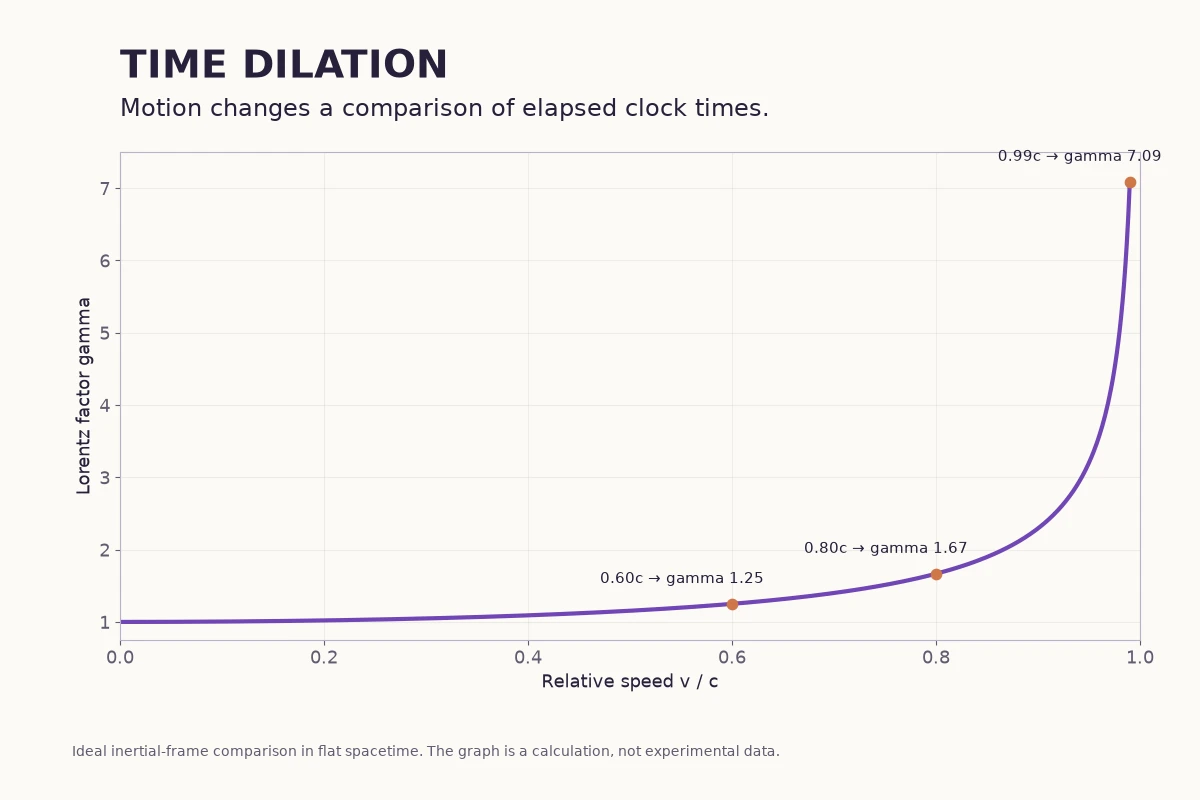
For a clock moving at constant speed in an inertial coordinate system, the Lorentz factor relates coordinate time to the moving clock's proper time. The speed in the formula is the relative speed measured in that frame, and the reference speed is the vacuum speed of light. The factor is one at zero relative speed and increases as the speed approaches that of light.
If the coordinate interval is known, divide it by the Lorentz factor to obtain the proper time accumulated by the moving clock during that constant-speed segment. Reversing that operation without checking which interval you have is a common source of mistakes. Label the coordinate interval and clock interval before calculating. Also keep the units consistent: a speed given as a fraction of light speed should not be mixed carelessly with kilometres per hour.
The simple expression is not a complete recipe for every trip through the universe. Changing speeds require an accumulation over the journey, and strong gravity requires the appropriate spacetime geometry. A single factor cannot be attached to a whole complicated mission without defining the model. Start with a simple case, state the approximations and add the necessary physics when the actual arrangement calls for it.
gamma = 1 / sqrt(1 - v^2/c^2)Delta tau = Delta t / gamma5. Work through a journey at sixty percent of light speed
Take an idealised Earth frame in flat spacetime. A spacecraft travels away at sixty percent of light speed and later returns at the same speed. Ignore the duration of the acceleration periods for this first calculation. At that speed, the Lorentz factor is one point two five. If the Earth-frame journey lasts ten years, the travelling clock accumulates eight years during the constant-speed portions.
We can make the geometry explicit. Let each leg take five Earth-frame years. The turnaround point is then three light-years from Earth in that frame. Each leg contributes four years to the travelling clock, giving eight in total. These are calculated values for a deliberately simplified scenario, not the timetable of an existing spacecraft or a claim that current propulsion can perform the trip.
Notice what the result does and does not imply. The traveller does not sit through ten personally experienced years while a watch mysteriously reports only eight. The traveller's own elapsed time is eight years in this model. The Earth observer's elapsed time is ten. A realistic plan would also account for acceleration, fuel, radiation, navigation and gravitational conditions; the clean example isolates the timing principle.
6. Resolve the apparent twin paradox
If uniform motion is relative, why can the traveller end up younger? During a single inertial segment, each inertial frame can describe the other's moving clocks as running slowly, using its own simultaneity convention. That reciprocal statement does not establish that the complete departure-and-reunion journeys are equivalent. A reunion comparison involves whole worldlines, not just one cruising segment.
In the simple return trip, the traveller changes inertial frames at turnaround. The Earth observer can remain in one inertial frame throughout the idealised experiment. The comparison of distant events changes when the traveller switches frames. A consistent spacetime calculation gives the elapsed time on both paths and produces the same reunion result regardless of the coordinates used to do the bookkeeping.
Acceleration helps identify the asymmetry of this particular travel arrangement, but it is misleading to call acceleration a universal time-slowing substance. Proper time depends on the full path and the spacetime metric. Other clock-comparison arrangements can distribute the acceleration differently. The useful question is which events and worldlines are involved, not which person should be described informally as the one who moved.
7. Distinguish clock rates from received signals
Suppose the spacecraft sends a numbered pulse every second of its own proper time. While it travels away, the Earth receiver records a larger gap between pulses. While it approaches, the pulses can arrive closer together. These received intervals depend on the changing separation and the relativistic Doppler relation. They are not identical to the time-dilation factor considered by itself.
You can see the distinction even before introducing relativity. A familiar sound source changes its received frequency as it approaches and recedes. With light, special relativity changes the quantitative relationship, but the importance of propagation remains. An experiment that compares remote clocks needs a method for transferring timing information and accounting for the geometry, rather than equating every received frequency change with a local clock malfunction.
Reuniting the clocks provides a particularly clear comparison because the final readings can be placed beside each other. Remote comparisons are also meaningful, but the reporting convention must be specified. Ask whether a statement concerns local proper time, coordinate time or the arrival rate of signals. Keeping those three ideas separate removes much of the apparent contradiction in popular explanations of time dilation.
8. Add gravity without importing a universal master clock
General relativity treats gravity through spacetime geometry. Two clocks held at different gravitational potentials can accumulate different proper times even when both are stationary relative to the same massive body in a suitable static approximation. Near Earth's surface, a clock held higher generally runs faster than an otherwise comparable clock held lower, after the relevant motion and environmental effects are accounted for.
That statement is a comparison between clocks and their locations. Each person standing beside one of the clocks still finds ordinary local timekeeping normal. The lower clock is not intrinsically damaged by gravity. To compare its rate with another location, we use a physical transfer of signals or a calculation within a specified spacetime model. There is no independent cosmic wall clock against which every local clock must be judged.
In a weak, nearly uniform field over a small height difference, the fractional rate difference is approximately the local gravitational acceleration multiplied by the height difference, divided by light speed squared. The approximation has a defined domain. It should not be extended unchanged to the horizon of a black hole or across an entire galaxy. Strong-field calculations need the appropriate geometry and a clear description of the observers.
Delta f / f ~= g * Delta h / c^29. Understand gravitational redshift as a comparison
A photon travelling between stationary observers at different heights can be measured at different frequencies by those observers. In a static gravitational setting, this connects directly with the comparison of their clock rates. The observed colour or frequency shift is not evidence that the local vacuum speed of light has changed from the value measured in an observer's nearby laboratory.
An atom used as a reference clock has a characteristic local transition. Comparing emitted and received signals against local standards reveals the frequency shift. Describing the process carefully matters: a photon does not carry a little internal wristwatch that reports how it felt during the journey. Its frequency is a measured relationship involving the field, the observer and the experimental arrangement.
The redshift interpretation also shows why a distant image is not a transparent window into another observer's present. Light arrives after propagation and with frequency changes that must be interpreted through a model. Good timing experiments specify the apparatus, signal path and reference clocks. They distinguish an operational comparison from a loose statement that gravity makes the entire universe run slowly in one place.
10. What laboratory clocks actually demonstrate
Relativistic clock differences are not limited to imagined interstellar trips. Optical atomic clocks are precise enough to compare very small differences in motion or height. NIST has reported clock comparisons that resolve relativistic effects at everyday scales, and later work has measured gravitational timing differences across extremely small height separations. These are laboratory measurements with calibration and uncertainty analysis, not a person subjectively noticing time stretch.
Atomic clocks use quantum transitions as frequency references, while relativity predicts how suitable clocks compare along different paths or at different locations. Those roles fit together without being the same theory. It is reasonable to describe an atomic-clock experiment as connecting quantum measurement tools with relativistic spacetime physics. It would be misleading to conclude that gravitational time dilation is therefore caused by a conscious observer collapsing a clock's wavefunction.
When reading a reported result, look for the quantity measured and the comparison being made. A tiny fractional frequency difference can be experimentally important even though no unaided human could feel it. Precision makes small effects accessible. It does not change the central idea that a clock records proper time locally and that the difference appears when readings from specified arrangements are compared.
11. Why satellite navigation must account for relativity
Satellite navigation combines timing information from moving clocks in different gravitational environments. The satellite clocks are not situated on an otherwise identical extension of Earth's surface. Their motion contributes one kind of relativistic correction, while their higher gravitational potential contributes another. A useful navigation system has to model those relationships rather than assuming every clock naturally keeps the same rate.
For a simplified description of GPS orbits, the gravitational contribution makes a satellite clock run faster than a surface reference, and the motion contribution acts in the opposite direction. Their familiar net scale is tens of microseconds per day. The exact operational system also handles additional timing, orbital and Earth-rotation details. The important lesson is that both effects belong in the model, not that one rounded number explains every correction.
Navigation turns small timing differences into meaningful distance-related errors because light travels a large distance during a short interval. That is a practical reason for careful timekeeping, not evidence that a phone directly measures its user's personal time dilation. The technology relies on a coordinated set of clocks, signals and calculations. Relativity is part of the engineering description that makes those signals useful.
12. Discuss black holes without saying time literally stops
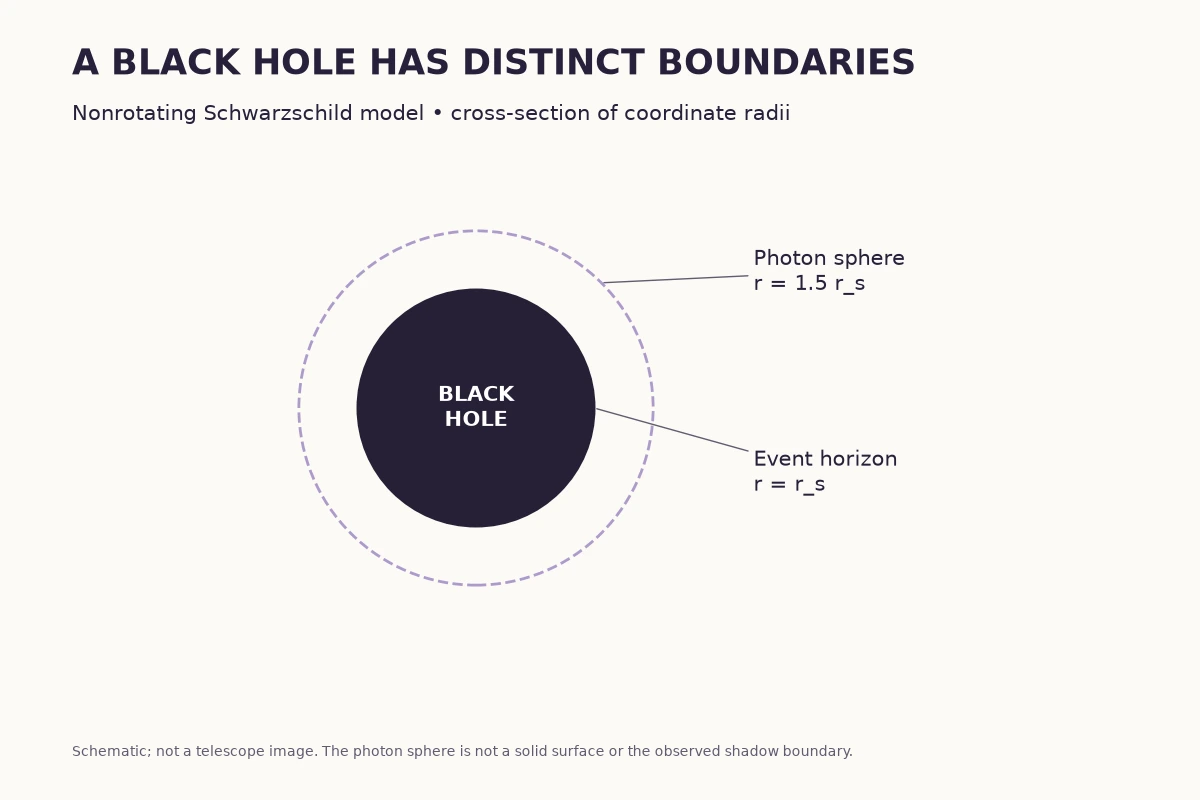
Near a black hole, a distant observer can receive light from an infalling object that becomes increasingly redshifted and delayed. In an idealised stationary description, signals associated with approaching the event horizon become progressively harder to receive. This is often shortened to the statement that the object freezes at the horizon. The shorthand can be misleading because the received image also becomes faint and observationally inaccessible.
An idealised freely falling clock can cross the horizon in a finite amount of its own proper time. The event horizon is not a material wall that necessarily stops the clock. What happens locally depends on the black hole's mass, the trajectory and the surrounding environment. Remaining stationary arbitrarily close to the horizon is a different physical situation from falling freely through it.
Do not combine an outside coordinate description with an infaller's proper time and then call the difference a contradiction. General relativity permits different useful coordinate systems, while physical predictions must agree where comparisons are possible. Our Black Holes guide develops the causal boundary more fully. For time dilation, the main lesson is to identify the observer and the clock before interpreting dramatic phrases about frozen time.
13. Keep the speed-of-light limit and photon question straight
For a massive object, the Lorentz factor grows without bound as its speed approaches light speed in an inertial frame. Accelerating that object to exactly the vacuum speed of light is not a finite-energy extension of the simple travel example. Time dilation therefore does not provide a convenient method for making an ordinary spacecraft cross the light-speed boundary.
A photon is a different case because it has no rest frame. It is not legitimate to imagine riding beside light and applying the ordinary moving-clock formula to a photon wristwatch. A lightlike path has zero proper-time interval in the mathematical description, but that does not define a physical rest-frame experience for the photon. Statements about what a photon feels introduce a viewpoint that special relativity does not supply.
These distinctions also separate forward differential ageing from speculative travel to the past. Two travellers can reunite having aged differently without either sending a message into an already observed past. More elaborate spacetime proposals raise additional theoretical questions. They should not be presented as consequences already demonstrated by a straightforward clock-comparison experiment. Established timing physics is striking enough without attaching unsupported time-machine claims.
14. Use a short checklist to test your understanding
Start any example by identifying the events, the clocks and the intended comparison. Is the spacetime approximately flat? Are the clocks moving uniformly, accelerating or held at different gravitational potentials? Does the stated interval belong to a coordinate frame or to one clock? Are you comparing the clocks directly, or interpreting signals received after travelling across changing distances?
Then check the limiting cases. The motion correction should approach the familiar low-speed result when the relative speed is small. A weak-field height approximation should not be trusted outside its stated range. Numerical answers should include units and a description of the idealisations. A correctly calculated factor attached to an incorrectly specified experiment can still produce an incorrect physical conclusion.
Finally, keep the interpretation modest and precise. Time dilation describes experimentally supported differences in elapsed time and clock comparison. It does not mean every observer notices their own thoughts slowing down, that photons possess a rest-frame viewpoint or that gravity has become a licence for any fictional travel scenario. The most powerful insight is simple: the time recorded by a clock belongs to its journey through spacetime, and different journeys need not agree.
15. Compare two numerical cases without overextending them
At eighty percent of light speed, the Lorentz factor is approximately one point six seven. A constant-speed clock therefore accumulates about six years during ten years of the chosen inertial frame's coordinate time. At ninety-nine percent of light speed, the factor is about seven point zero nine, so the corresponding clock interval is about one point four one years. These examples illustrate how rapidly the relationship changes near light speed.
The numbers do not describe what a stationary observer literally sees through a telescope at every instant. Received images also involve the light-travel and Doppler effects discussed earlier. Nor can the two examples be combined into a reunion story without specifying how the traveller changes speed and returns. They are simple comparisons between coordinate time and proper time over well-defined constant-speed segments.
A useful exercise is to reverse the question. If the travelling clock records one year at sixty percent of light speed, the chosen inertial frame assigns one point two five years to that segment. That reversal helps expose accidental multiplication or division errors. Always write down which clock supplies the starting interval. Relativity becomes much easier to follow when the symbols represent a clear experimental arrangement rather than an unexplained collection of impressive numbers.
Sources and further reading
Continue exploring physics
Connect this explanation with the other guides on time, gravity, black holes and light.
Explore Quantum Physics