Astrology
Disha Vichaar and Disha Shool: Travel Directions, Weekdays and the Reasoning Behind the Tradition
Before a long journey, some Indian families ask two questions: which day are we leaving, and in which direction are we travelling? Disha Vichaar means considering direction; Disha Shool is a particular traditional rule that associates a weekday with a direction regarded as unsuitable for beginning a journey. The rule belongs to cultural and astrological practice. Reading it accurately requires understanding what the chart says, which convention a family follows and where a traditional explanation ends.
This guide presents the commonly published weekday pattern and explains how to interpret it without turning an ordinary journey into a source of fear. It also separates symbolic reasoning from things a traveller can actually verify, such as a weather warning or a transport timetable. A directional chart does not establish that an accident, delay or success will happen. Urgent travel and essential care should never depend on obtaining a favourable entry in such a chart.
1. What the words mean and what question they address
Disha is direction. Shool is commonly explained through the image of a thorn or pointed obstruction. In this setting, the expression refers to a traditional obstacle associated with setting out towards a particular compass direction. It is a rule about the proposed beginning of a journey, rather than a description of the road, vehicle or destination itself. That distinction is easy to lose when a short social-media post simply announces that travel is forbidden.
Disha Vichaar is the broader discussion. A person may use the phrase when asking about a weekday, a destination, an almanac or a family custom. Establish which question is being asked before answering. A request to understand a tradition is different from a request for today's road conditions. Neither should be answered by pretending that the other has been checked. A useful explanation can acknowledge a belief while keeping the actual journey in view.
2. The common weekday and direction pattern
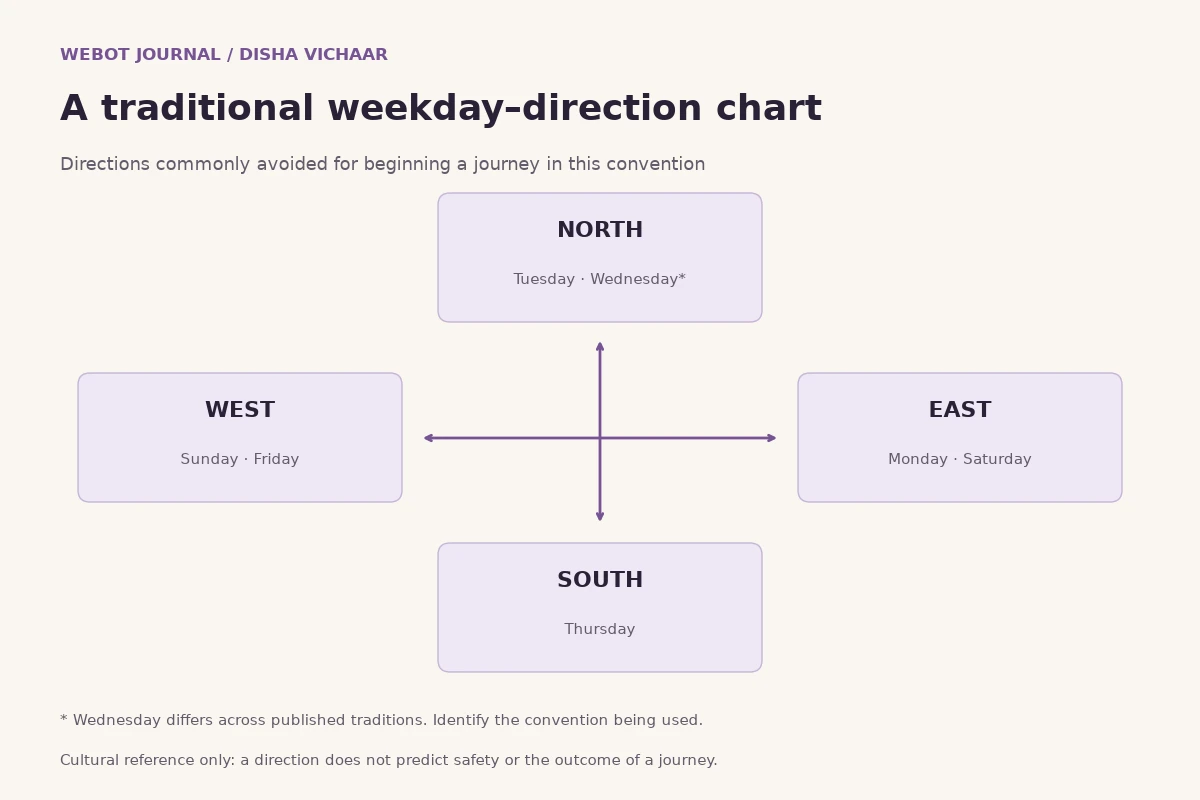
The widely published simplified chart associates Sunday with avoiding a westward departure; Monday, east; Tuesday, north; Wednesday, north; Thursday, south; Friday, west; and Saturday, east. This is a traditional association, not a tested travel-risk classification. Contemporary accounts, including Swara Yoga and other almanac-style publishers, describe the pattern while also noting variations. The chart is a starting reference for understanding the practice, not a universal instruction that overrides circumstances.
Read the wording carefully. A direction absent from that day's avoided entry is not automatically guaranteed to be auspicious or safe. The chart gives one restricted association within a larger tradition; it does not evaluate every possible route. Nor does it prove that a person who already travelled in the listed direction made a mistake. Keep the table's limited meaning attached to it whenever it is shared with relatives or in a message group.
3. How to identify the direction of a real journey
Start with the departure point and destination on a map. Is the destination broadly north, east, south or west of the origin? Then ask how the tradition you follow defines the relevant direction. Some discussions focus on the overall destination; others describe the initial departure. These are not always the same, especially when a station lies in one direction and the onward destination lies in another. Do not silently switch definitions to create a preferred answer.
An example makes the distinction clearer. A traveller leaves a house, drives south to a railway station and boards a train towards a city northeast of home. The driveway, the station and the final destination each describe a different segment. A simple four-direction chart does not settle which segment the family intends to assess. Record the convention being used and acknowledge uncertainty rather than offering an exact verdict from an ambiguous route.
4. Facing, moving and living in a direction are different
The direction a person faces while packing a bag is not necessarily the direction of travel. Similarly, living in an east-facing home does not mean every trip is eastward. Door orientation, the location of a place on a map and the path taken through streets are separate pieces of information. Mixing them can produce a different answer every time the person turns a corner.
For a family discussion, draw a small route with an arrow from the starting area to the destination area. Label the door separately if someone believes its facing matters. That modest drawing helps reveal whether people are discussing the same thing. It also prevents a practical navigation question from becoming an argument about a house. You do not need to publish an address or share precise personal travel plans to understand the distinction.
5. Why the weekday is part of the traditional logic
Within the belief system, weekdays are not treated as interchangeable labels. They form part of an ordered symbolic calendar and are associated with celestial or religious meanings. Disha Shool places a directional preference inside that calendar. Its internal logic is therefore a relationship between symbolic categories. Explaining that relationship is different from demonstrating a physical force that changes the condition of a road at the beginning of a weekday.
People sometimes ask for the scientific reason behind the exact chart. It is more accurate to say that this guide describes a traditional rule and does not establish its causal validity. A story about sunlight, magnetism or ancient journeys would need its own evidence before it could be presented as the rule's historical origin. An appealing explanation should not be promoted to a fact merely because it makes the pattern easier to remember.
6. Traditional reasoning and practical reasoning can coexist
A family may find a departure ritual reassuring. Agreeing on a starting time can also make packing more organised. These experiences may explain why a custom remains meaningful to the participants. They do not show that a compass direction controls later events. Name the benefit at the level actually observed: the family felt prepared, left together or made time for a farewell.
The journey itself still needs ordinary planning. A route can be convenient because it has a dependable connection, or inconvenient because it involves a difficult transfer. Those observations do not require an astrological explanation. Discuss them beside the cultural preference. If both suggest the same departure, the decision may be easy. If they conflict, make the actual cost of changing the trip visible instead of saying that one label automatically resolves the choice.
7. Monday: use the chart without losing the appointment
Consider a fictional traveller who has a confirmed appointment in another city on Monday. The family notices that their preferred chart flags the proposed direction. The first question is whether there is any genuine flexibility in the appointment and transport booking. A cultural preference can be considered when choices are equally workable. It should not be represented as evidence that the scheduled journey will go badly.
Write down the available options before changing anything. Would leaving a day earlier require accommodation? Would a later departure miss the appointment? Can the traveller afford the change? These questions turn a vague worry into a concrete comparison. The example does not prescribe one answer for every family; it shows why an honest conversation needs more information than a day name. Essential responsibilities should remain visible throughout that conversation.
8. Tuesday: separate a new journey from daily routines
A commuter may wonder whether the chart applies every time they leave for work, return home or buy groceries. Contemporary practice is not uniform about what counts as a relevant journey. If a family uses the rule mainly for a significant departure, it should say so. Extending a custom to every small movement can make ordinary life feel governed by an endless series of restrictions that the original discussion never specified.
For example, a person who travels to the same workplace each Tuesday has a routine with familiar constraints. A social-media warning does not establish a new hazard on that route. Check any real notice from the transport operator or local authority when relevant. If the family wants to understand its customary exception for routine movement, discuss that as a question of practice. Do not turn uncertainty about a custom into a claim about immediate danger.
9. Wednesday: acknowledge a published difference
Wednesday illustrates why one should identify the tradition rather than announce a universal rule. Some contemporary discussions assign the usual northern entry, while others describe Wednesday as an exception. The Swara Yoga account explicitly notes this disagreement. This guide reports that variation without deciding that one family's practice invalidates another's. A reader should not be frightened because two online charts give different answers.
When comparing sources, note their publication, wording and assumptions. Are they presenting a basic weekday table or a more specific rule with conditions? Are they describing their own practice or quoting an identifiable text? If the distinction matters to a family, ask for a clear account of the convention they have chosen. Combining an exception from one source with prohibitions from another can create a rule that neither source actually teaches.
10. Thursday: a direction is not a judgment about a place
A traditional travel restriction should not become a negative judgment about people or regions located in that direction. A destination may be someone's home, workplace, college or place of worship. The chart does not establish anything about the worth of that place or its residents. Keep the conversation focused on how a particular custom treats departure, rather than making broad statements about an entire part of the country.
Imagine a family considering two transport connections to the same destination. One includes an exhausting overnight transfer; the other is simpler. A directional preference alone does not evaluate those experiences. Compare the actual itinerary, the traveller's needs and the conditions under which the trip will occur. If a traditional consideration remains part of the decision, describe it as that consideration. Avoid presenting a symbolic classification as a complete assessment of a real location.
11. Friday: consider everyone affected by a change
Moving a departure may affect more people than the traveller. Someone may have arranged a pickup, booked leave or organised a shared vehicle. A considerate discussion includes those commitments. The purpose is not to dismiss a family belief, but to ensure that a proposed adjustment is understood before others are asked to absorb its consequences.
A useful approach is to separate the preferred option from the workable option. The family can state its cultural preference and then ask whether a practical alternative exists. If no suitable alternative exists, that is a fact about the available arrangements. It is not a moral failure by the traveller. People can remain respectful towards a tradition without claiming that every constraint can be satisfied on every journey.
12. Saturday: avoid an expensive decision made from fear
Weekend departures often involve tickets or group plans made well in advance. If a directional concern arises late, pause before cancelling. Check the actual terms and consequences of changing the booking, and consult the people who share the plan. This is a practical review of the situation, not a prediction that keeping or changing the booking will create a particular future outcome.
A warning that insists on an immediate paid remedy deserves careful questioning. What exactly is being claimed? What is the basis for the claim, and is the proposed purchase optional? A traveller should be able to ask these questions without being threatened with misfortune. Cultural guidance can be offered respectfully; fear-based certainty should not be mistaken for evidence. Keep the final decision proportionate to the real circumstances.
13. Sunday: distinguish a family observance from a rule for others
One household may follow a departure custom while another does not. Travelling together makes that difference visible. Discuss preferences before the departure day rather than treating agreement as obvious. A shared itinerary needs a workable decision, but the participants do not need to share every explanation behind it. Respect includes allowing a person to describe a custom as meaningful to them without requiring everyone else to accept its predictions.
For a group trip, agree which arrangements are essential and which observances can be accommodated without disruption. A short private prayer or farewell may be easy to include. A major detour or a missed connection is a different request. Talking about the actual action helps the group judge the request fairly. The day chart does not answer questions about consent, shared costs or the needs of other travellers.
14. Midnight, sunrise and the problem of an unstated boundary
Calendar discussions can use different day boundaries. A booking system displays civil dates and local clock times; some traditional calendar practices use sunrise-based conventions for particular purposes. A departure shortly after midnight is therefore a poor place to rely on an unexplained screenshot. Ask which convention the source is using before attempting to apply its weekday rule to an edge case.
Do not change a ticket date in your mind to make it fit a belief calculation. The operator's stated departure date and time remain the information needed to catch the service. If a traditional interpretation is also being considered, write it separately with its assumptions. This avoids a very practical error: arriving on the wrong date because a cultural day label was confused with the date printed on a transport reservation.
15. Time zones and long-distance journeys
A journey may begin in one time zone and arrive in another. The destination's local weekday can differ from the departure city's weekday at the same instant. A guide that gives only a day name without saying where it applies cannot resolve such a case. Do not assume that a generic internet table has evaluated the itinerary, transit points or local calendar convention.
Create a plain itinerary first, with each departure and arrival written in the local time used by the operator. Then, if the family wants a traditional interpretation, identify the reference location and method being used. The practical itinerary should remain readable even if no one reaches agreement about the symbolic interpretation. Travellers need clear arrangements more than they need an artificial certainty about a complicated boundary case.
16. Return journeys and several stops
An outward journey and a return journey may occur on different days and point in different directions. A multi-stop trip adds further decisions about what counts as a new departure. These cases reveal the limits of a simple weekly chart. The table itself does not state how every connection, overnight stay or change of vehicle should be classified.
For a fictional journey from home to a relative's town and then to a third city, list the segments before discussing the custom. If the family treats the entire trip as one undertaking, record that. If it treats separate overnight departures differently, record that instead. Avoid repeatedly redefining the journey after an event occurs. A consistent stated convention is more informative than a rule that changes whenever the traveller encounters an ordinary inconvenience.
17. Exceptions and remedies vary across traditions
Published accounts describe exceptions, timing qualifications and symbolic remedies, but their details differ. This guide does not present one food, object or detour as a verified way to change travel risk. If a family follows a harmless observance, understand what it means within that family's practice. Do not convert a description of an observance into a guarantee about the outcome of the journey.
An observance should also fit the person. A cultural suggestion about consuming something is not a reason to ignore dietary needs or professional advice. A proposed detour is not automatically sensible just because it is called symbolic. Consider what the action requires in the real itinerary. A respectful explanation can say that a practice exists while declining to promise that it neutralises danger or makes every route appropriate.
18. Do not confuse Disha Shool with other calendar systems
Travel discussions may also mention other astrological or almanac concepts. They are not interchangeable names for the same calculation. A weekday-direction pattern does not by itself compute an auspicious time for a particular city, date or person. If a source adds further conditions, those conditions need their own explanation rather than being presented as though they were already included in a seven-row chart.
When reading a detailed assessment, ask what inputs were actually used. Was it just the weekday, or were additional calendar elements considered? Was a location necessary, and was it supplied? These questions clarify the scope without requiring you to adopt the belief system. An answer should be judged by whether it describes its method honestly, not by how many specialised terms it includes.
19. What would evidence for a physical claim require?
A claim that one weekday-direction combination causes more travel harm is a different claim from saying that a community avoids that combination. To investigate the physical claim, one would need a clearly stated rule, reliable records and a way to compare journeys fairly. The analysis would also need to consider practical differences such as travel volume, route characteristics and weather. A few remembered stories cannot supply that comparison.
This distinction matters when someone offers a new scientific-sounding explanation. Mentioning energy or magnetism is not the same as showing a measurement that supports the exact weekly pattern. Ask which part was observed, which part was inferred and whether alternative explanations were considered. This guide provides cultural context and practical examples; it does not claim to have performed such a study or to have established a predictive mechanism.
20. Remembering a bad journey can change how a rule feels
Suppose a person experiences a delay and later notices that the chart had flagged the direction. The association may feel striking. But to assess a general claim, the uneventful journeys and journeys that did not fit the rule matter too. A personal story can explain why someone values a custom without becoming a dependable forecast for the next traveller.
If you keep a personal travel journal, record ordinary trips as well as unusual ones. Write the route and circumstances before reviewing the outcome, so the definition is not adjusted afterwards. Keep private details private; there is no need to post a full itinerary publicly. The purpose is clearer reflection, not proving that a family member is right or wrong through one selected anecdote.
21. Build a practical departure checklist beside the tradition
A useful departure note can include the operator's current schedule, the route, the necessary documents, contact arrangements and the needs of the people travelling. Check official information when a condition may have changed. Keep a buffer that suits the actual transfer rather than assuming that a symbolic choice has removed the need to prepare. These are practical actions whose purpose can be explained directly.
If the family also considers Disha Vichaar, put that preference in a separate line with the convention being used. This keeps the note honest: one part records arrangements, another records a cultural observance. In an urgent situation, act on the urgent need. A missed ritual or an unfavourable entry should not be used to delay essential assistance, evacuating a hazardous place or obtaining necessary care.
22. Common questions about Disha Vichaar
Does an avoided direction mean an accident will happen? The chart does not establish that prediction. Does a direction absent from the avoided entry guarantee success? It does not. Which Wednesday rule should a family follow? First identify the convention they already use, because contemporary accounts acknowledge a difference. Does changing the first turn of a route prove that a risk has been removed? This guide makes no such claim.
Can a person understand the tradition without organising every trip around it? Yes. Learning what a custom means is different from accepting every claim attached to it. The most useful reading preserves that distinction, explains variations and keeps real travel needs visible. A day-direction chart can be part of a cultural conversation; it should not replace a clear itinerary, current official information or considerate decisions about the people who will make the journey.
Sources and further reading
Explore Astrology
Explore traditional numerology, dream symbolism, head-to-toe Til Vichar and home Vastu, with practical explanations and a clear distinction between belief, reflection and evidence.
Explore Astrology