Religion / Dharm
What happens after death? A journey through religions, communities and ancient civilizations
A tiny Egyptian figure, a Māori farewell pathway and the cycle of rebirth: visions of what follows death are among humanity’s most compelling stories. Follow the answers different societies have offered to an unknowable horizon.
This is a sourced introduction to religion and culture. Beliefs are presented as beliefs, historical interpretations as interpretations, and uncertainty remains visible.
One question, many maps
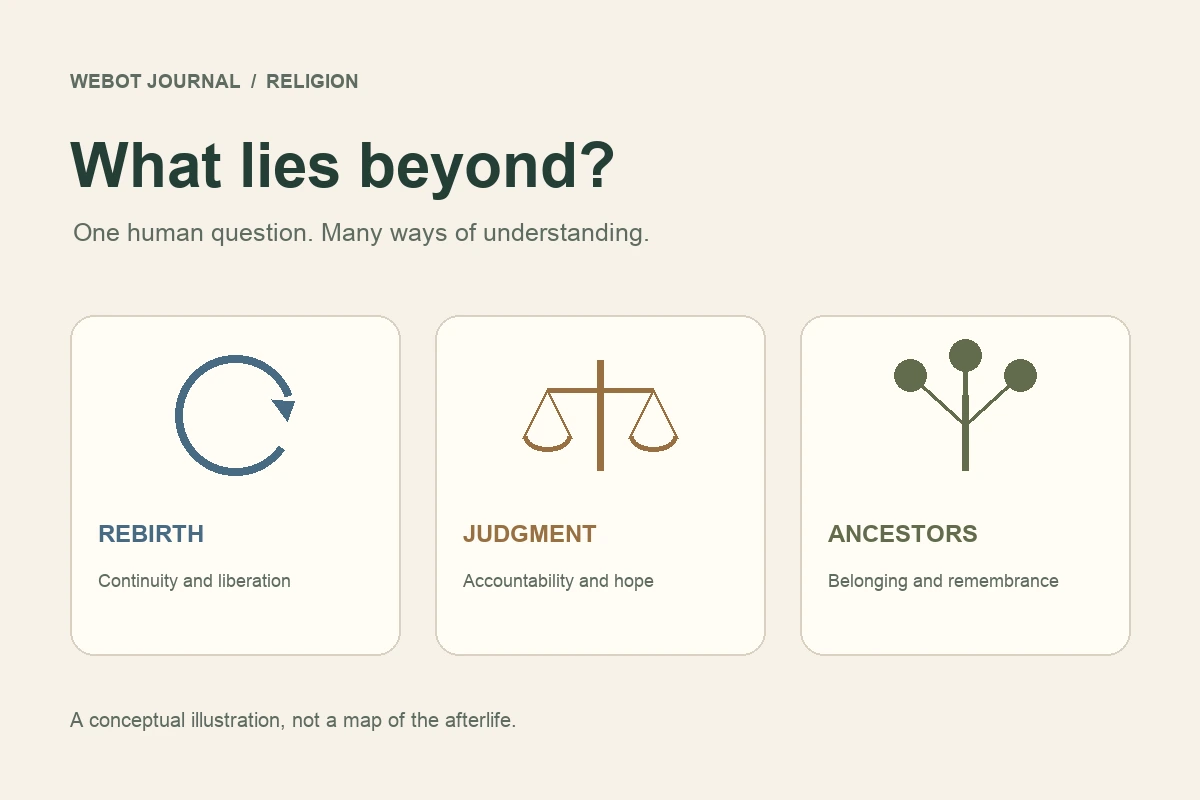
Imagine three doorways: one opens into another birth, another toward judgment, and a third toward the ancestors. These are an editorial metaphor for different traditions, not interchangeable descriptions of one destination. The question “what happens after death?” also asks what a person is, what makes a life meaningful, and whether relationships can outlast separation.
This journey compares selected teachings and recorded customs, not every believer. A religious text, a community account and a tomb provide different kinds of evidence. None should be presented as a scientific demonstration of an afterlife.
Hindu traditions: another life, or freedom from the cycle?
In many Hindu traditions, death ends a bodily life while karma shapes further rebirth within samsara. Moksha means release from that cycle. The exciting twist is that an enjoyable next life and ultimate liberation are different goals.
Harvard’s Pluralism Project explains that Vedanta schools differ over the relationship between atman and Brahman. So even shared words do not produce a single Hindu account. Stories, philosophical teachings and family mourning customs should not be collapsed into one mandatory timetable for the soul.
Buddhist traditions: rebirth without an unchanging self
Many Buddhist traditions teach karma and rebirth while rejecting an independent, unchanging self. That makes “the same permanent soul simply changes bodies” a misleading shortcut. Liberation concerns ending the causes that sustain suffering and the cycle of rebirth.
Some Tibetan teachings describe bardo, an intermediate state, with a traditional maximum of 49 days. This is a particular religious account, not a measured universal duration or a doctrine shared identically by all Buddhists. Other Buddhist traditions frame the transition differently.
Jain traditions: a soul becoming free
Jain teaching affirms individual souls, or jivas, bound in repeated birth. Karma is understood as matter that obscures the soul; liberation removes that bondage. The liberated siddha is beyond bodily rebirth.
The Pluralism Project connects this account with nonviolence, restraint and nonattachment. Here the central question is not which judge assigns a destination, but how a soul becomes free from what binds it. Similar words such as karma therefore need tradition-specific explanations.
Sikhi: the question turns toward how we live
Sikh teachings discuss the cycle of birth and death and liberation, but the Sikh Research Institute also stresses love, connection with the Divine and living meaningfully now. Death is approached within acceptance of the Divine order.
This changes the emphasis of the story: instead of treating the afterlife as a travel itinerary, ask what remembrance, humility and a less possessive life mean today. Different Sikh interpreters may explain the imagery differently; this is not a complete account of every Sikh’s personal belief.
Islam: barzakh and resurrection
Islamic teaching places death within a journey toward resurrection and divine judgment. Quran 23:100 describes a barrier until the day people are raised; its commentary explains barzakh as the intervening condition.
The picture differs from repeated earthly reincarnation. Accountability continues beyond this life. Details of the grave and the intermediate state are discussed through further texts and interpretations; a brief comparison should not turn those varied discussions into an invented day-by-day schedule.
Christian traditions: resurrection, hope and differences
Resurrection and life everlasting are central Christian hopes; the Vatican Catechism describes the resurrection of the body, not merely an endlessly surviving disembodied soul. Christian traditions also speak of judgment and communion with God.
Catholic teaching describes purgatory as purification for those assured of salvation. That is specifically Catholic doctrine, not a belief accepted in the same form by all Christians. Views of the intermediate state and the language of heaven and hell differ between churches.
Jewish traditions: more than one answer
Jewish discussions include olam haba, the world to come, and resurrection; some mystical traditions also discuss reincarnation. These ideas have histories and do not form one universally agreed diagram.
My Jewish Learning highlights disagreements even among major medieval thinkers over the world to come. A useful comparison leaves room for that debate and for the strong emphasis on ethical obligations in this life.
Indigenous communities: first ask whose tradition
There is no single “tribal religion.” Māori, Santal, Tiwi and Toraja communities have distinct histories, and their living traditions change. A practice recorded in one place cannot stand for every family, region or generation.
Community names matter. So does the difference between an older ethnographic description, a museum’s interpretation of an object and what living members say now. The examples below are selected public accounts, not access to restricted sacred knowledge.
Māori: a farewell along a remembered landscape
Te Ara records northern Māori traditions in which wairua, the spirit, travels toward Te Rerenga Wairua, a departure place at the far north. In tangihanga, spoken farewells can address the deceased directly.
The landscape becomes part of the farewell: a place of memory and a pathway in tradition. This northern account should not be assigned unchanged to every iwi, or tribe. Here departure is a relationship between people, ancestors and place, not just a destination on an abstract map.
Santal: remembrance in family and community
A regional Hindi account preserved by IGNCA describes Santal death rites, offerings in the deceased’s name and bhandan, a later communal rite. It also records differences in burial and cremation.
The account helps us see mourning as a social process, rather than merely disposal of a body. It is a regional ethnographic source with its own framing, not a survey of present-day Santal belief. Do not use it to label all Santals or to make supernatural causes of death into factual claims.
Tiwi and Toraja: ceremonies that help a passage
The Australian Museum describes Tiwi Pukumani ceremonies around carved, painted grave posts. In the recorded tradition these ceremonies help the spirit reach the spirit world. The museum also notes Christian elements in present-day practice.
In Sulawesi, Indonesia, Toraja ancestral remembrance is represented in objects such as tau tau figures; the Metropolitan Museum identifies a wooden example from the late nineteenth or early twentieth century. An object documents a particular cultural expression, not every Toraja person’s theology. Neither example represents all Indigenous peoples.
Ancient Egypt: what if your heart had to testify?
Ancient Egyptian funerary traditions imagined a dangerous passage and judgment. In the weighing of the heart, the heart was compared with the feather of Ma’at. Tomb equipment and funerary texts were intended to protect and guide the deceased.
The surprising detail is the shabti: a small figure intended to perform work for the deceased in the afterlife. The Australian Museum traces changing forms from around 2100 BCE onward. The next world could echo ordinary needs, including labour. Egyptian beliefs and access to elaborate preparations changed over centuries and with wealth.
Mesopotamia: not every afterlife was paradise
In the Metropolitan Museum’s guide to the ancient Near East, Mesopotamian texts describe many dead as spirits in a dark netherworld. This is a striking contrast with the assumption that an afterlife must be an improved version of earthly life.
These are literary and religious portrayals from a long, varied history, not eyewitness reports. Sumerian, Akkadian and later contexts should not be flattened into a single timeless creed. The contrast is still illuminating: hope for continuity need not mean a promise of comfort.
Greece and China: shadows, memory and a furnished next world
The Met’s account of ancient Greece describes Homer’s underworld of shades and the importance of proper burial and remembrance. This is a particular literary picture, not the whole of Greek belief; its power lies partly in the living refusing to forget.
For Qin and Han China, 221 BCE–220 CE, the Met describes elite tombs equipped for continued existence, including figures standing in for attendants. These objects show how an imagined next world could resemble familiar social life. An elite tomb cannot tell us what every ordinary person believed.
What can a tomb actually tell us?
A vessel or ornament in a grave can support an interpretation about ritual care, identity or an imagined afterlife. It does not by itself reveal an exact doctrine. Written sources, archaeological context and comparisons must be considered together.
A civilization with undeciphered writing is an especially clear limit: a modern reader cannot confidently supply its missing theology. Nor does a similar symbol prove that two religions borrowed from one another. Similarity opens a research question; it does not settle the history.
The question that brings us back to life
Across these accounts, we encounter recurring concerns: consequences, freedom, belonging and remembrance. That is an editorial comparison, not a claim that the traditions teach the same thing. Their differences are part of what makes the journey worth taking.
Perhaps the most intimate question is not only “where will I go?” but “what will remain in the people whose lives I touch?” Whatever a reader’s faith or uncertainty, listening carefully to another community’s answer can deepen the way we understand care, mortality and the time we share.
Sources and context
- Hindu traditions — Harvard Pluralism Project: Vedanta
- Karma and rebirth — Harvard Pluralism Project
- Buddhist teachings — Harvard Pluralism Project
- Tibetan bardo — Study Buddhism, Serkong Rinpoche teaching
- Jain jiva and liberation — Harvard Pluralism Project
- Jain karma — Harvard Pluralism Project
- Sikhi, death and the afterlife — Sikh Research Institute
- Sikh liberation — Sikh Research Institute, Alahania
- Islam: barzakh — Quran 23:100 and commentary
- Christian resurrection — Vatican Catechism, Article 11
- Catholic purgatory — Vatican Catechism, 1030–1032
- Jewish afterlife diversity — My Jewish Learning
- Māori death customs — Te Ara, Encyclopedia of New Zealand
- Santal death customs — IGNCA, regional ethnographic account
- Tiwi Pukumani — Australian Museum
- Toraja ancestor figure (tau tau) — Metropolitan Museum of Art
- Ancient Egypt: preparation and judgment — Australian Museum
- Mesopotamia: The Afterlife — Metropolitan Museum of Art, educator guide
- Ancient Greece: death and burial — Metropolitan Museum of Art
- Qin and Han China, 221 BCE–220 CE — Metropolitan Museum of Art
Keep exploring religion and culture
Engaging, sourced explorations of religious and cultural traditions on death, life, ancestors and liberation.
Explore Religion articles